Andorra Currency EuroEUR
What money to use in Andorra, how notes and coins break down, and the best ways to exchange - get the local cash sorted before you go.
| Currency Name | Euro |
|---|---|
| Currency Code | EUR |
| Currency Symbol | € |
| Issuing Country | Andorra |
| Time Zone | UTC+1 to UTC+2 |
| Dialling Code | +376 |
About Euro (EUR)
Currency Overview
Although not an EU member, Andorra has used the euro (currency code EUR, symbol €) as its de facto currency since 2002, before which the Spanish peseta and French franc were in circulation. In 2011, it signed a monetary agreement with the EU, authorising the issuance of its own euro coins, which entered circulation in 2014. Andorra has no central bank; its monetary regulation is managed by its national financial authority. One euro equals 100 cents and is fully interchangeable with euros from other eurozone countries.
Denomination System
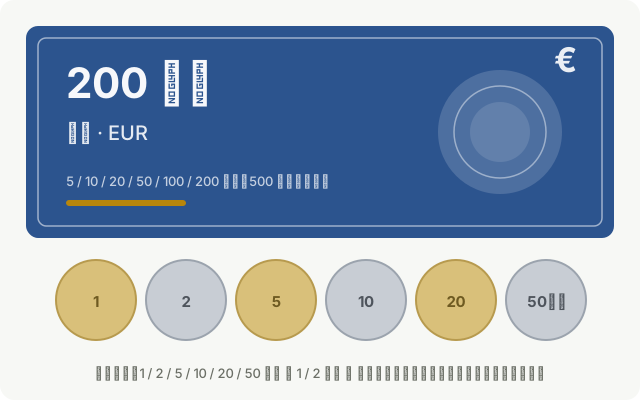
Banknotes are standardised across the eurozone and issued by the European Central Bank, with common denominations of 5, 10, 20, 50, 100, and 200 euros. Coins come in denominations of 1, 2, 5, 10, 20, 50 cents and 1, 2 euros. Andorran coins feature national landmarks and coats of arms on the reverse: 1, 2, and 5-cent coins depict Casa de la Vall (the former parliament building); 10, 20, and 50-cent coins show the Romanesque Church of Sant Climent de Pal; 1-euro coins feature the Church of Sant Martí de la Cortinada; 2-euro coins bear the Andorran coat of arms. These coins are highly collectible, and commemorative issues are released annually.
Cash and Payment Habits
Shops, supermarkets, and restaurants in Andorra generally accept Visa and Mastercard, with most also offering contactless payment options. There are ATMs operated by local banks in most commercial areas. However, as a shopping haven, many tobacco shops, small craft stores, and rural markets still operate largely with cash, and bargaining in shops is often done in cash. It is advisable to carry 100–200 euros in cash. Since there is no independent currency exchange system, travellers usually exchange euros in advance at airports or banks in Barcelona or Toulouse. There are also a few exchange points in Andorra la Vella serving neighbouring shoppers.
Traveler Tips
- Tobacco, alcohol, and cosmetics are duty-free favourites, but quantities are strictly limited by French and Spanish customs—exceeding allowances will result in duties.
- Shopping peaks on weekends and during the Christmas season. Parking is limited on main streets, so it’s best to park in public garages and walk.
- Bargaining in cash is more common in small shops and markets, but card payments rarely offer discounts.
- No currency exchange is needed when re-entering Andorra from Spain or France, but customs checks are frequent—keep receipts.
Andorra Overview
Country Details »Overview of Andorra
Andorra (officially the Principality of Andorra) is a landlocked microstate nestled between France and Spain, located in the high mountain valleys of the eastern Pyrenees. Covering an area of 468 square kilometres with a population of about 80,000, it is the world’s sixth smallest sovereign nation and the only one with Catalan as its official language. The capital, Andorra la Vella, is one of the highest-elevation capitals in Europe, situated in the Valira River valley at around 1,000 metres above sea level. The country’s seven parishes (administrative divisions) are spread along the river valley and mountain ridges.
Andorra has a globally unique political system: its heads of state are the President of France and the Bishop of Urgell (a diocese in Spain), a dual-principality arrangement established by a treaty in 1278 and still in place after more than 700 years. Executive power is exercised by the head of government and parliament, with the General Council (Consell General) serving as the legislative body. Although not a member of the European Union, Andorra has been deeply integrated into the European economy since joining the United Nations in 1993. In 2011, it signed a monetary agreement with the EU and was officially authorised to mint euro coins.
Geography and Climate
Entirely mountainous, Andorra has an average elevation of about 1,300 metres, with its highest peak, Coma Pedrosa, reaching 2,942 metres. The Valira River flows east to west across the country, and most towns, roads, and ski resorts are located along the valleys. The terrain consists of granite and slate, dotted with lakes, meadows, and fir forests. The Madriu-Perafita-Claror Valley is a UNESCO World Heritage Site, representing a classic example of Pyrenean high-mountain cultural landscapes.
The climate is alpine continental: winters are long and snowy, with the main ski season typically lasting from early December to early April. Summers are cool and dry, with daytime temperatures around 25°C and cooler evenings, making it a popular European destination for summer retreats and hiking. Spring and autumn are short, and mountain passes may occasionally experience snow closures—drivers should be aware of seasonal tyre requirements.
Historical Background
Legend has it that Charlemagne granted a charter to the people of Andorra in recognition of their assistance in battles against the Moors, which Andorrans regard as the origin of their protected status. In the 13th century, disputes over sovereignty of the valley between the Bishop of Urgell and the Count of Foix led to a 1278 pact establishing joint rule by both secular and religious leaders—the co-principality. The secular title eventually passed to the French head of state. This arrangement largely kept Andorra out of medieval European conflicts, fostering a unique tradition of mountain autonomy.
In 1993, Andorra adopted a constitution through a national referendum, completing its transition to a modern sovereign state and joining the United Nations. It has since established diplomatic relations with many countries, joined international organisations, and gradually liberalised its financial sector. While using the euro in practice since 2002, it formally signed a currency agreement with the EU in 2011 and minted its first euro coins featuring national designs in 2014. Tourism took off in the 1950s and 1960s, with skiing, shopping, and hot springs making this mountain principality one of Europe’s most visited per capita.
Economy and Currency
Andorra’s economy is centred on tourism, which drives the majority of its GDP. Winter offers skiing, summer provides hiking, and year-round attractions include tax-free shopping and spa treatments. The country has long maintained low tax rates, making products such as tobacco, alcohol, cosmetics, electronics, and clothing cheaper than in France or Spain. Neighbouring shoppers often cross the border on weekends. Traditional industries include livestock farming and tobacco cultivation, while recent efforts have focused on upgrading ski resorts and developing mountain wellness services. The official currency is the euro (EUR, symbol €), with national coins issued since 2014 featuring iconic landmarks such as Casa de la Vall (the former parliament building) and the Church of Santa Coloma, as well as the national coat of arms.
Culture and Society
Catalan is the official language and is used in schools, while Spanish and French are also widely spoken. Andorrans uphold the culture of the Catalan mountains: Romanesque churches with slate roofs dot the villages, and the Sanctuary of Our Lady of Meritxell is the national patron shrine. Traditional dances like the sardana and harvest festivals take place in village squares during summer. The cuisine blends Catalan flavours with mountain specialties, with dishes such as snow potato stew, grilled lamb, and wild herb omelettes being winter staples. The society is peaceful and orderly, with some of Europe’s lowest crime rates and a strong sense of community.
Tourism Overview
Andorra’s tourism can be divided into three main areas: winter skiing (with over 300 kilometres of slopes across the Grandvalira and Vallnord resorts), year-round tax-free shopping (along Andorra la Vella’s main streets and in the Encamp commercial district), and mountain nature (including hiking in the Madriu Valley, visits to Coma Pedrosa, and routes to Romanesque churches in Ordino). Caldea, a landmark spa in Escaldes-Engordany, is also a major attraction. With no airport or railway, access is typically via bus from Barcelona or Toulouse (around 3 hours). Most visitors combine Andorra with trips to Catalonia or Occitania. It offers an affordable alternative to classic Alpine skiing experiences.
Andorra Travel Guide
All Guides »Andorra Travel Quick Guide: Multiple Schengen Visas, Skiing & Hiking Seasons, Budgets & Mountain Etiquette
How to Enter, Explore, and Budget in the Pyrenean Principality Between France an...
Andorra 7-Day Classic Itinerary: Skiing, Shopping, Hot Springs & a Loop Through the Pyrenees 7 days
The complete experience of the Principality of the Valleys of Andorra: Connect G...
Andorra 4-Day Short Trip: Capital, Ski Resorts, Hot Springs, and Shopping District Itinerary 4 days
Even with limited holiday time, experience three key themes—skiing, hot springs,...
Must-visit attractions in Andorra: World Heritage valleys, ski resorts, and hot spring landmarks
The highlights of this thousand-year-old principality are concentrated between r...
Andorra Food Guide: Caldero Stew, Snow Potatoes, and Catalan Flavors
Mountain produce meets Catalan traditions—Caldero stew, meatball soup, and snow ...
Andorra Transport Guide: No Airport, No Railways – Reach the Mountains by International Buses and Valley Shuttles
All entry and exit is via long-distance buses from Spain and France, while valle...