Switzerland Currency Swiss FrancCHF
What money to use in Switzerland, how notes and coins break down, and the best ways to exchange - get the local cash sorted before you go.
| Currency Name | Swiss Franc |
|---|---|
| Currency Code | CHF |
| Currency Symbol | CHF |
| Issuing Country | Switzerland |
| Time Zone | UTC+1 |
| Dialling Code | +41 |
About Swiss Franc (CHF)
Currency Overview
The official currency of Switzerland is the Swiss Franc (currency code CHF, symbol CHF, commonly written as Fr. or SFr.). It is issued by the Swiss National Bank (Schweizerische Nationalbank, SNB), with 1 Swiss Franc equal to 100 rappen (called Rappen in German and centime in French). The Swiss Franc has long been regarded as one of the world's most stable currencies and is an important safe-haven and reserve currency. It is important to reiterate that Switzerland is not a member of the European Union and does not use the euro. All transactions within the country are conducted in Swiss Francs; Liechtenstein, in a currency union with Switzerland, also uses the Swiss Franc.
Denomination System
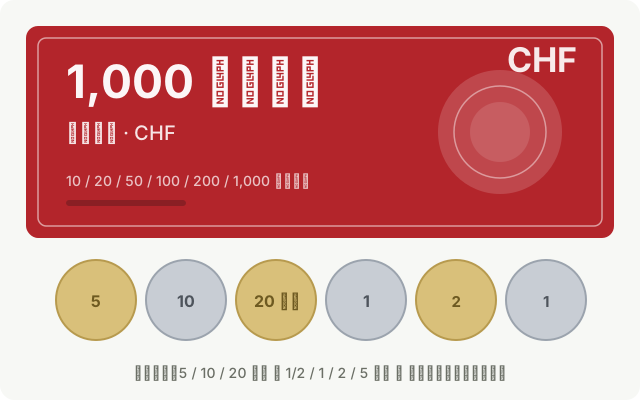
The current series of Swiss Franc banknotes (ninth series, issued between 2016 and 2019) includes six denominations: 10, 20, 50, 100, 200, and 1000 Swiss Francs. The banknotes feature themes related to Swiss organizations and capabilities: 10 Francs represents time, 20 Francs light, 50 Francs wind, 100 Francs water, 200 Francs matter, and 1000 Francs language. The designs avoid portraits and instead use modular abstract graphics and hand gestures, giving them a modern aesthetic. The previous (eighth) series of banknotes, though no longer issued, can still be exchanged at banks.
Swiss coins come in denominations of 5, 10, 20 rappen and 1/2, 1, 2, 5 Swiss Francs. The 5 Franc coin is one of the highest and most widely circulated denominations, while 1 rappen coins are no longer minted or used. The obverse of the coins features the image of Helvetia or the Swiss cross, with the denomination on the reverse. All versions are interchangeable regardless of the year of issue.
Cash and Payment Habits
Cash usage in Switzerland is higher than in the Netherlands or Nordic countries. While credit and debit cards are widely accepted in supermarkets, hotels, train stations, and large stores, bakeries, small restaurants, mountain cable car stations, farmers' markets, and some small shops still prefer cash. Therefore, it is advisable to carry some Swiss Francs in cash. The local mobile payment system TWINT is widely used but is primarily available to users with Swiss bank accounts, making it inconvenient for foreign tourists.
It is recommended to carry 40–80 Swiss Francs in small bills for tips, markets, cable cars, and drinks. For larger purchases, use cards when possible. Be aware that some merchants may be hesitant to accept high-denomination 200 and 1000 Franc notes and might refuse them. Cash can be withdrawn at ATMs in airports, train stations, and major banks, but be mindful of foreign card fees. While exchange counters at airports and train stations are convenient, their exchange rates and fees are typically higher than those at banks in the city.
Tips for Travelers
- Switzerland is not part of the Eurozone. Please use Swiss Francs for pricing and payments. Change given in euros is usually calculated at unfavorable exchange rates.
- The Swiss Travel Pass covers most trains, buses, boats, and museum entry fees, making it cost-effective for long-distance travel.
- Popular routes such as the Jungfrau, Zermatt, and Glacier Express require advance booking for tickets and mountain cable cars, especially for the Jungfraujoch.
- Mountain weather is unpredictable. Bring windproof and waterproof jackets, hiking boots, and sunglasses appropriate for the altitude, as temperatures at the summit can be much lower than in the valleys.
- Swiss public transportation is extremely punctual, with short transfer times. However, missing a connection may result in a long wait, so check the timetables carefully.
- Ready-to-eat meals and sandwiches from supermarkets (Coop, Migros) are cost-effective and a good way to control food expenses.
- Tap water in Switzerland is generally safe to drink. Drinking fountains are common in streets and stations, and you can refill your water bottle.
- Waste sorting and recycling are strictly enforced. Follow the instructions at your accommodation, as improper disposal may result in fines.
- Most shops are closed on Sundays, especially in small towns. Stock up on supplies on Saturday before your trip.
Switzerland Overview
Country Details »Overview of Switzerland
Switzerland (officially the Swiss Confederation) is located in Central Europe. It is a landlocked country surrounded by Germany, France, Italy, Austria, and Liechtenstein. It covers an area of approximately 41,300 square kilometers and consists of 26 cantons (Kanton), with Bern as its capital. Switzerland operates under a federal system. Its highest executive body is the Federal Council, composed of seven members who collectively exercise authority. The President of the Confederation is elected annually by rotation among the council members. This unique institutional design is considered an important foundation for Switzerland's political stability.
Switzerland is internationally recognized as a permanent neutral country. Since its neutral status was established at the Congress of Vienna in 1815, it has remained uninvolved in both World Wars, making it the host to numerous international organizations. Geneva is home to institutions such as the United Nations European headquarters, the World Health Organization, and the International Red Cross. Zurich and Basel are major hubs for finance and pharmaceuticals. Although Switzerland is not a member of the European Union or the Eurozone, it participates deeply in European economic integration through bilateral agreements and is part of the Schengen Area.
Geography and Climate
Switzerland's terrain can be divided into three major regions: the Alps in the south, covering about 60% of the country; the Central Plateau (Mittelland), accounting for around 30%, where most of the population and cities are concentrated; and the Jura Mountains in the northwest, making up about 10%. The country's highest peak is the Dufourspitze (approximately 4,634 meters), while the most famous Jungfrau stands at 4,158 meters. The Jungfraujoch railway station at the base of the Jungfrau (approximately 3,454 meters) is known as the "Top of Europe" and is the highest railway station in Europe.
Switzerland is the source of many major rivers: the Rhine flows north into the North Sea, the Rhône flows west into the Mediterranean Sea, the Inn flows east into the Black Sea, and the Ticino belongs to the Adriatic Sea basin. The country is dotted with glaciers and lakes, including Lake Geneva, Lake Zurich, Lake Lucerne, Lake Thun, and Lake Brienz, all of which offer scenic beauty and recreational value. The climate varies greatly with altitude. The lowlands experience a temperate oceanic to continental transitional climate, with frequent snowfall in winter. Mountain temperatures drop sharply with altitude, resulting in significant differences in climate between valleys and snowlines within the same season. Travelers should pack clothing appropriate for the altitude of their destination.
Historical Background
The founding of Switzerland is often traced back to 1291 when the three alpine cantons of Uri, Schwyz, and Unterwalden formed a perpetual alliance at the Rütli Meadow to resist external rule. This alliance is considered the precursor to the Swiss Confederation. Over time, the confederation expanded, defeating the Holy Roman Emperor in the Swabian War in 1499 and effectively breaking away from the empire. The Treaty of Westphalia in 1648 formally recognized Switzerland's independence. After the defeat at the Battle of Marignano in 1515, the Swiss cantons abandoned expansion and adopted a policy of neutrality. Swiss mercenaries, however, were long renowned across Europe for their loyalty and combat prowess.
The Congress of Vienna in 1815 confirmed Switzerland's status as a permanent neutral country. In 1848, Switzerland adopted a federal constitution, transforming the loose confederation into a modern federal state and establishing Bern as the federal capital. During both World Wars, Switzerland remained neutral and took in a large number of refugees. After the wars, it gradually integrated into the international system, joining the United Nations in 2002 and the Schengen Area in 2008.
Economy and Currency
Switzerland is a highly developed industrial and service-based economy. Its financial sector is represented by private banking and insurance in Zurich, the pharmaceutical industry by giants like Novartis and Roche, and the watchmaking industry by globally renowned brands such as Rolex, Omega, and Swatch. Precision machinery, chemicals, and the food industry (notably Nestlé) are also strong. Tourism is a significant pillar of the national economy, and the agricultural sector excels in dairy products and cheese production.
The official currency is the Swiss Franc (CHF, symbol CHF, commonly written as Fr. or SFr.). It is issued by the Swiss National Bank (SNB), with 1 Swiss Franc equal to 100 rappen (also called centimes in French). It is important to note that Switzerland is not a member of the European Union or the Eurozone, and transactions within the country are conducted in Swiss Francs, not euros. Liechtenstein also uses the Swiss Franc. Some border towns and tourist areas may accept euros, but change is usually given in Swiss Francs at unfavorable exchange rates.
Culture and Society
Switzerland is a multilingual and multicultural federation. Its four official languages—German, French, Italian, and Romansh—reflect distinct regional lifestyles and cultural characteristics. The German-speaking region tends to be more formal, the French-speaking region more romantic, and the Italian-speaking region more warm-hearted. The society is characterized by local autonomy and civic participation, with direct democracy playing a significant role through referendums and federal initiatives.
Punctuality, cleanliness, order, and environmental awareness are core values in Swiss society. Public transportation is renowned for its punctuality, and waste sorting and recycling are strictly enforced. The culinary culture blends German, French, and Italian influences, featuring dishes like fondue, raclette, rösti, and various sausages and pastas. Swiss chocolate and cheeses such as Gruyère and Emmental are national treasures. National Day on August 1st features fireworks nationwide, while the alphorn and yodeling are iconic traditional elements.
Tourism Overview
Switzerland's tourism highlights are renowned worldwide for its combination of mountains, lakes, and railways: Lucerne offers the Chapel Bridge and Lion Monument, with access to Mount Pilatus or Mount Rigi; Interlaken, situated between two lakes, serves as a gateway to the Jungfrau; Zermatt is famous for the iconic pyramid of the Matterhorn; St. Moritz and Davos are premier destinations for alpine holidays and skiing; Zurich, Geneva, Lausanne, and Bern each have their own urban charm, with Bern's Old Town listed as a UNESCO World Heritage Site and Lausanne hosting the Olympic Museum.
Switzerland's scenic railways are attractions in themselves: the Glacier Express and Bernina Express traverse snow-capped mountains and valleys, while the Golden Pass connects Lucerne and Interlaken. Coupled with the country's extensive and punctual train and postal bus networks, the Swiss Travel Pass allows efficient travel across the country, making it ideal for rail tours and mountain hiking.
Switzerland Travel Guide
All Guides »Switzerland Pre-Trip Guide: Schengen Visa, Seasons, Budget Reference & Local Etiquette
Switzerland is not part of the eurozone, most shops are closed on Sundays, and p...
Classic 8-Day Switzerland Itinerary: Zurich, Lucerne, Jungfrau Region, and Zermatt Loop 8 days
Connect three iconic cities and two majestic alpine peaks, taking in the Alps in...
4-Day Short Trip in Switzerland: Lucerne, Interlaken, and the Jungfrau Region 4 Days
The most iconic lakes and mountains in central Switzerland, connected into a rel...
Must-visit attractions in Switzerland: mountains, lakes, and scenic railways
From the Jungfrau to the Matterhorn, from Lake Lucerne to the Glacier Express, h...
Swiss Food Guide: Cheese Fondue, Rösti, and Chocolate
Alpine farming and herding traditions give Swiss cuisine its hearty and warming ...
Swiss Travel Guide: Swiss Travel Pass, Trains, and Post Buses
Switzerland’s public transport runs like clockwork, and choosing the right pass ...