Seychelles Currency Seychellois rupeeSCR
What money to use in Seychelles, how notes and coins break down, and the best ways to exchange - get the local cash sorted before you go.
| Currency Name | Seychellois rupee |
|---|---|
| Currency Code | SCR |
| Currency Symbol | ₨ |
| Issuing Country | Seychelles |
| Time Zone | UTC+4 |
| Dialling Code | +248 |
About Seychellois rupee (SCR)
Currency Overview
The official currency of Seychelles is the Seychellois rupee (currency code: SCR, symbol: ₨ or SR), issued by the Central Bank of Seychelles. The subunit is the cent, with 1 rupee equal to 100 cents. Since the 2008 currency reform, the Seychellois rupee has floated freely, with exchange rates fluctuating significantly based on tourism income and foreign reserves. Exchange rates against major global currencies should be checked based on real-time rates.
Denomination System
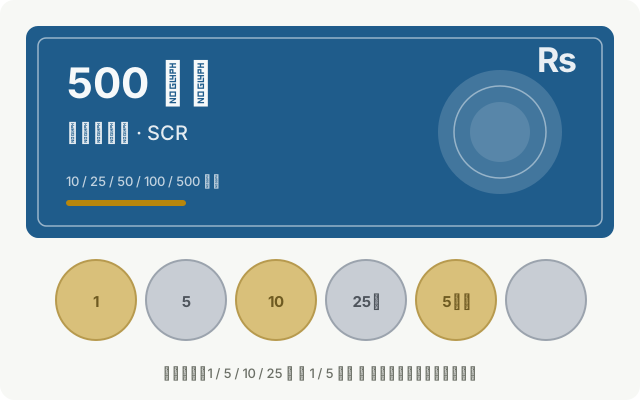
Current banknotes come in denominations of 25, 50, 100, 500 rupees, featuring themes of Creole culture, dance, and natural ecology. Coins include 1, 5, 10, 25 cents, as well as 1 and 5 rupees. In tourist settings, prices in rupees can easily run into the hundreds or thousands. It’s normal for a basic restaurant meal per person to cost around 200–400 rupees, and a taxi from the airport to town is about 400 rupees—be prepared for these price levels. Older 10 and 20 rupee notes have largely been phased out, but if you receive them, they can be exchanged at banks for current notes at face value without penalty.
Cash and Payment Habits
High-end resorts, large restaurants, and dive centers generally accept Visa/Mastercard, though some may charge around 2–3% transaction fees. Local snack shops, buses, taxis, and markets mainly operate in cash. Banks and ATMs are available near Victoria and Beau Vallon on Mahé, and near the ferry terminals on Praslin. Exchange rates at airports, banks, and authorized exchange counters are better than those at hotel front desks. Many resorts quote prices in euros, so confirm the billing currency and whether taxes are included when booking.
Locals use rupees for daily transactions. Travelers can legally exchange currency at banks and authorized exchange points with their passports and should keep exchange receipts to convert leftover rupees back to foreign currency before departure. Bank operating hours in Victoria are limited to weekdays during the day, with only airport exchange counters open on weekends. Island-hoppers should plan currency exchanges in advance and avoid waiting until the last stop to withdraw or exchange money.
Traveler Tips
- Prices are generally high; it’s advisable to budget at least $210 per person per day.
- Buses are very cheap and cover main routes on Mahé, but carry small rupee coins for fares.
- Resorts and dive shops are card-friendly, but bring cash for smaller islands and markets.
- Before leaving, use your exchange receipts to convert unused rupees back to foreign currency; airport exchange counters have limited hours.
Seychelles Overview
Country Details »Seychelles Overview
Seychelles (officially the Republic of Seychelles) is an island nation located in the central western Indian Ocean, about 1,600 kilometers east of the African mainland and northeast of Madagascar. It consists of 115 islands, with a land area of approximately 455 square kilometers and a population of around 100,000, making it the smallest and least populous country in Africa. The capital, Victoria, is situated on the northeast coast of the largest island, Mahé, and is the country’s only port and commercial center.
Seychelles is one of the highest-income countries per capita in Africa, with an economy heavily reliant on tourism and fishing. It maintains a premium island holiday approach, featuring one-hotel-per-island concepts, private beaches, and yacht-based island hopping. These features consistently place Seychelles among the world’s top honeymoon and vacation destinations.
Geography and Climate
The 115 islands are divided into two groups: the inner islands, around 42 in number, including Mahé, Praslin, and La Digue, which are rare granite islands—massive pinkish-white granite boulders rolling down to beaches surrounded by coconut palms and turquoise waters, creating a globally unique landscape. The outer islands are mostly coral atolls scattered across vast waters, with Aldabra Atoll being the most famous. Morne Seychellois (905 meters) on Mahé is the highest point in the country.
The climate is tropical maritime, with temperatures typically ranging from 24–31°C year-round. The northwest monsoon season from December–March is hot, humid, and rainy, while the southeast trade wind season from May–September is cooler and drier but can bring rougher seas. The transitional months of April–May and October–November feature calm winds and excellent visibility, making them prime times for diving and sailing.
Historical Background
The islands were uninhabited before Western arrival. Portuguese navigators were the first to record them in the early 16th century. In 1756, France officially claimed the islands, naming them after Minister of Finance Jean Moreau de Séchelles. The first settlers arrived in 1770, establishing plantations and bringing laborers from Africa and India, laying the foundation of today’s Creole society. After the Napoleonic Wars in 1814, the islands became a British colony and remained so for over a century, with spice and coconut plantation economies continuing.
Seychelles gained independence on June 29, 1976, but experienced a coup the following year and was under a one-party system for many years. A new constitution restoring multiparty politics was adopted in 1993, stabilizing the political situation and enabling the high-end development of the tourism sector.
Economy and Currency
Tourism accounts for about a quarter of GDP, with tuna fishing and processing being another key industry. Victoria Harbour is one of the world’s major canned tuna production centers. The official currency is the Seychellois rupee (SCR), which has had a floating exchange rate since 2008; see the currency section for details. The country maintains a ‘fewer but more exclusive’ high-end tourism strategy by controlling hotel bed capacity and ecological limits.
Culture and Society
Seychelles is a classic Creole society, formed by generations of intermarriage among descendants of African, European, Indian, and Chinese immigrants, resulting in a generally harmonious and inclusive demographic makeup. Creole, English, and French are all official languages, and the majority of residents are Roman Catholic. The cuisine features fish curry, octopus salad, and coconut milk desserts. Moutya dance was inscribed on the UNESCO Intangible Cultural Heritage list in 2021. The annual Creole Festival in October, lasting several weeks and featuring music, food, and beauty contests, is the country’s liveliest event.
Tourism Overview
Classic itineraries often include a “three-island tour”: Beau Vallon Beach and Morne Seychellois National Park on Mahé, the Vallée de Mai World Heritage Site on Praslin—home to the coco de mer, the world’s only natural habitat—and La Digue’s slow-paced life with ox carts and the iconic granite beach at Anse Source d’Argent. Those with higher budgets may fly to Aldabra Atoll to explore the world’s largest coral atoll and its population of over 100,000 giant tortoises. Other experiences include Sainte Anne Marine Park, birdwatching on Bird Island, and sailing-based island hopping.
Seychelles Travel Guide
All Guides »Seychelles Travel Snapshot: Visa-Free Access, Monsoon Seasons, Budget Tips & Island Etiquette
Essential Guide to Visiting Top Honeymoon Islands: Visa Requirements, Monsoon Pa...
Classic 7-Day Seychelles Itinerary: A Three-Island Hopping Route – Mahé, Praslin, and La Digue 7 Days
This seamless route connects Vallée de Mai, Anse Source d'Argent, and Beau Vallo...
Seychelles 4-Day Short Trip: Quick Island-Hopping Between Mahé and La Digue 4 days
Only have 4 days off? A highly efficient itinerary covering two days on Mahé and...
Must-visit attractions in Seychelles: Valley de Mai, Giant Tortoise Atoll, and granite beaches
With 115 islands, which ones to choose? A full guide to highlights and durations...
Seychelles Food Guide: Creole Curry, Octopus Salad, and Beachside Night Markets
How to Eat at a Creole Table? A Complete Guide to Fish Curry, Octopus Salad, Lad...
Seychelles Transport Guide: Ferry Hopping, Island Buses & Cycling Tips
How to choose ferries between Mahé, Praslin, and La Digue? Full guide to airport...