Ethiopia Currency Ethiopian BirrETB
What money to use in Ethiopia, how notes and coins break down, and the best ways to exchange - get the local cash sorted before you go.
| Currency Name | Ethiopian Birr |
|---|---|
| Currency Code | ETB |
| Currency Symbol | Br |
| Issuing Country | Ethiopia |
| Time Zone | UTC+3 |
| Dialling Code | +251 |
About Ethiopian Birr (ETB)
Currency Overview
The currency of Ethiopia is the Ethiopian Birr (currency code ETB, symbol Br, English: Birr), with 1 Birr equal to 100 santim, issued by the National Bank of Ethiopia. In recent years, the Birr has faced depreciation pressure due to foreign exchange shortages and inflation. There may be differences between the official exchange rate and the market rate, so base your travel budget on the exchange rate on the day of travel. The Birr is also one of the few currencies in East Africa that is not pegged to the US dollar and floats relatively independently. Its value fluctuations can significantly impact local prices, so travelers should allow for some budget flexibility.
Denominations
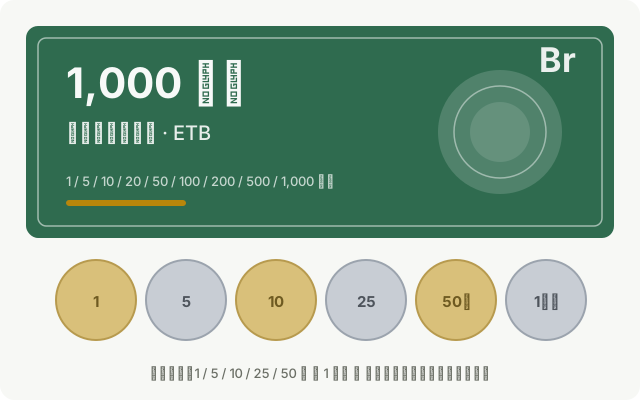
Current banknotes come in denominations of 1, 5, 10, 50, 100, and 200 Birr, with the 200 Birr note being a more recently issued denomination featuring themes of national history, agriculture, and folklore. Coin denominations include 1, 5, 10, 25, 50 santim, and 1 Birr. Small change is often given in coins and small-denomination bills. While colors and security features may vary slightly across different years of issuance, older banknotes remain legal tender and can be used without concern.
Cash and Payment Habits
Ethiopia is a cash-based society. Most markets, restaurants, taxis, and attraction entry fees only accept Birr in cash. Card payments are mostly limited to high-end hotels, select restaurants, and large malls in the capital. Foreign cards may face restrictions when withdrawing cash from local ATMs, so it’s advisable to carry US dollars or euros in cash and exchange them for Birr at banks or authorized exchange services in Addis Ababa, keeping the exchange receipts for possible conversion back upon departure.
Mobile payments are growing rapidly locally but remain difficult for short-term foreign visitors to use. Cash is still the primary method for travel. Some attractions and tour operators may accept US dollars in cash from foreign tourists, so confirm payment methods in advance.
Traveler Tips
- Exchange Birr at banks or authorized exchange services and request receipts. Avoid street-side private exchanges to prevent counterfeit bills or disputes.
- There are limits on how much Birr cash you can take out of the country, but exchange receipts can be used to convert leftover Birr back to foreign currency.
- Mobile network and ATM coverage is limited in highland areas, so carry enough cash before arriving in the capital.
- Attraction tickets, flights, and hotels may require payment in US dollars, so it’s wise to carry small amounts of US cash as well.
Ethiopia Overview
Country Details »Ethiopia Overview
Ethiopia (officially the Federal Democratic Republic of Ethiopia) is located in the Horn of Africa and is a large inland country in northeastern Africa. It borders Djibouti and Somalia to the east, Kenya to the south, South Sudan and Sudan to the west, and Eritrea to the north. With a land area of approximately 1.1036 million square kilometers and a population of around 126 million, it is the second most populous country in Africa. The capital, Addis Ababa, situated on the central plateau at an elevation of about 2,300 meters, is home to the headquarters of the African Union (AU) and the United Nations Economic Commission for Africa, earning it the nickname "the political capital of Africa."
Ethiopia is a federal republic composed of over ten ethnic states and chartered cities. The official working language is Amharic, while Oromo, Tigrinya, Somali, and others are also widely spoken. The country holds a unique place in modern African history as one of the few African nations that successfully resisted European colonization and maintained long-term independence.
Geography and Climate
Ethiopia is predominantly a highland country, often referred to as the "Roof of Africa." The central and northern regions form the Ethiopian Highlands, with an average elevation of 2,000 to 3,000 meters, and the highest peak, Ras Dashen, reaching approximately 4,550 meters. The East African Rift Valley runs from north to south through the country, creating a series of lakes and volcanic landscapes. The eastern and southeastern parts gradually descend into the Ogaden Plateau and lowlands, with the Danakil Depression in the northeast reaching a lowest point about 125 meters below sea level—making it one of the hottest places on Earth.
The climate is significantly influenced by altitude. Although located in the tropics, the highlands enjoy a cool climate, with annual average temperatures of about 15–20°C and spring-like conditions year-round. The lowlands are hot and arid. The country generally experiences a dry season (October to March) and a rainy season, with the heaviest rainfall occurring during the long rainy season from June to September. The best time to visit is typically from October to March, but be prepared for significant temperature differences between day and night in the highlands and pack warm clothing.
Historical Background
Ethiopia is home to one of the world’s oldest civilizations. The Aksumite Empire, which flourished around the Common Era, was renowned for its towering stelae and Red Sea trade. In the 4th century, it officially adopted Christianity, becoming one of the first countries to establish it as the state religion. Later, the Solomonic Dynasty ruled for centuries, leaving architectural wonders such as the rock-hewn churches of Lalibela and the castles of Gondar. In 1896, Emperor Menelik II defeated invading Italian forces at the Battle of Adwa, marking a pivotal moment in African anti-colonial history.
Ethiopia was briefly occupied by Italy from 1936 to 1941 but regained independence afterward and joined the United Nations. The monarchy ended in 1974, followed by years of military rule and civil war. A new government came to power in 1991, and Eritrea gained independence in 1993, leaving Ethiopia landlocked. In 2018, Prime Minister Abiy Ahmed initiated reforms and achieved reconciliation with Eritrea, earning him the Nobel Peace Prize. However, large-scale armed conflict broke out in the northern Tigray region in late 2020 and spread to parts of Amhara, causing severe humanitarian impacts. A peace agreement, the Pretoria Agreement, was signed in November 2022, and the situation remains under recovery and reconstruction.
Economy and Currency
Ethiopia’s economy is primarily agriculture-based, with agriculture accounting for a significant share of both GDP and employment. Coffee is the largest export commodity, along with oilseeds, flowers, pulses, and leather. The livestock sector is among the largest in Africa. In recent years, the government has promoted industrialization and infrastructure development, including the construction of an electrified railway connecting Addis Ababa and Djibouti, as well as investments in hydropower and manufacturing.
The official currency is the Ethiopian Birr (ETB, symbol Br), with 1 Birr equal to 100 santim, issued by the National Bank of Ethiopia. The Birr has faced depreciation pressure due to foreign exchange shortages and inflation. There has historically been a gap between the official and market exchange rates, so always exchange currency through authorized channels and request receipts.
Culture and Society
Ethiopian culture is distinct: it has its own script (Ge'ez), a calendar that is about 7–8 years behind the Gregorian calendar, and major religions including Ethiopian Orthodox Christianity and Islam, which have coexisted for centuries. Ethiopia is considered the birthplace of coffee, originating from the Kaffa forest in the southwest—the word “coffee” is derived from there. Traditional Ethiopian coffee ceremonies involve brewing coffee in a jebena pot, accompanied by roasted grains and frankincense incense, often lasting over an hour as an important hospitality ritual.
The staple food is injera, a sour flatbread made from teff flour, served with various stews called wat. Doro wat (spicy chicken stew) and beyaynetu (vegetarian platter) are among the most iconic dishes. Meals are eaten with the right hand, typically shared from a single plate, reflecting an important social tradition.
Tourism Overview
Ethiopia boasts some of Africa’s most unique historical and natural attractions: the rock-hewn churches of Lalibela are hailed as the Eighth Wonder of the World; Lake Tana is the source of the Blue Nile, dotted with ancient monasteries on its islands and shores; the castles of Gondar’s Fasil Ghebbi complex are known as Africa’s Camelot; Simien Mountains National Park is home to geladas and Walia ibex and is a UNESCO World Heritage Site; and the Erta Ale lava lake in the Danakil Depression is one of the few places in the world where an active lava lake can be observed up close. The capital, Addis Ababa, hosts the African Union headquarters and the National Museum, which displays the famous fossil of Lucy.
Safety Note: Armed conflicts have occurred in recent years in Ethiopia’s Tigray Region and parts of Amhara. Although a peace agreement has been signed, localized security risks remain. Travelers are advised to stick to relatively stable areas like Addis Ababa, Gondar, Lalibela, Bahir Dar, and Awasa. Before traveling, monitor the latest consular advisories, purchase travel insurance covering emergency medical treatment and evacuation, and avoid large gatherings or sensitive locations.
Ethiopia Travel Guide
All Guides »Ethiopia Travel Quick Guide: Visa on Arrival, Best Time to Visit, Budget & Safety Tips
How to apply for an e-visa or visa on arrival, the best time to go, daily costs,...
Ethiopia 7-Day Classic Loop: Addis Ababa – Bahir Dar – Gondar – Lalibela 7 days
Explore the source of the Blue Nile, Africa’s Camelot castles, and rock-hewn chu...
Ethiopia 4-Day Short Trip: Addis Ababa and Nearby Volcanic Lakes 4 days
Based in the capital, this itinerary takes you to volcanic lakes, monasteries, a...
Complete list of must-visit attractions in Ethiopia: rock-hewn churches, castles, and highland heritage
A city-by-city guide to Ethiopia’s top attractions, covering UNESCO World Herita...
Ethiopian Food Guide: Injera, Wat Stews & Coffee Ceremony
From the sour flatbread injera to spicy stews, raw beef kitfo to coffee ceremoni...
Complete Guide to Transportation in Ethiopia: Domestic Flights, Light Rail, Taxis, and Private Cars
Covering round-trips to and from Bole Airport, Addis Ababa’s light rail and ride...