Timor-Leste Currency US DollarUSD
What money to use in Timor-Leste, how notes and coins break down, and the best ways to exchange - get the local cash sorted before you go.
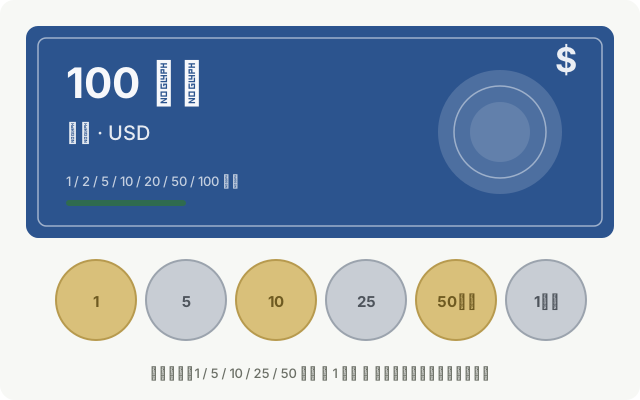
| Currency Name | US Dollar |
|---|---|
| Currency Code | USD |
| Currency Symbol | $ |
| Issuing Country | Timor-Leste |
| Time Zone | UTC+9 |
| Dialling Code | +670 |
About US Dollar (USD)
Currency Overview
Timor-Leste does not have its own legal tender. Since the transition period following independence from Indonesia in 2000, the US Dollar (currency code USD, symbol $) has been the official currency, with all transactions, bank accounts, and salaries denominated in dollars. The Indonesian Rupiah is not used, and visitors do not need to exchange for local currency—carrying US Dollars is sufficient for nearly all purchases.
To facilitate small change, the Central Bank of Timor-Leste issues centavo coins, each equivalent to one US cent, with 1 USD equaling 100 cents. These coins circulate alongside US dollar banknotes nationwide.
Denominations
US dollar banknotes in circulation include denominations of 1, 2, 5, 10, 20, 50, and 100 USD, though the 2 USD note is less common, and large bills like 50 and 100 USD are often difficult to break. Centavo coins issued by Timor-Leste come in 1, 5, 10, 25, and 50 cent denominations, often featuring designs of local flora, fauna, and crops such as coffee beans and rice stalks. US-issued 1, 5, 10, 25, and 50 cent coins are also widely accepted.
Both US dollar coins and Timor-Leste centavo coins can be used locally but are rarely exchangeable abroad, so it’s advisable to spend them during your stay.
Cash and Payment Habits
Timor-Leste is a predominantly cash-based society. Apart from some hotels, supermarkets, and international restaurants in Dili, credit card and mobile payment options are limited. Local shops, markets, restaurants, taxis, and chartered vehicles generally only accept cash. ATMs are available in towns like Dili and Baucau but are scarce and occasionally malfunction, with high cross-bank withdrawal fees.
It’s recommended to carry small-denomination US dollar bills, especially 1, 5, 10, and 20 USD, as larger bills like 50 and 100 USD are often hard to break. Banks and some currency exchange services in Dili may handle USD and AUD, but rates are usually average, so bringing USD directly is the most convenient option.
Traveler Tips
- Carry newer US dollar banknotes issued after 2000, as older or damaged bills are often refused.
- Small-denomination bills (1, 5, 10 USD) are very useful—bring as many as possible.
- Try to spend all Timor-Leste centavo coins before leaving, as they cannot be exchanged abroad.
- Credit card acceptance is limited; prepare sufficient cash based on your daily budget.
Timor-Leste Overview
Country Details »Overview of Timor-Leste
Timor-Leste (officially the Democratic Republic of Timor-Leste) is located at the eastern end of the Lesser Sunda Islands (Nusa Tenggara) in Southeast Asia. Its territory includes the eastern part of Timor Island, the Oecusse enclave in West Timor, and smaller islands such as Atauro and Jaco. It borders Indonesia’s West Timor to the west and faces Australia across the Timor Sea to the south. The country covers an area of approximately 14,900 square kilometers, with its capital Dili situated on the northern coast as the national political, economic, and cultural hub.
Timor-Leste is the first new sovereign nation of the 21st century, regaining formal independence on May 20, 2002, and is one of Asia’s youngest countries. It is divided into 13 administrative districts, with a population primarily composed of ethnic groups such as the Tetum and Mambai. The official languages are Tetum and Portuguese, and Catholicism is widely practiced among the populace.
Geography and Climate
The terrain of Timor-Leste is predominantly mountainous, with Mount Ramelau (also known as Tatamailau) rising to about 2,963 meters, the country’s highest peak. The northern coastline is relatively flat, with towns such as Dili, Liquiçá, and Manatuto along the shore. The southern coast is steeper, and areas like Suai and Viqueque have a drier climate. Atauro Island, located about 25 kilometers north of Dili, is renowned for its unspoiled coral reefs and excellent diving conditions.
The climate is tropical, divided into a rainy season (November to April) and a dry season (May to October). The dry season offers clear skies and low humidity, making it the best time to visit. The rainy season brings frequent afternoon thunderstorms, and mountain roads may be disrupted by landslides. Coastal lowlands are hot year-round, while higher-altitude areas like Maubisse and Ermera in the central highlands are significantly cooler, offering respite from the heat and ideal conditions for coffee cultivation.
Historical Background
Timor Island was colonized by Portugal starting in the 16th century, with the Portuguese establishing missions, coffee plantations, and trading posts. In 1859, Portugal and the Netherlands signed a treaty dividing the island into eastern and western parts, with the east under Portuguese control and the west under Dutch (later Indonesian) rule. During World War II, Japan briefly occupied Timor Island. After Portugal withdrew in 1975, Timor-Leste unilaterally declared independence, but Indonesia invaded by the end of the year, leading to decades of Indonesian rule.
In 1999, under United Nations supervision, Timor-Leste held a referendum in which the majority voted for independence from Indonesia. This was followed by significant unrest, and the United Nations Transitional Administration in East Timor took over governance. On May 20, 2002, the Democratic Republic of Timor-Leste was officially established as the first new nation of the 21st century. Since then, the country has gradually rebuilt, with oil and gas revenues and coffee exports becoming key economic pillars, and overall social stability has been maintained.
Economy and Currency
Timor-Leste has a small economy, with petroleum and natural gas revenues forming a major portion of government income. Offshore oil and gas fields in the Timor Sea are jointly developed by Timor-Leste and Australia, with earnings deposited into a national petroleum fund. Agriculture remains the livelihood for most of the population, and coffee—particularly Arabica beans—is the most important export crop. Highland coffee from regions like Ermera and Maubisse is well regarded in international markets. The service sector and government spending play significant roles in urban economies, while tourism is still in its early stages.
Timor-Leste does not have its own currency. Since 2000, the US Dollar (USD) has been the legal tender, with US dollar banknotes and coins widely circulated nationwide. Additionally, the country issues its own centavo coins, equivalent in value to US cents, to facilitate small transactions.
Culture and Society
Timorese society blends influences from Austronesian, Melanesian, and Portuguese colonial cultures. Traditional sacred houses (uma lulik) can be found in villages, Catholicism is widespread, and churches and religious festivals are integral to community life. Portuguese vocabulary, architecture, and cuisine also leave a distinct mark. Locals are warm and hospitable, with strong community ties where family and village form the core social units.
Music and handicrafts are cultural highlights. Handwoven tais fabrics, known for their unique geometric patterns and natural dyes, are a key national symbol. Traditional music features bamboo percussion and guitar accompaniment. Timor-Leste shares Timor Island’s linguistic diversity with Indonesia, with over ten local languages spoken nationwide, though Tetum serves as a common interethnic language.
Tourism Overview
Timor-Leste is a rare off-the-beaten-path destination in Southeast Asia, with few tourists and minimal commercialization. Key introductory sites near Dili include the Christ statue, the Resistance Museum, and Areia Branca Beach. Diving enthusiasts favor Atauro Island’s coral walls and the rich marine life of the Timor Sea. Hikers can climb Mount Ramelau for sunrise or explore the rainforests and white sands of Jaco Island in Nino Konis Santana National Park.
Overall travel infrastructure is basic, with overland travel from Dili mainly relying on chartered vehicles or 4WD rentals. Accommodation is concentrated in Dili and a few other towns, and road conditions outside paved areas are poor. The country is better suited for travelers seeking tranquility, diving, and hiking rather than conventional resort holidays. In recent years, Timor-Leste coffee has been promoted as a tourism highlight, with coffee region tours offering insights into cultivation and roasting processes.
Timor-Leste Travel Guide
All Guides »Timor-Leste Travel Quick Guide: Visa, Seasons, Budget & Etiquette
Get your visa, seasonal info, budget, and etiquette sorted before you go—this he...
Classic 7-Day Timor-Leste Itinerary: Dili, Atauro Island & Highland Coffee Region 7 days
Using Dili as a hub, this relaxed yet fulfilling itinerary weaves together city ...
Timor-Leste 4-Day Itinerary: Dili City and Atauro Island Island-Hopping 4 days
Even with limited time, you can experience the highlights: urban sights, coastal...
Must-visit attractions in Timor-Leste: From the coastal capital to highland snow-capped mountains
A regional breakdown of Timor-Leste’s top attractions, including highlights and ...
East Timor Food Guide: A Flavor Map from Grilled Fish to Highland Coffee
A dining scene influenced by Austronesian, Melanesian, and Portuguese cultures—s...
East Timor Travel Guide: Airport Transfers, Local Transport, and Island-Hopping Ferries
Everything you need to know about getting from Dili Airport to town, getting aro...