St. Vincent and the Grenadines Currency East Caribbean DollarXCD
What money to use in St. Vincent and the Grenadines, how notes and coins break down, and the best ways to exchange - get the local cash sorted before you go.
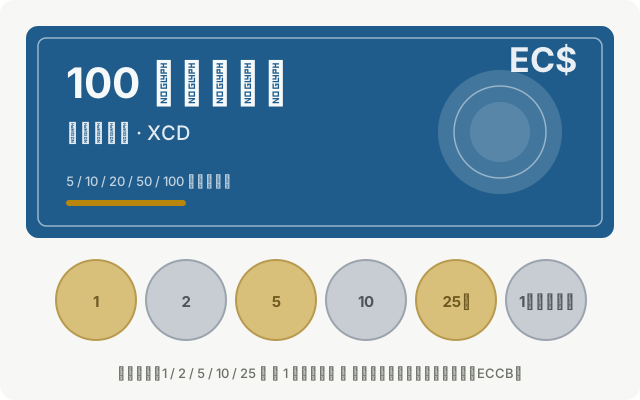
| Currency Name | East Caribbean Dollar |
|---|---|
| Currency Code | XCD |
| Currency Symbol | EC$ |
| Issuing Country | St. Vincent and the Grenadines |
| Time Zone | UTC-4 |
| Dialling Code | +1784 |
About East Caribbean Dollar (XCD)
Currency Overview
The official currency of Saint Vincent and the Grenadines is the East Caribbean Dollar (currency code XCD, symbol EC$), issued by the Eastern Caribbean Central Bank (ECCB). It is the shared currency of eight small island nations and territories within the Eastern Caribbean Currency Union. Since July 1976, the East Caribbean Dollar has been pegged to the US Dollar at a fixed rate of 1 USD = 2.7 XCD, a rate that has remained unchanged for over 40 years, making budgeting simple for travelers without the need to track real-time exchange rates.
Denominations
Banknotes in circulation come in denominations of 5, 10, 20, 50, and 100 East Caribbean Dollars. These are part of a new series designed uniformly by the ECCB, featuring a portrait of Queen Elizabeth II or a watermark on the front, and a collage of scenic views from member countries on the back. Coins are available in 1, 2, 5, 10, 25 cents, and 1 dollar, with smaller denominations featuring polygonal designs for easy tactile recognition. The most commonly used banknotes and coins for purchases on the islands are the 5, 10, and 20 dollar denominations.
Cash and Payment Practices
In Kingstown, there are banks, ATMs, and a few merchants that accept Visa, but payment options quickly become limited once you leave the main island. On islands such as Bequia, Mayreau, and Union Island, most restaurants, guesthouses, taxis, and inter-island boat operators only accept cash. Entrance fees to Tobago Cays Marine Park are also collected on-site by park rangers. It is recommended to withdraw enough cash for your entire trip in Kingstown or Bequia, and to carry small denominations such as 5 and 10 dollar bills for tips, juice stands, and boat fares.
US dollar bills are widely accepted in tourist areas, with merchants typically giving change at an approximate exchange rate of 1:2.6 to 1:2.7 (change is given in East Caribbean Dollars). Yacht charters and high-end resorts generally accept credit cards and prepayments. When withdrawing cash, use ATMs located inside banks or official premises, and avoid using street-side ATMs at night.
Traveler Tips
- The exchange rate is fixed at 1 USD = 2.7 XCD; use this rate for conversions and beware of merchants offering unfavorable rates such as 1:2.5.
- No ATMs are available at inter-island docks, so make sure to carry enough cash for your entire journey before leaving Kingstown.
- Small denomination bills are most practical; prioritize using 5 and 10 dollar bills when paying boat operators and vendors.
- Tipping is generally not mandatory in restaurants. If a service charge of 10% is included in the bill, additional tipping is not required. Leaving around 5% is appreciated for good service.
St. Vincent and the Grenadines Overview
Country Details »Overview of Saint Vincent and the Grenadines
Saint Vincent and the Grenadines is located at the southern end of the Windward Islands in the Lesser Antilles of the eastern Caribbean Sea. It consists of the main island of Saint Vincent and a string of smaller islands to the south (the northern part of the Grenadines). The country covers an area of approximately 389 square kilometers, with a population of about 100,000. Its capital, Kingstown, is situated on the southwestern coast of Saint Vincent. The country gained independence from the United Kingdom on October 27, 1979, and is a member of the Commonwealth and the United Nations. It operates under a parliamentary system, and its official language is English.
Despite its small size, the country boasts some of the Caribbean’s most renowned sailing and island-hopping waters. The islands of Bequia, Mustique, Canouan, Mayreau, and Union Island are lined up in a row, while the crescent-shaped reef of Tobago Cays Marine Park is a mecca for sailors and fans of *Pirates of the Caribbean*.
Geography and Climate
The main island of Saint Vincent is a volcanic island, approximately 29 kilometers long from north to south. In the central-northern part stands the active stratovolcano La Soufrière, which rises 1,234 meters above sea level and is the country’s highest point. The island features deeply cut streams, numerous waterfalls, and predominantly black volcanic sandy beaches along the coast. The eastern coast is windy and rough, while the western leeward side is calmer and suitable for anchoring. The smaller Grenadine islands have low-lying terrain, surrounded by coral reefs, with waters that transition from light green to deep blue, making them world-class anchorages and snorkeling spots.
The climate is tropical maritime, with temperatures ranging from 24 to 30 degrees Celsius year-round. The dry season from January to May features stable trade winds, making it the peak sailing and tourist season. The rainy season and hurricane season span from June to November. In April 2021, La Soufrière volcano erupted violently several times, leading to the emergency evacuation of around 20,000 residents and severe damage to the northern part of the main island. Since then, post-disaster reconstruction and tourism recovery have continued, with major tourist areas located in the southern part of the main island and the Grenadines, which were minimally affected by the volcano.
Historical Background
Saint Vincent was recorded by Europeans during Christopher Columbus’s third voyage in 1498. However, due to the resistance of the indigenous Kalinago people, European colonial powers were unable to establish a foothold for a long time until the 18th century when Britain and France repeatedly contested the island. After the Treaty of Versailles in 1783, the island came under British control, and some of the indigenous people were relocated to Central America. Following the abolition of slavery in 1834, Portuguese and East Indian indentured laborers arrived, forming today’s society, which is predominantly of African descent with mixed European and Asian ancestry. Internal self-government was granted in 1969, and the country gained full independence on October 27, 1979.
Since independence, the country has been primarily agriculture-based, with bananas and arrowroot serving as key exports. Arrowroot starch has been exported globally since the 19th century and remains a flagship agricultural product of “Made in Saint Vincent.” The 2021 volcanic eruption was the most severe natural disaster in the country’s independent history, with international aid and remittances supporting the reconstruction of northern communities.
Economy and Currency
The economy is based on agriculture (bananas, arrowroot, taro), fishing, tourism, and small-scale offshore services. In recent years, the focus has shifted toward high-end tourism and the yacht economy. Mustique Island is known for its celebrity private holiday villas, while Canouan Island has seen the development of resorts and a private airport. The official currency is the East Caribbean Dollar (XCD), which is pegged at a fixed rate of 2.7 to 1 US dollar and issued by the Eastern Caribbean Central Bank. It is used across the Eastern Caribbean Currency Union, including Dominica, Saint Lucia, Grenada, and other member states.
Culture and Society
The population is predominantly of African descent, and English is the official language, though Vincentian Creole English is commonly spoken. The Vincy Mas festival, held annually in June and July, is part of the Caribbean carnival season, featuring soca music and steelpan bands that play through the night. Bequia Island’s tradition of small boat building and whaling (now strictly regulated by international conventions) has shaped a unique island craftsmanship culture. The country has also gained recognition in the Caribbean arts scene with locally produced works such as the Oscar-nominated film *Milk and Honey* and various art projects by painters and writers.
Tourism Overview
The tourism experience in Saint Vincent and the Grenadines is divided into two parts: the main island is ideal for volcano hiking (such as climbing the crater of La Soufrière), visiting the oldest botanical garden in the Western Hemisphere (established in 1765), and relaxing on black sand beaches. The Grenadines, on the other hand, are a true island-hopping paradise. Visitors can charter sailboats or take inter-island ferries from Kingstown or Bequia, exploring each island in turn. Snorkel in the unspoiled waters of Tobago Cays to see turtles and coral, or watch kiteboarding in the horseshoe-shaped lagoon of Union Island. Several scenes from the first *Pirates of the Caribbean* movie were filmed here, and visitors can still sail in the same crystal-clear waters and white sands.
St. Vincent and the Grenadines Travel Guide
All Guides »Saint Vincent and the Grenadines Travel Preview: Visa, Seasons, Budget, and Island-Hopping Essentials
How to Get the Most Out of a Sailing Paradise: Visa Options, Dry Season Sailing ...
Classic 7-day island-hopping itinerary in Saint Vincent and the Grenadines: Main Island – Bequia – Tobago Cays – Union Island 7 days
Journey south from the volcanic main island to a sailor’s paradise: hike, sail, ...
Saint Vincent and the Grenadines 4-Day Short Trip: Highlights of Bequia and Tobago Cays 4 days
Skip the main island and head straight to the southern isles: experience Bequia’...
Must-visit attractions in Saint Vincent and the Grenadines: Tobago Cays, Bequia, and the volcano
Two main sections: hiking on the main volcanic island and island-hopping in the ...
Saint Vincent and the Grenadines Food Guide: Seafood, Breadfruit, and Rum Under the Stars
Island-Hopping Dining Guide: Fresh Grilled Fish, National Breadfruit Dishes, Tar...
Complete Guide to Transportation in Saint Vincent and the Grenadines: Connecting Flights, Island Ferries & Charter Boats
How to make connecting flights, check island ferry schedules, share sailing char...