Malaysia Currency Malaysian RinggitMYR
What money to use in Malaysia, how notes and coins break down, and the best ways to exchange - get the local cash sorted before you go.
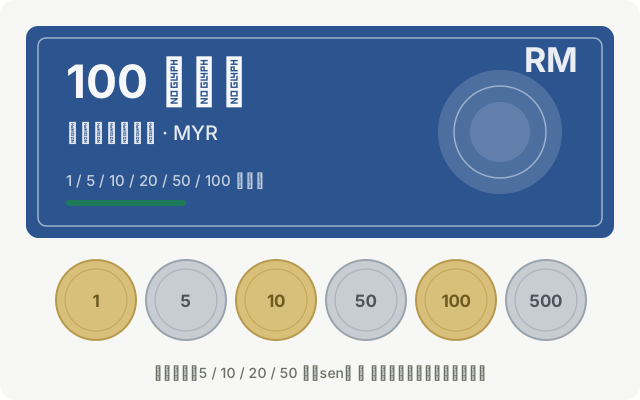
| Currency Name | Malaysian Ringgit |
|---|---|
| Currency Code | MYR |
| Currency Symbol | RM |
| Issuing Country | Malaysia |
| Time Zone | UTC+8 |
| Dialling Code | +60 |
About Malaysian Ringgit (MYR)
Currency Overview
The official currency of Malaysia is the Ringgit (currency code MYR, symbol RM, Malay for "jagged," derived from the serrated edges of Spanish silver coins). 1 Ringgit = 100 sen. The currency is issued by Bank Negara Malaysia (the Central Bank of Malaysia) and is one of the more stable currencies in Southeast Asia.
Denomination System
There are six denominations of banknotes currently in circulation: 1, 5, 10, 20, 50, and 100 Ringgit (a small number of 500 Ringgit notes are no longer issued but can still be exchanged). The front of the banknotes features the portrait of Malaysia’s first Yang di-Pertuan Agong, while the back showcases themes of the country’s nature and culture, with each denomination in different colors. There are four coin denominations: 5, 10, 20, and 50 sen, with the Yang di-Pertuan Agong’s portrait on the front and traditional patterns on the back.
Cash and Payment Habits
Electronic payments are widely used in Malaysia, with popular local options such as DuitNow QR, Touch 'n Go eWallet, and GrabPay. International visitors can use Visa, Mastercard, and UnionPay credit cards for direct payments at malls, restaurants, convenience stores, and Grab taxis. Cash remains essential at hawker centers, night markets, traditional shops, and taxis.
It is recommended to carry some cash: around 100–200 Ringgit per person per day is sufficient for general meals and transportation. Currency can be exchanged at airports, banks, and authorized exchange counters (such as those in Kuala Lumpur’s Mid Valley and Bukit Bintang areas), with minimal differences in exchange rates. ATMs are widely available in cities and airports, though some banks may charge a small fee for foreign cards.
Traveler Tips
- Do not bring or consume pork or alcohol in halal restaurants.
- Dress modestly when entering mosques (cover arms and knees), and women should wear a headscarf. Some mosques provide free robes.
- During Ramadan, avoid eating or drinking in public during daylight hours out of respect for local customs.
- Electronic payments are widely accepted on public transport, Grab, and in convenience stores, but carry cash for hawker centers and night markets.
- In Penang and Ipoh, many signature dishes are found at hawker centers, where prices are affordable and portions are generous.
Malaysia Overview
Country Details »Overview of Malaysia
Malaysia is located in Southeast Asia and consists of two landmasses separated by the South China Sea: West Malaysia (the southern part of the Malay Peninsula), which borders Thailand to the north and faces Singapore across the Johor Strait to the south; and East Malaysia (Sarawak and Sabah), located on the northern part of Borneo, adjacent to Indonesia and Brunei. The country covers an area of approximately 330,000 square kilometers, with its capital, Kuala Lumpur, situated on the central west coast of West Malaysia. Kuala Lumpur is the political, economic, and cultural center of Malaysia, while the administrative center is located in Putrajaya to the south.
Malaysia is a federal constitutional monarchy. The Yang di-Pertuan Agong (King) is elected every five years from among the nine hereditary rulers of the Malay states. The country is divided into 13 states and 3 federal territories and is a multiethnic, multireligious, and multilingual nation.
Geography and Climate
The terrain of West Malaysia is dominated by the Titiwangsa Mountains running through the center, flanked by coastal plains on both sides. East Malaysia features the rainforests, rivers, and mountains of Borneo, with Mount Kinabalu (4,095 meters) in Sabah being one of the highest peaks in Southeast Asia. Tropical rainforests cover about 60% of the country, making it one of the most biodiverse nations in the world.
Located near the equator, Malaysia has a hot and humid climate year-round, with average temperatures ranging from 26°C to 29°C. The northeast monsoon from November to March brings heavy rainfall to the east coast and East Malaysia, while the southwest monsoon from May to September brings relatively drier weather to the west coast. Therefore, the best travel season for West Malaysia is from March to October, and the prime time for diving in Sabah is from May to September.
Historical Background
The region of Malaysia has been engaged in trade with India, China, and the Middle East since ancient times. The Malacca Sultanate, established around 1400, became a crucial maritime trade hub in Southeast Asia. Starting in the 16th century, Portugal, the Netherlands, and Britain successively invaded the region, with British colonial rule lasting until the mid-20th century.
Malaya gained independence in 1957, and in 1963, Malaya, Singapore, Sarawak, and Sabah formed Malaysia (Singapore withdrew in 1965). After independence, Malaysia achieved rapid economic growth through rubber, palm oil, tin mining, and manufacturing industries, becoming one of the "Four Asian Tigers" in the 1990s.
Economy and Currency
Malaysia is a major global exporter of palm oil, natural rubber, liquefied natural gas, and semiconductor packaging and testing. The electronics manufacturing industry is clustered in Penang, and tourism is also a significant source of income. The official currency is the Malaysian Ringgit (MYR), issued by Bank Negara Malaysia (the Central Bank of Malaysia), with 1 Ringgit = 100 sen.
Culture and Society
Malaysia’s population is composed of Malays (approximately 60%), Chinese (approximately 22%), Indians (approximately 7%), and indigenous peoples. Malay is the national language, and English is widely used in business and education. Islam is the official religion, but freedom of religion for Buddhism, Christianity, Hinduism, and other faiths is constitutionally guaranteed. Mosques, temples, Indian shrines, and churches coexist in cities.
Malaysian cuisine is one of its most distinctive attractions: dishes like nasi lemak, satay, bak kut teh, laksa, Hainanese chicken rice, roti canai, and various Nyonya dishes are often found together on the same table. Penang and Malacca have been designated as UNESCO World Heritage cities due to their rich history and culinary culture.
Tourism Overview
Malaysia offers a diverse range of travel experiences: the urban landscape and Twin Towers of Kuala Lumpur, the food and murals of Penang, island getaways in Langkawi and Redang, the tea plantations of the Cameron Highlands, the historic districts of Malacca, the iconic Mount Kinabalu in Sabah, and the diving opportunities in Semporna. This variety forms a complete chain from cities to rainforests to islands. The convenience of visas, affordable airfares, and widespread English proficiency make Malaysia an exceptionally cost-effective destination in Southeast Asia.
Malaysia Travel Guide
All Guides »Quick Guide to Traveling in Malaysia: Visas, Seasons, Budget, and Etiquette
Dress and dietary restrictions in a multi-religious country, and how to make the...
Classic 7-Day Malaysia Itinerary: Kuala Lumpur – Penang – Langkawi – Sabah 7 days
A route combining four experiences: city life, food, islands, and rainforest.
Malaysia 4-Day Short Trip: Kuala Lumpur + Malacca 4 days
Enjoy a fulfilling trip without going to the islands: modern city life + UNESCO ...
Must-visit attractions in Malaysia: From the Petronas Towers to Mount Kinabalu
Cities, ancient towns, highlands, islands, and rainforests — five faces of Malay...
Malaysia Food Guide: A Culinary Mosaic
Sharing a table with Malay, Chinese, and Indian flavors is Malaysia’s most immed...
Malaysia Travel Guide: Grab, Intercity Buses & Budget Airlines
Kuala Lumpur’s rail transit, intercity buses, and low-cost carriers — the three ...