Colombia Currency Colombian PesoCOP
What money to use in Colombia, how notes and coins break down, and the best ways to exchange - get the local cash sorted before you go.
| Currency Name | Colombian Peso |
|---|---|
| Currency Code | COP |
| Currency Symbol | $ |
| Issuing Country | Colombia |
| Time Zone | UTC-5 |
| Dialling Code | +57 |
About Colombian Peso (COP)
Currency Overview
The official currency of Colombia is the Colombian Peso (currency code COP, symbol $; to avoid confusion, often written as COL$). It is issued by the Bank of the Republic (Banco de la República), Colombia’s central bank. The peso has no subunit and is one of the currencies in Latin America with the highest numerical denominations. A typical simple meal often costs between ten and twenty thousand pesos. Visitors may need some time to adjust to the scale of the numbers.
Denominations
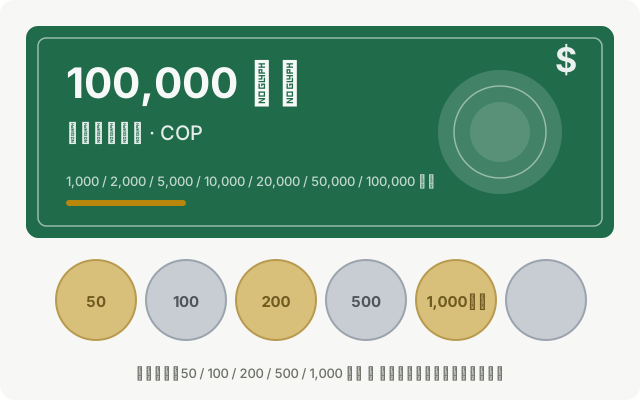
Currently circulating banknotes come in six denominations: 2,000, 5,000, 10,000, 20,000, 50,000, and 100,000 pesos. The designs honor Colombia’s nature, culture, and history: the 20,000-peso note features Agustina, known as the “Mother of Nurses of Latin America”; the 50,000-peso note depicts literary master Gabriel García Márquez and the inspiration for Macondo; the 100,000-peso note illustrates the epic poem The Song of the Hero and the Andean condor. Coins are issued in 50, 100, 200, 500, and 1,000 pesos, with smaller denominations frequently used in everyday transactions.
Cash and Payment Habits
In major cities like Bogotá, Medellín, and Cartagena, shopping malls, chain restaurants, and hotels generally accept international credit cards (Visa, Mastercard). Locals commonly use mobile payment apps such as Nequi and Daviplata. However, street food vendors, traditional markets, long-distance buses, and small-town shops mostly deal in cash. It is advisable to carry around 100,000–200,000 pesos per person per day in cash, primarily in small denominations under 20,000 pesos, for easier transactions and making change. Banks and ATMs in malls are relatively safe, but always shield your PIN and be aware of your surroundings when withdrawing money.
Tips for Travelers
- Exchange money at airports, banks, or authorized exchange offices—exchange rates are usually better at banks than airport counters.
- Peso denominations are large. Always mentally calculate and double-check unit and total prices before paying, and keep your receipts.
- ATM withdrawals have limits per transaction and high fees. Make multiple small withdrawals when possible, and prefer using ATMs inside malls.
- Try to use up all your pesos before leaving Colombia, as recycling options abroad are limited and exchange rates are unfavorable.
Colombia Overview
Country Details »Overview of Colombia
Colombia (officially the Republic of Colombia) is located in the northwest of South America, bordering the Caribbean Sea to the north and the Pacific Ocean to the west. It is the only South American country with coastlines on both oceans. To the east, it borders Venezuela and Brazil; to the south, Peru and Ecuador; and to the northwest, Panama. It serves as a key gateway to the South American continent. Covering an area of about 1.142 million square kilometers, the country has a population of approximately 52 million. Its capital, Bogotá, is situated in a high-altitude plateau basin at around 2,640 meters above sea level in the Andes Mountains, serving as the national center for politics and culture. The second-largest city, Medellín, is known as the “City of Eternal Spring” due to its urban renewal and spring-like climate all year round.
Colombia is a presidential republic divided into 32 departments (provinces). It ranks as the second most biodiverse country on Earth and has the highest number of bird species in the world.
Geography and Climate
The Andes Mountains extend into Colombia and split into three cordilleras—Western, Central, and Eastern—that run through the western part of the country. The eastern region consists of vast plains of the Orinoco and lowlands of the Amazon rainforest. The northern Caribbean coastal area is flat and open, with the snow-capped Sierra Nevada de Santa Marta mountains standing dramatically next to the sea, creating a striking contrast. Situated on the equator, Colombia does not have traditional four seasons; climate is determined by altitude. Lowland areas are hot year-round, central valleys are mild and pleasant, and highland cities like Bogotá are cool and autumn-like. Medellín, known as the “City of Eternal Spring,” has an average annual temperature of around 22 degrees Celsius.
Historical Background
Before the arrival of the Spanish, the region was home to the indigenous Muisca (Chibcha) and Tairona peoples, known for their advanced gold craftsmanship. The legend of El Dorado originated from their ceremonial gold offerings in lakes. In 1499, the Spanish arrived and later established the Viceroyalty of New Granada. On July 20, 1810, the independence movement began in Bogotá, and after Simón Bolívar’s victory at the Battle of Boyacá in 1819, the Republic of Gran Colombia was founded. It dissolved around 1830, leading to the formation of separate nations including Venezuela and Ecuador. In the mid-to-late 20th century, Colombia faced prolonged internal armed conflict and issues related to the drug trade. However, since the government signed a peace agreement with the Revolutionary Armed Forces of Colombia (FARC) in 2016, security has significantly improved, and tourism has grown rapidly.
Economy and Currency
Colombia is the fourth-largest economy in Latin America. It has long been among the world’s top three coffee producers, and “Colombian Coffee” is a globally recognized brand. The country is the second-largest exporter of flowers and produces over half of the world’s emeralds. Oil and coal are also major exports. The official currency is the Colombian Peso (COP), issued by the Bank of the Republic. It is one of the more freely traded currencies in Latin America. Daily transactions often involve large numbers, and visitors should get used to prices quoted in units of thousands.
Culture and Society
Colombian culture blends Spanish, Indigenous, and Afro-Caribbean traditions. Literary giant Gabriel García Márquez, inspired by his hometown of Aracataca, wrote One Hundred Years of Solitude, bringing magical realism to the world stage. The streets of Cartagena reflect scenes from the novel. Musically, vallenato, cumbia, and carrilera are popular genres. Traditional foods include arepas (corn cakes), bandeja paisa (a hearty mountain platter), and ajiaco (a Bogotá chicken and potato soup). Colombians are warm and festive, with Christmas lights in Bogotá and Medellín, and colorful flower parades by local growers, showcasing their love for celebration and color.
Tourism Overview
Colombia offers a rich and diverse travel experience: Bogotá’s Gold Museum houses the world’s largest collection of pre-Columbian gold artifacts, and visitors can take cable cars or a funicular up Mount Monserrate for panoramic city views. Medellín’s cable car system and the graffiti-filled Comuna 13 neighborhood showcase the city’s transformation. The central Coffee Cultural Landscape is a UNESCO World Heritage Site, and the wax palm forests of the Cocora Valley are the tallest palms in the world. The Caribbean coast features Cartagena’s well-preserved colonial walls and colorful old town, one of the most beautiful colonial cities in the region. Tayrona National Park combines rainforest, beaches, and snow-capped mountains. While safety has improved significantly in recent years and popular destinations are generally safe, regional differences exist. Travelers should avoid officially warned remote areas and stay vigilant against pickpocketing in cities.
Colombia Travel Guide
All Guides »Colombia Travel Quick Guide: Visa-Free Policy, Best Seasons, Budget & Etiquette
A valid U.S. visa or Schengen residence permit allows visa-free entry; the two d...
Classic 8-Day Colombia Itinerary: Bogotá — Coffee Region — Medellín — Cartagena 8 days
Experience Colombia’s highlights in one seamless journey: the highland ancient c...
Colombia 4-Day Itinerary: Cartagena and the Caribbean Coast 4 days
A mix of ancient cities, island-hopping, and Tayrona National Park lets you expe...
A must-visit list of attractions in Colombia: the Gold Museum, Coffee Valley, and Caribbean ancient cities
From highlands to coastlines, here’s a city-by-city guide to 14 must-see attract...
Colombia Food Guide: Arepas, Mountain Platters, and Coffee Tasting
Cornmeal cakes with everything, hearty mountain platters, comforting ajiaco soup...
Complete Guide to Transportation in Colombia: Airports, Rapid Transit, Cable Cars, and Intercity Buses
Understand Bogotá’s BRT, Medellín’s metro-cable, and Colombia’s affordable domes...