Republic of the Congo Currency Central African CFA francXAF
What money to use in Republic of the Congo, how notes and coins break down, and the best ways to exchange - get the local cash sorted before you go.
| Currency Name | Central African CFA franc |
|---|---|
| Currency Code | XAF |
| Currency Symbol | FCFA |
| Issuing Country | Republic of the Congo |
| Time Zone | UTC+1 |
| Dialling Code | +242 |
About Central African CFA franc (XAF)
Currency Overview
The official currency of the Republic of the Congo is the Central African CFA franc (Franc CFA, currency code: XAF, symbol: FCFA), issued uniformly by the Bank of Central African States (Banque des États de l’Afrique Centrale, BEAC) and circulating within the member states of the Central African Economic and Monetary Community (CEMAC). The Republic of the Congo does not issue its own currency, so the CFA franc used in the country is the same as that used in Gabon, Cameroon, the Central African Republic, and others.
The Central African CFA franc maintains a fixed exchange rate with the euro at 1 euro = 655.957 XAF, ensuring currency stability and simplifying currency conversion calculations based on the euro.
Denominations
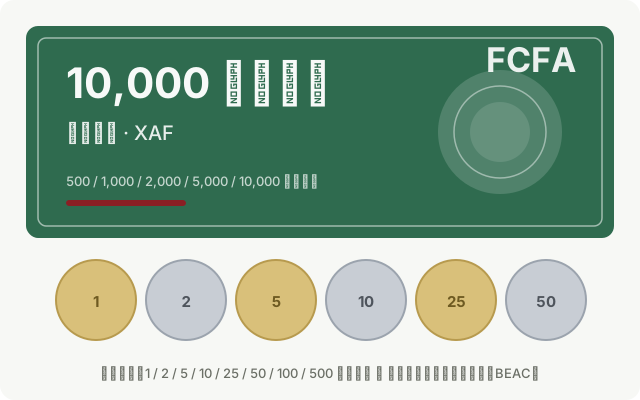
Circulating banknotes are issued in denominations of 500, 1,000, 2,000, 5,000, and 10,000 XAF, featuring designs that represent the Central African Economic and Monetary Community and its member countries. Multiple versions exist due to different issuance years. Coin denominations include 1, 2, 5, 10, 25, 50, 100, and 500 XAF, though lower-value coins are rarely seen in daily use.
With many note versions in circulation, receiving older or slightly damaged bills is not a concern, but newer, undamaged bills are recommended for smoother transactions with vendors and small businesses.
Cash and Payment Practices
The Republic of the Congo is a cash-based economy. Street vendors, markets, small restaurants, taxis, and long-distance buses generally accept only cash. Card payments are limited, usually available only at a few high-end hotels, large supermarkets, and bank branches in Brazzaville and Pointe-Noire, and primarily support Visa and Mastercard—UnionPay cards have low acceptance.
ATMs are scarce and often malfunction or have low withdrawal limits, so relying solely on card withdrawals is not advisable. The most reliable approach is to bring euro cash and exchange it for CFA francs at banks, airports, or authorized exchange counters upon arrival, keeping some smaller denomination bills for everyday purchases.
Traveler Tips
- Exchanging euro cash offers the best rates; U.S. dollars may also be accepted at some places, but exchange rates may be less favorable.
- Airports, banks, and authorized exchange counters offer more reliable rates; avoid private street money changers to prevent disputes over counting.
- Large bills can be difficult to break; request smaller denominations like 1,000 and 2,000 XAF when exchanging money.
- There are limits on the amount of CFA francs you can take out of the country, and amounts exceeding the limit require declaration—check the latest regulations in advance.
Republic of the Congo Overview
Country Details »Overview of the Republic of the Congo (Brazzaville)
The Republic of the Congo (République du Congo), commonly referred to as the Republic of the Congo (Brazzaville), is located in central Africa on the western bank of the lower Congo River. It borders Gabon to the west, Cameroon and the Central African Republic to the north, the Democratic Republic of the Congo (DRC) across the Congo River to the east and south, and the Atlantic Ocean to the southwest, with a coastline of about 170 kilometers. The country covers an area of approximately 342,000 square kilometers.
The Republic of the Congo is a presidential republic, divided into more than ten provinces. The capital, Brazzaville, is situated on the northern bank of the Congo River, directly opposite Kinshasa, the capital of the Democratic Republic of the Congo. The two cities are the closest pair of national capitals in the world. The country has a population of around 6 million. French is the official language, and other widely spoken languages include Lingala and Kituba, among other Bantu languages.
Geography and Climate
The terrain rises gradually from the southwestern coastal region to the northeastern inland areas: the coastal zone consists of a narrow plain, followed inland by the Mayombe mountain range, the Niari Valley, the Batéké Plateau in the central region, and the expansive Congo Basin in the north and northeast. The Congo River and its major tributary, the Ubangi River, form the eastern and southern borders, converging within the country and creating a significant riverine landscape. The northern Likouala region is characterized by swamps and river networks, forming part of the peatlands of the Congo Basin and serving as important carbon sinks and wildlife habitats.
The climate is tropical equatorial, hot and humid year-round, with an average annual temperature of around 25°C. The southern coastal and central regions experience a relatively cooler dry season from June to September, which is also the most favorable time for travel. The northern Likouala area receives rain throughout the year, with the rainy season lasting from October to May, featuring frequent rainfall and high humidity—bring rain protection and mosquito repellent.
Historical Background
The Congo River basin, where the Republic of the Congo is located, was historically part of Bantu kingdoms such as the Kingdom of Kongo. Portuguese explorers arrived along the coast in the late 15th century, followed by European merchants and missionaries. In the late 19th century, French explorer Pierre Savorgnan de Brazza signed agreements with local leaders, leading to French colonial rule on the right bank of the Congo River—Brazzaville was named after him. In 1910, Brazzaville became the capital of French Equatorial Africa, serving as the political center of France’s colonial administration in Central Africa.
The Republic of the Congo gained independence on August 15, 1960. From the 1960s to the 1980s, it pursued a socialist path and was among the first African nations to establish a one-party system. In the early 1990s, it transitioned to a multi-party system, experienced a civil war in 1997, and has since been rebuilding under its existing political framework. Understanding this modern history helps explain the shared yet distinct relationship between the Republic of the Congo and the Democratic Republic of the Congo, as well as the historical context of Brazzaville and Kinshasa facing each other across the river.
Economy and Currency
Oil is the economic backbone of the Republic of the Congo, with Pointe-Noire being the main oil port and the country’s second-largest city. National finances and export revenue heavily rely on crude oil and timber. Agriculture focuses on cassava, cocoa, coffee, and palm products, primarily in the southern and central regions, while forestry and fishing are vital livelihoods in coastal and riverine areas.
The official currency is the Central African CFA franc (code: XAF, symbol: FCFA), issued by the Bank of Central African States (BEAC). It maintains a fixed exchange rate of 1 euro = 655.957 XAF, contributing to its relative stability. The Republic of the Congo does not issue its own currency; the regional currency system is used uniformly, which means currency exchange and payment methods are consistent across the Central African Economic and Monetary Community for travelers.
Culture and Society
The Republic of the Congo is one of the birthplaces of Sapeur (Sapologie, or Sape) fashion culture. Brazzaville’s “Sapeurs” are known for their colorful tailored suits, elegant accessories, and refined demeanor, treating fashion as a form of dignity and art. This cultural expression has become a shared emblem along both banks of the Congo River. Congolese rumba and soukous music also originated in this region, significantly influencing the development of African popular music.
The society is predominantly Bantu, with social customs emphasizing greetings and respect for elders. Handshakes and polite conversation are common when meeting. The staple diet includes cassava-based foods, such as saka-saka (cassava leaves), peanut stew, smoked fish, and freshwater fish. Bananas, cassava, and palm wine are also commonly found on dining tables.
Tourism Overview
Tourist highlights in the Republic of the Congo focus on nature and culture: Odzala-Kokoua National Park in the north is renowned for its western lowland gorillas and tropical rainforest ecosystem, and is a UNESCO World Heritage Site. The Likouala swamps and Congo Basin peatlands are vital ecological barriers. Brazzaville offers views of the Congo River and Sapeur culture, while Pointe-Noire combines coastal charm with oil port character. Overall, tourism infrastructure is limited, with transportation and accommodation less developed than in more established East African destinations—making it suitable for experienced travelers seeking authentic and immersive experiences.
Special notes: Security and transport conditions in the northern Likouala and Sangha regions, as well as some border areas, are challenging. The Foreign Ministry’s Consular Protection Center has issued repeated advisories recommending avoidance of these areas and careful consideration of travel plans. If visiting is essential, stay informed on the latest advisories, purchase insurance covering emergency medical care and evacuation, and take anti-malaria and personal safety measures.
Republic of the Congo Travel Guide
All Guides »Congo (Brazzaville) Travel Quick Guide: Visa, Best Time to Visit, Budget Tips & Safety Etiquette
Get your visa, travel season, budget range, and safety guidelines sorted before ...
Classic 7-Day Congo (Brazzaville) Route: Brazzaville, Pointe-Noire & the Loango Coast 7 days
Focusing mainly on the relatively safer southern region, this itinerary links th...
4-Day Short Trip to Congo (Brazzaville): In-Depth Exploration of Brazzaville City and the Congo River 4 Days
Centered around the capital, this four-day itinerary compresses the Congo River ...
Must-visit Attractions in the Republic of the Congo: Tropical Rainforests, Lowland Gorillas, and the Congo River
From the northern Odzala rainforest to the southwestern coast of Pointe-Noire, t...
Congo-Brazzaville Food Guide: Cassava Leaves, Peanut Stew, and Congo River Grilled Fish
From cassava staples to palm wine and tropical fruits, the dining table in Congo...
Republic of the Congo (Brazzaville) Transport Guide: Airport Transfers, Train Schedules, and Private Car Hire
Flights connect the capital and the port city, while trains and roads have limit...