Haiti Currency Haitian GourdeHTG
What money to use in Haiti, how notes and coins break down, and the best ways to exchange - get the local cash sorted before you go.
| Currency Name | Haitian Gourde |
|---|---|
| Currency Code | HTG |
| Currency Symbol | G |
| Issuing Country | Haiti |
| Time Zone | UTC-5 |
| Dialling Code | +509 |
About Haitian Gourde (HTG)
Currency Overview
The official currency of Haiti is the Gourde (currency code: HTG; symbol: G), issued by the Banque de la République d’Haïti (the Central Bank of Haiti). One gourde is divided into 100 centimes, though centime coins are rarely seen in circulation. The term “gourde” originates from a silver coin used during the Spanish colonial period. Historically, the gourde has circulated alongside foreign currencies such as the US dollar and the French franc. Haiti has long faced challenges such as high inflation and currency depreciation, leading to significant fluctuations in the exchange rate of the gourde against the US dollar. Historically, the rate often ranged around dozens of gourdes per dollar, but in recent years it has depreciated to over 100 gourdes per dollar. Always check the current rate at the time of travel, and confirm rates and pricing in person when exchanging or paying.
Denominations
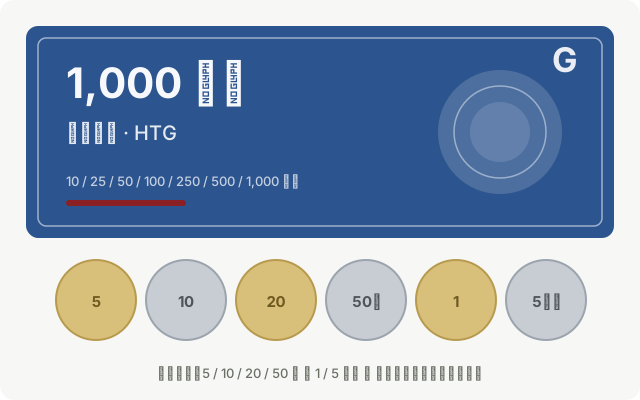
Common banknotes currently in circulation include denominations of 10, 20, 25, 50, 100, 250, 500, and 1,000 gourdes. Different editions often feature portraits of notable historical figures and landmarks on the front, and scenes of historical events, architecture, or natural scenery on the back. Coins come in denominations of 5, 10, 20, 50 centimes, as well as 1 and 5 gourdes. Due to inflation, smaller coins are seldom used in everyday transactions, with 25, 50, 100, 250, and 500 gourde notes being more common. Denominations are distinguished by color and size, with higher values typically used for rent or bulk purchases, while smaller transactions are often settled with coins or lower-denomination bills. Multiple versions of banknotes are in simultaneous circulation, and if you receive damaged or heavily worn bills, you may request replacements. Merchants and banks generally accept older notes as well.
Cash and Payment Practices
Haiti’s economy is highly cash-dependent. Markets, street vendors, taxis, and most small shops only accept cash. Public transportation and informal transactions are almost exclusively cash-based. Credit card acceptance is very limited, available only at a small number of hotels, banks, and supermarkets in the capital and tourist zones, and service can be unreliable due to security concerns and connectivity issues. Mobile payments and digital wallets are not widely used. The US dollar is commonly accepted in commercial venues and tourist areas, often alongside gourde pricing, with change typically given in gourdes. Due to the concentration of banks and ATMs in urban areas and restrictions on withdrawing cash with foreign cards, it is advisable to carry mostly US dollar cash and exchange a small amount of gourdes for minor expenses. Distribute your cash holdings to reduce risk. When bargaining in markets or small shops, cash can facilitate transactions, but always stay aware of your surroundings and keep valuables secure.
Traveler Tips
- The US dollar is widely used, but change is often given in gourdes. Carry small-denomination US dollar bills.
- Avoid openly counting large amounts of cash or wearing expensive jewelry on the street. Keep valuables separated.
- ATMs are scarce and subject to security risks. Avoid relying on them and bring enough cash in advance.
- Exchange rates for gourdes can vary significantly due to inflation and currency fluctuations. Compare rates and ask for receipts before exchanging money.
Haiti Overview
Country Details »About Haiti
Haiti (French: Haïti) is located on the western part of Hispaniola Island (also called Haiti Island) in the Greater Antilles of the Caribbean Sea. It shares a border with the Dominican Republic to the east, faces the Atlantic Ocean to the north, the Caribbean Sea to the south, and lies across the Windward Passage from Cuba and Jamaica to the west. The country covers an area of approximately 27,800 square kilometers, with its capital, Port-au-Prince, situated on the Gulf of Gonâve along the west coast. It serves as the national center for politics, economy, and culture. The official languages are French and Haitian Creole (Kreyòl Ayisyen), and the population is around 12 million.
Haiti is the earliest independent nation in Latin America and the Caribbean, as well as the world’s first republic established by a successful slave revolution, and it boasts a deep and distinctive cultural heritage. The country is divided into 10 départements (provinces) and features mountainous terrain, making it one of the most mountainous nations in the Caribbean. It holds a unique position in Caribbean culture, with far-reaching influence in music, painting, and folk beliefs.
Geography and Climate
Haiti’s landscape is predominantly mountainous, covering about three-quarters of the country. The central region includes mountain ranges such as the Chaîne de la Selle, with the highest peak being Pic la Selle in the southeast, reaching approximately 2,680 meters. Plains are mainly found along the coasts and river valleys, with the Artibonite Valley being an important agricultural area. The coastline is rugged, featuring the notable port city of Cap-Haïtien in the north and the Labadee cruise ship port, which welcomes Royal Caribbean cruises. In the northwest, Tortuga Island (Île de la Tortue) was once a haunt for Caribbean pirates, and the southwestern tip of the island includes narrow islets such as Île-à-Vache.
The climate is tropical, with hot lowlands along the coast and cooler temperatures in the mountains. The average annual temperature in Port-au-Prince is about 27°C. The year is divided into a dry season (November to March) and a rainy season (April to October), with heavy rains and flash floods common during the latter. The hurricane season lasts from June to November. As Haiti lies within the hurricane belt, it has suffered repeated severe impacts in history. Travelers should closely monitor weather forecasts and tropical storm alerts before visiting.
Historical Background
The original inhabitants of Hispaniola were the Taíno people. In 1492, Christopher Columbus arrived on the island during his first voyage, and the Spanish subsequently established colonial rule, leading to the near-extinction of the indigenous population due to enslavement and disease. The western part of the island was ceded to France under the Treaty of Ryswick in 1697, becoming known as Saint-Domingue. France developed a plantation economy based on sugarcane, coffee, and cotton, importing large numbers of enslaved Africans, which briefly made the colony one of the wealthiest regions in the world at the time.
In 1791, inspired by the French Revolution, a massive slave revolt erupted in Saint-Domingue. Led by figures such as Toussaint Louverture, the insurgents fought for over a decade, repelling Spanish, British, and French forces. On January 1, 1804, Jean-Jacques Dessalines declared independence, establishing the nation of Haiti. It became the world’s first republic founded by a black slave revolution and the first independent nation in Latin America. Haiti subsequently experienced various forms of government, including empires and republics, along with prolonged political instability. From 1915 to 1934, it was occupied by the United States. In January 2010, Haiti was struck by a devastating magnitude 7.0 earthquake, causing catastrophic loss of life and infrastructure, and the rebuilding process has been long and difficult.
Economy and Currency
Haiti is one of the least developed countries in the Western Hemisphere. Its economy relies primarily on agriculture, remittances, and small-scale light industry and garment manufacturing. Industrial infrastructure is weak, and the country depends heavily on imports for energy and food. Traditional agricultural exports include coffee, mangoes, cocoa, and sugarcane. Remittances, mainly from the United States and the Dominican Republic, make up a significant portion of GDP and serve as a crucial financial lifeline for many families. In recent years, economic and humanitarian conditions have worsened due to political instability, rising crime, and natural disasters.
The official currency is the Haitian Gourde (currency code: HTG; symbol: G), issued by the Banque de la République d’Haïti (Bank of the Republic of Haiti). One gourde is divided into 100 centimes. The US dollar is widely accepted, especially in tourist areas and commercial establishments, and is often displayed alongside prices quoted in gourdes.
Culture and Society
Haitian culture is a unique blend of African, French, and Caribbean indigenous traditions, setting it apart in the region. Haitian Creole is the most widely spoken language, while French is the official language. In terms of religion, alongside Catholicism and Protestantism, Haitian Vodou—an Afro-Caribbean spiritual belief system—has significant cultural influence. Officially recognized as a religion in 2003, Vodou has deeply influenced Haitian music, art, and dance through its drumming, rituals, and iconography.
Haiti is known for its vibrant painting, naive art, sculpture, and music. The colorful Haitian painting style holds a distinctive place in Caribbean art. In music, Kompa is the national genre—a lively rhythm that has influenced the wider Caribbean. The local diet features rice, beans, cassava, plantains, and spicy stews. Popular dishes include riz et pois (rice with bean sauce), griot (fried pork), and dried beef. Haitian society places strong value on family, church, and community mutual aid, with festive and musical atmospheres being integral parts of daily life.
Tourism Overview
Haiti offers rich historical and cultural heritage, with tourism resources centered around historic sites, beaches, and mountains. The National History Park in the north is the country’s sole UNESCO World Heritage Site. It includes the Citadelle Laferrière, the largest fortress in the Americas, perched atop a mountain, along with the ruins of the nearby Palace of Sans-Souci. Together, they reflect the post-independence founding history. Labadee on the north coast is an exclusive port of call for Royal Caribbean cruises, attracting visitors with its white sandy beaches and water activities. The capital, Port-au-Prince, retains colonial-era architecture and bustling art markets, while Jacmel on the southern coast is famed for its colorful murals and seaside charm.
It must be objectively stated that Haiti faces severe and ongoing challenges, including political instability, gang violence, kidnappings, and widespread insecurity. Many governments have issued their highest-level travel warnings for the country. Currently, the security situation in and around Port-au-Prince is particularly grave, with the capital’s airport having experienced prolonged disruptions to normal operations, making routine tourism virtually unfeasible. This page focuses on providing information about the country’s culture and geography to foster understanding. If travel is absolutely necessary, carefully follow the latest consular advisories, conduct a full safety assessment, purchase insurance with emergency evacuation coverage, and heed guidance from professional organizations throughout your trip.
Haiti Travel Guide
All Guides »Haiti Travel Quick Guide: Visas, Safety Alerts, Seasons, Budgets & Essential Travel Info
Haiti faces serious safety concerns, and many governments have issued strong tra...
Classic Haiti 7-Day Itinerary: A Deep Dive into Northern Heritage Parks and Cultural Landmarks 7 Days
If safety conditions permit, the historical parks, Labadie, and art towns along ...
Haiti 4-Day Short Trip: Cap-Haïtien and North Coast Historical & Cultural Highlights 4 days
A four-day cultural itinerary centered on Cap-Haïtien, focusing on UNESCO World ...
Essential Attractions in Haiti: World Heritage Sites, Historic Cities, and Caribbean Coast Experiences
Explore Haiti’s cultural landmarks: Citadelle Laferrière, Sans-Souci Palace, Lab...
Haitian Cuisine Guide: Creole Flavors on a Caribbean Island
Rice with bean soup, fried pork, spicy pickles, and pumpkin soup—Haitian Creole ...
Haiti Transportation Guide: Airports, Tap-Taps, Private Transfers, and Inter-Island Travel
From the two main airports in Port-au-Prince and Cap-Haïtien to the colorful Tap...