Ecuador Currency US DollarUSD
What money to use in Ecuador, how notes and coins break down, and the best ways to exchange - get the local cash sorted before you go.
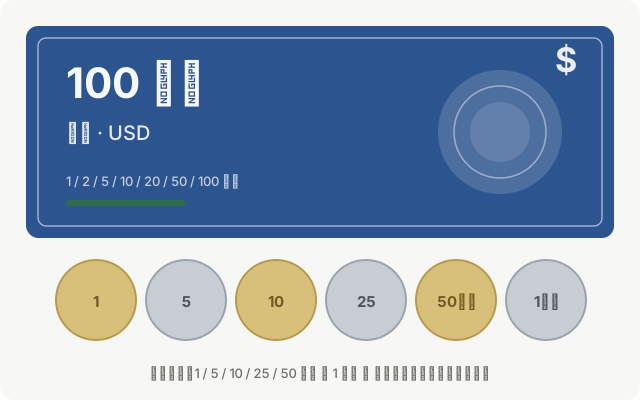
| Currency Name | US Dollar |
|---|---|
| Currency Code | USD |
| Currency Symbol | $ |
| Issuing Country | Ecuador |
| Time Zone | UTC-5 to UTC-6 (UTC−6 for the Galápagos Islands) |
| Dialling Code | +593 |
About US Dollar (USD)
Currency Overview
Ecuador is a fully dollarized country with no national currency—the US dollar (currency code USD, symbol $) is the sole legal tender and circulating banknote. In March 2000, after a severe banking crisis and hyperinflation, Ecuador permanently replaced its former currency, the sucre (named after independence hero Antonio José de Sucre), with the US dollar at a fixed exchange rate. Since then, all paper currency has been denominated in dollars, while Ecuadorian-minted 1, 5, 10, 25, and 50-cent coins are used alongside US coins. This system remains in place today. Dollarization has stabilized prices but also removed Ecuador’s ability to set independent monetary policy, with interest rates and exchange rates largely following US economic trends.
Denominations
The banknotes and coins in circulation match those of the US dollar, with common denominations including 1, 5, 10, 20, 50, and 100 dollars. Banknotes under 1 dollar are not used. The difference lies in coins: since 2000, Ecuador’s Central Bank has minted its own 1, 5, 10, 25, and 50-cent coins featuring national figures and emblems, called “centavos.” These are equivalent in value to US-minted cents and circulate alongside them.
Cash and Payment Habits
Dollarization has made prices in Ecuador relatively higher than in neighboring Latin American countries. Cash remains important for daily transactions, especially in markets, taxis, small shops, and rural areas. Major hotels, chain restaurants, malls, and supermarkets in cities like Quito and Guayaquil accept international credit cards such as Visa and Mastercard, though some may charge fees. ATMs are widely available in cities and dispense US dollars, but watch for withdrawal limits and fees. Since currency exchange is unnecessary (only dollars are used), travelers need only bring US cash. It’s advisable to carry small denominations (1 and 5 dollar bills) for easier transactions and change.
Traveler Tips
- Bringing US dollar cash is most convenient, but large bills may be hard to break in small shops—carry smaller denominations.
- Check the condition and authenticity of received dollar bills, as damaged notes may be refused.
- Credit card acceptance is mainly in cities; cash is still needed for some inland and Galápagos purchases.
- For the Galápagos, budget for park entry fees and related costs, often payable in foreign cash or by card.
Ecuador Overview
Country Details »Ecuador Overview
Ecuador (officially the Republic of Ecuador, República del Ecuador) is located in northwestern South America, bordering the Pacific Ocean to the west, Colombia to the north, and Peru to the east and south. It covers an area of approximately 284,000 square kilometers (including the Galápagos Islands), with a population of around 18 million. Its capital, Quito, lies in the Andean valley at an altitude of about 2,850 meters. The country’s name, Ecuador, means “equator” in Spanish, as the equator runs through the northern part of the country, earning it the nickname “the Land of the Equator.”
Geographically, Ecuador is divided into four distinct regions: the western coastal lowlands (Costa), the central Andean highlands (Sierra), the eastern Amazon rainforest (Oriente), and the Galápagos Islands in the Pacific Ocean (Insular). About 70% of the population is of mixed or European descent, while Indigenous peoples (mainly Quechua and others) make up around 7%, with the remainder being Afro-Ecuadorians and other groups. Spanish is the official language, and Indigenous languages such as Quechua are also spoken in mountainous and rainforest areas.
Geography and Climate
Ecuador lies on the Pacific Ring of Fire and is dotted with volcanoes. Chimborazo, at 6,268 meters, is the country’s highest peak; due to the equatorial bulge, its summit is the farthest point from Earth’s center. Cotopaxi, at around 5,897 meters, is one of the world’s highest active volcanoes. The “Avenue of the Volcanoes” in the Andes connects a series of snow-capped peaks. The eastern region is part of the upper Amazon basin, with areas like Yasuní National Park among the most biodiverse on Earth. About 1,000 kilometers off the western coast, the Galápagos Islands feature unique volcanic landscapes and many endemic species.
The climate varies greatly by altitude and region: the coastal lowlands are hot and humid, with the rainy season from December to May; the mountains have spring-like weather year-round but with large day-night temperature differences—Quito’s temperatures range around 8–20°C. The Amazon lowlands are hot, humid, and rainy year-round, while the Galápagos is relatively dry and cooler from June–November. Generally, June–September and December–January are the best times to visit, though plans should be tailored to specific regions like the mountains, rainforest, or islands.
History
The area now known as Ecuador was once home to various Indigenous groups before being incorporated into the Inca Empire in the 15th century. Spanish conquest began in 1533, and the region was ruled first from the Viceroyalty of Peru and later the Viceroyalty of New Granada for nearly 300 years. On August 10, 1809, an anti-colonial uprising in Quito marked the beginning of the independence movement. After gaining independence in 1822, Ecuador briefly joined Gran Colombia before becoming an independent republic in 1830. The country has since experienced frequent shifts between conservative and liberal governments. In 1835, British naturalist Charles Darwin visited the Galápagos Islands aboard the HMS Beagle, gathering key insights for his theory of evolution. On October 31, 1900, the national flag’s yellow, blue, and red tricolor design was officially adopted. In the 20th century, Ecuador underwent multiple political changes and economic fluctuations, including a severe banking crisis in 1999. In March 2000, it adopted full dollarization to stabilize the economy, which remains in place today.
Economy and Currency
Ecuador’s economy relies on exports of oil, bananas, shrimp, flowers, cocoa (especially premium “Arriba” cocoa), and tuna, with tourism and remittances also contributing significantly. In March 2000, following hyperinflation and a banking crisis, Ecuador abandoned its national currency, the sucre, and adopted the US dollar as legal tender, becoming a fully dollarized economy. No national banknotes are issued domestically—the US dollar is the sole circulating currency—while Ecuadorian-minted 1, 5, 10, 25, and 50-cent coins are used alongside US coins.
Culture and Society
Ecuadorian culture blends Andean Indigenous traditions, Spanish colonial heritage, and Afro-Ecuadorian and coastal Creole influences. Indigenous communities in the mountains maintain Quechua languages, traditional weaving, and vibrant market cultures, with Otavalo’s Indigenous market being especially famous. Religious festivals and Catholic traditions are deeply rooted across urban and rural areas, and Quito is densely packed with colonial churches and monasteries. The cuisine features coastal dishes like ceviche (citrus-marinated seafood) and encebollado (fish soup), as well as highland specialties such as hornado (roast pork), llapingachos (potato patties), and locro de papa (potato stew). Cuy (roast guinea pig) is a festive dish. Football is the most popular sport.
Tourism Highlights
Ecuador’s highlights are remarkably concentrated: Quito’s Old Town is one of the first UNESCO World Heritage Sites (designated in 1978), and its Equator Monument and Inti Ñan Museum let visitors stand in both hemispheres. Cuenca is another World Heritage-listed colonial city. The central “Avenue of the Volcanoes” offers views of snow-capped peaks like Cotopaxi and Chimborazo, along with cable cars, hiking, and scenic trains. The eastern Amazon region, including Yasuní and Cuyabeno, is ideal for rainforest adventures and birdwatching, with Baños serving as a gateway. The Galápagos Islands, where Darwin found inspiration for his theory of evolution, are home to about 97% of reptiles and land mammals found nowhere else, including giant tortoises, marine iguanas, blue-footed boobies, and Galápagos sea lions. Note that Ecuador’s security situation has tightened in recent years, with increased theft and robbery in some cities and coastal areas. Avoid traveling alone at night, safeguard valuables, and book trips through reputable tour operators.
Ecuador Travel Guide
All Guides »Ecuador Travel Quick Guide: Visas, Seasons, Budget, and High-Altitude Safety
Ecuador has tightened its visa policy, fully adopted the US dollar, and traveler...
Classic 8-Day Ecuador Itinerary: Quito — Avenue of the Volcanoes — Amazon — Galápagos 8 days
Colonial old towns, Andean snow-capped peaks, the Amazon rainforest, and the Gal...
Ecuador 4-Day Short Trip: Highlights of Quito and the Avenue of the Volcanoes 4 days
You can experience the best of Ecuador without going to the islands—base yoursel...
Essential Attractions in Ecuador: Colonial Cities, Volcanoes, and the Galápagos
A regional guide to Ecuador’s top attractions, from colonial towns to active vol...
Ecuador Food Guide: Ceviche, Hornado, and Andean Flavors
The citrus-marinated seafood of the coast and the roasted pork and potato dishes...
Ecuador Transportation Guide: Airports, Intercity Buses, and the Galápagos
Here's how to plan your airport transfers, intercity buses, and island travel in...