Finland Currency EuroEUR
What money to use in Finland, how notes and coins break down, and the best ways to exchange - get the local cash sorted before you go.
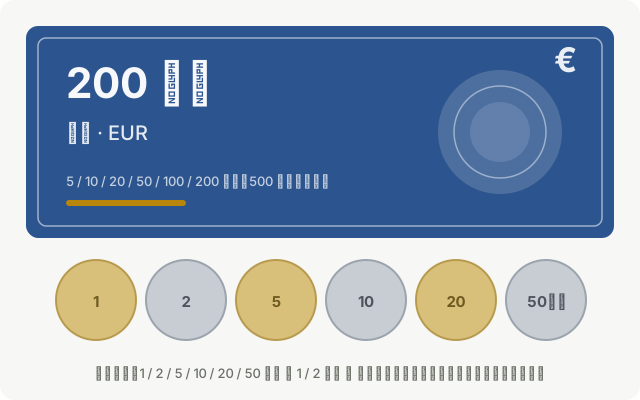
| Currency Name | Euro |
|---|---|
| Currency Code | EUR |
| Currency Symbol | € |
| Issuing Country | Finland |
| Time Zone | UTC+2 (5 hours during daylight saving time) |
| Dialling Code | +358 |
About Euro (EUR)
Currency Overview
The official currency of Finland is the euro (currency code EUR, symbol €). One euro is equal to 100 cents. The euro is issued jointly by the European Central Bank (ECB) and the central banks of the eurozone countries. Euro banknotes share a unified design, while the common map side of coins is standard across the euro area, with the national side designed individually by each member state. Finland adopted the euro in 1999 when it was launched, and euro banknotes and coins entered circulation in 2002, making it one of the first eurozone members.
Denominations
Euro banknotes come in seven denominations: 5, 10, 20, 50, 100, 200, and 500 euros. They feature architectural styles from different periods in European history, with varying colors and sizes—larger denominations have wider dimensions. Coins are issued in eight denominations: 1, 2, 5, 10, 20, and 50 cents, plus 1 and 2 euros. Coins valued at 1 and 2 cents are copper-colored, while others are gold-toned or bicolored.
A unique feature of Finnish euro coins is the national side design: smaller coins often show the lion from the Finnish coat of arms, the 1 euro coin depicts two flying swans, and the 2 euro coin features a cloudberry flower with leaves—symbols reflecting Finland’s nature and national identity.
Cash and Payment Habits
Finland is one of the most cashless societies in the world. Debit and credit cards as well as mobile payments are extremely widespread. Supermarkets, restaurants, public transport, and ticket machines generally accept contactless card payments. Mobile payment apps and bank transfers are also commonly used. Visitors can manage nearly all expenses with an international credit card enabled for overseas transactions (Visa/Mastercard), and some merchants may not accept cash at all.
It’s still wise to carry a small amount of euro cash for small shops, markets, or remote areas. Finnish ATMs, operated by the Otso network, are widely available at banks and shopping centers, making cash withdrawals convenient.
Traveler Tips
- Finland has relatively high prices. Self-catering at supermarkets is much more economical than dining out, and affordable “lunch deals” are often available during weekday lunch hours.
- Cards are accepted in most situations; it’s advisable to carry only a small amount of euro cash for emergencies.
- Tipping is not mandatory, as service charges are usually included. You may leave a tip voluntarily if you’re particularly satisfied.
- Non-EU residents can claim a VAT refund on purchases if they meet the minimum spend requirement per store and keep the receipts.
Finland Overview
Country Details »Overview of Finland
Finland (officially the Republic of Finland) is located in the Fennoscandian region of Northern Europe. It borders Russia to the east, Norway to the north, the Gulf of Bothnia and Sweden to the west, and the Gulf of Finland and Estonia to the south. Covering an area of approximately 338,000 square kilometers, it is one of the larger countries in Europe, yet has a population of just around 5.6 million, making it sparsely populated. The capital, Helsinki, is situated on the southern coast of the Gulf of Finland and serves as the country’s political, economic, and cultural center. Finland is a parliamentary republic, with the president as the head of state and the prime minister leading the government.
Finland is a flagship of Nordic welfare states, consistently ranking among the world’s leaders in education, innovation, and social governance. Its official languages are Finnish and Swedish, with about 90% of residents speaking Finnish as their mother tongue and Swedish as the main minority language. Finland regularly scores at the top in global rankings for gender equality, corruption perception, and education investment. The society is known for high levels of trust and a pragmatic approach to life.
Geography and Climate
Finland is renowned for its lakes and forests. With roughly 188,000 lakes of varying sizes, it is known as the “Land of a Thousand Lakes.” Forests cover over 70% of the country, making it one of Europe’s most forested nations. The northern region of Lapland lies within the Arctic Circle and is one of Europe’s last great wildernesses, characterized by rolling hills, wetlands, and snowy plains. The terrain is generally flat, with the highest peak located in northwestern Lapland at around 1,324 meters above sea level.
The climate is a transitional type between subarctic and temperate continental. Winters in the south are cold and summers mild, while the north experiences long, harsh winters with months of snow cover, polar nights, and the Northern Lights. Summers in the south offer long daylight hours, while the north enjoys the Midnight Sun, where the sun does not set for extended periods.
Historical Background
Finland was originally a tribal society and gradually came under Swedish control from the 12th century, influenced by Swedish culture for centuries. After the Finnish War in 1809, it became an autonomous Grand Duchy under the Russian Empire, retaining its own laws and parliament. Amid the Russian Revolution in 1917, Finland declared independence in December of that year, followed by a civil war. During World War II, Finland fought two wars against the Soviet Union, then pursued a cautious foreign policy, balancing between East and West while developing its industries and welfare system. It joined the European Union in 1995 and adopted the euro in 2002, emerging as a Nordic hub for high technology and innovation.
Economy and Currency
Finland is a highly developed industrial and knowledge-based economy. Its competitive industries include forestry and paper, machinery and shipbuilding, electronics and telecommunications, clean technology, and gaming. Global brands such as Nokia, Kone elevators, and Angry Birds originated here. Despite its small population, Finland ranks among the world’s leaders in R&D investment and education levels. As a member of the EU, Finland uses the euro (EUR, symbol €), and was among the first countries to adopt it.
Culture and Society
Sauna is the most iconic aspect of Finnish culture. There are numerous saunas across the country, and taking a sauna is a common way to socialize, relax, and connect with nature. A quintessential experience is sweating in a lakeside cabin and then jumping into an icy lake. Finns tend to be reserved, valuing peace, personal space, honesty, and rules. The country also has deep roots in design, architecture, music, and literature, with internationally beloved figures such as composer Jean Sibelius, architect Alvar Aalto, and the Moomins.
Tourism Overview
Finnish tourism balances Nordic urban experiences with polar adventures: Helsinki’s South Harbor features landmarks like the Helsinki Cathedral, Temppeliaukio Church, and design districts that blend modernity and tradition. Rovaniemi in Lapland is globally recognized as the hometown of Santa Claus, where you can cross the Arctic Circle to visit Santa’s Village. Saariselkä and Inari are famous for aurora viewing and glass igloo hotels. Winter activities include dog sledding, reindeer sleigh rides, and icebreaker cruises, while autumn showcases Lapland’s spectacular fall colors (ruska).
Finland Travel Guide
All Guides »Finland Travel Essentials: Visas, Seasons, Budget, and Sauna Etiquette
Get up to speed on Schengen visas, polar days and nights, budgeting, and sauna c...
Finland 7-Day Classic Itinerary: Helsinki — Rovaniemi — Saariselkä 7 Days
Experience the city, Santa Claus Village, and Lapland’s aurora in one trip, with...
Finland 4-Day Short Trip: Helsinki and the Ancient Town of Porvoo 4 days
Based in Helsinki, explore the design capital, a maritime fortress, and a wooden...
Essential Attractions in Finland: Helsinki, Lapland, and the Lake District
From urban churches to Santa Claus Village in the Arctic Circle and the Northern...
A Guide to Finnish Cuisine: Karelian Pie, Salmon Soup, and Reindeer Meat
Finnish cuisine is simple, hearty, and built around rye, berries, lake fish, and...
Finland Transport Guide: Loop Trains, Night Trains & City Trams
Understand the HSL, VR trains and airport loop — getting from southern cities to...