Guyana Currency Guyanese dollarGYD
What money to use in Guyana, how notes and coins break down, and the best ways to exchange - get the local cash sorted before you go.
| Currency Name | Guyanese dollar |
|---|---|
| Currency Code | GYD |
| Currency Symbol | G$ |
| Issuing Country | Guyana |
| Time Zone | UTC-4 |
| Dialling Code | +592 |
About Guyanese dollar (GYD)
Currency Overview
The official currency of Guyana is the Guyanese dollar (currency code: GYD, symbol: G$ or $), with 1 dollar equal to 100 cents. It is issued by the Bank of Guyana, the country’s central bank, established in 1965. The Guyanese dollar has been the local accounting unit since British Guiana in 1839, with the first banknotes issued in November 1965 after the bank’s establishment. It became the official national currency upon independence in 1966. In recent years, the Guyanese dollar has operated under a managed float exchange rate, generally maintaining relative stability against the US dollar. Although the currency is theoretically divided into 100 cents, coins are rarely used in daily transactions, and prices may still be marked in cents—but settlements are usually rounded to the nearest whole dollar.
Denominations
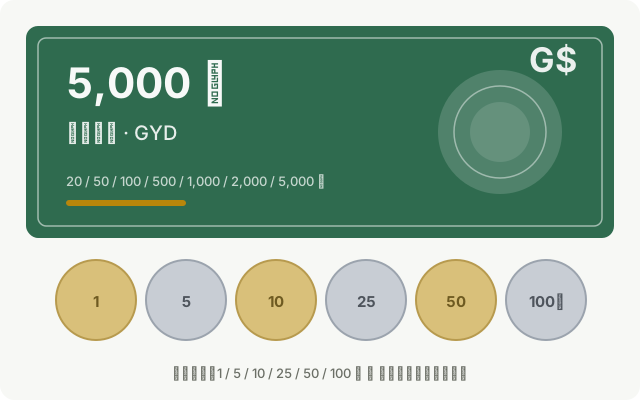
Current banknotes come in denominations of 20, 50, 100, 500, 1,000, 2,000, and 5,000 Guyanese dollars. Each note features national historical figures, symbols like Kaieteur Falls, and depictions of flora and fauna, with different colors for easy identification. Coins are mainly in 1, 5, and 10 dollar denominations, with occasional commemorative 100 dollar coins; coins are less commonly used in everyday transactions than banknotes.
Cash and Payment Habits
Guyana remains a cash-based society. Hotels, large supermarkets, chain restaurants, and some travel agencies in Georgetown accept international credit cards such as Visa and Mastercard, but outside Georgetown—especially at markets, taxis, and small inland shops—cash is almost exclusively used. The US dollar is widely used for hotels, airfare, package tours, and high-value purchases, with change usually given in Guyanese dollars. Cash can be withdrawn or exchanged at banks, authorized foreign exchange bureaus (cambios), and ATMs, though airport exchange services typically offer poor rates—visitors are advised to exchange money in the city.
Traveler Tips
- Carry sufficient cash, especially when leaving Georgetown for inland or coastal towns.
- ATM withdrawal limits are low and fees may apply; it’s better to withdraw larger amounts to reduce costs.
- Large-denomination bills may be hard to change in small shops, so keep smaller bills (20, 50, 100 dollars) handy.
- Use only banks or licensed cambios for currency exchange, and avoid street money changers.
Guyana Overview
Country Details »About Guyana
Guyana (officially the Co-operative Republic of Guyana) is located in the northeastern part of South America, bordering the Atlantic Ocean to the north, Suriname to the east, Venezuela to the west, and Brazil to the south. It covers an area of approximately 215,000 square kilometers. As the only English-speaking country in South America, it has a population of about 800,000, with its capital, Georgetown, situated at the mouth of the Demerara River and home to nearly half of the country’s population. Geographically and culturally closer to the Caribbean, Guyana is a member of the Caribbean Community (CARICOM), and the Guyanese Creole language, with a Caribbean accent, is widely spoken in daily life.
The word “Co-operative” in Guyana’s official name originates from the cooperative socialist ideals promoted when the republic was established in 1970. The country consists of coastal plains, white sand belts, inland plateaus, and southern savannahs. A highly diverse society is formed by Indo-Guyanese, Afro-Guyanese, Indigenous peoples, mixed-race individuals, as well as Chinese and Portuguese descendants.
Geography and Climate
Guyana’s terrain is roughly divided into four zones from north to south: the Atlantic coastal plain (where about 90% of the population lives, with much of the land below sea level and protected by dikes and drainage canals built during Dutch colonial times), the white sand belt, the inland plateau, and the southern Rupununi savannah. Major rivers include the Essequibo (Guyana’s longest river), the Demerara, the Berbice, and the Corentyne. Mount Roraima, a flat-topped tepui in the Pakaraima Mountains reaching about 2,810 meters, is Guyana’s highest peak. Its tabletop mountains are believed to have inspired Sir Arthur Conan Doyle’s novel The Lost World.
The climate is tropical rainforest and tropical savannah, characterized by high temperatures and humidity year-round, with average annual temperatures of 24–32°C. There are two rainy seasons annually (mid-May to mid-July and mid-November to mid-January). The inland rainforest receives abundant rainfall, while the southern Rupununi savannah is better suited for travel during the dry season (around September to March).
Historical Background
Guyana’s coastal and inland regions have been inhabited for tens of thousands of years by Indigenous peoples such as the Arawak, Carib, Makushi, and Wapishana, whose descendants still make up about 10% of the population. In the 17th century, the Dutch established three colonies—Essequibo, Demerara, and Berbice—digging dikes and canals to develop sugarcane plantations. Between 1814 and 1815, these territories were officially ceded to Britain and merged into British Guiana in 1831. After slavery was abolished in 1834, plantation owners brought indentured laborers from India, China, Portugal, and other regions. Starting in the 1840s, large numbers of South Asian immigrants arrived, profoundly shaping the current demographic makeup.
On May 26, 1966, Guyana gained independence from Britain, becoming the first former British colony on the South American mainland to do so. It became a cooperative republic in 1970. Post-independence politics were long influenced by ethnic divisions, and the economy experienced periods of stagnation. In 2015, significant offshore oil reserves were discovered in the Stabroek Block, with production starting in 2019, making Guyana one of the fastest-growing emerging economies in the world in recent years. There is an ongoing territorial dispute with Venezuela over the Essequibo region, currently under consideration by the International Court of Justice.
Economy and Currency
Traditionally, Guyana’s economy was based on sugarcane, rice, bauxite, gold, and timber. The discovery and extraction of offshore oil are rapidly transforming the nation’s fiscal situation and industrial structure, significantly raising per capita income and updating the urban landscape of Georgetown. The official currency is the Guyanese dollar (GYD, symbol G$), issued by the Bank of Guyana. The exchange rate with the US dollar has remained relatively stable. While the US dollar is not the official currency, it is widely accepted in hotels, travel agencies, and for major purchases.
Culture and Society
Guyanese society is a mosaic of diverse ethnic groups: Indo-Guyanese make up about 40%, Afro-Guyanese about 30%, with mixed-race and Indigenous peoples also comprising significant portions, along with Chinese and Portuguese communities. Religiously, Hinduism, Christianity, Islam, and indigenous beliefs coexist, with temples, mosques, and churches often found in the same neighborhoods. Cricket is the national sport, and the national team competes as part of the West Indies. The cuisine is a blend of Creole, Indian, African, and British influences, with pepperpot, cook-up rice, and roti with curry being among the most iconic dishes. Mashramani, a massive carnival held on February 23 to celebrate Republic Day, is the country’s largest festival.
Tourism Overview
The heart of Guyanese travel lies inland: Kaieteur Falls is famed for its approximately 226-meter single-drop height and abundant water flow, accessible only by small aircraft; the Iwokrama Rainforest Reserve features a 30-meter-high canopy walkway, ideal for spotting jaguars, harpy eagles, and giant otters; the southern Rupununi savannah and nearby Makushi and Wapishana Indigenous communities offer horseback riding, stargazing, and eco-lodges; Shell Beach on the Atlantic coast is a nesting site for sea turtles like the leatherback. Georgetown’s wooden colonial architecture (such as St. George’s Cathedral, Stabroek Market, and City Hall) and seaside sunsets form the backbone of city sightseeing. It’s important to note that inland travel mainly relies on small aircraft and 4x4 vehicles, which can be costly and involve relatively basic infrastructure. Some areas of Georgetown have safety concerns, so it’s advisable to arrange travel plans through licensed local tour operators.
Guyana Travel Guide
All Guides »Guyana Travel Quick Guide: Visa, Seasons, Budget & Rainforest Interior Travel Essentials
Before traveling to Guyana, it’s important to understand the visa requirements, ...
Classic 7-Day Guyana Itinerary: Georgetown – Kaieteur – Iwokrama – Rupununi 7 days
Starting from a wooden colonial old town, flying over pristine rainforests to se...
Guyana 4-Day Short Trip: Highlights of Georgetown and the Surrounding Areas 4 days
Even with limited time, you can experience Guyana by using Georgetown as your ba...
Must-visit Attractions in Guyana: From Kaieteur Falls to the Rupununi Savanna
A region-by-region guide to the best natural and cultural sites in Guyana, with ...
Guyana Food Guide: Pepperpot, Cook-Up Rice, and Curry Roti
Guyanese cuisine is a melting pot of Creole, Indian, African, and British flavor...
Guyana Travel Guide: Small Planes, Inland Tours, and Getting Around Town
Inland Guyana has almost no highways, so it’s essential to understand your optio...