Guinea-Bissau Currency West African CFA francXOF
What money to use in Guinea-Bissau, how notes and coins break down, and the best ways to exchange - get the local cash sorted before you go.
| Currency Name | West African CFA franc |
|---|---|
| Currency Code | XOF |
| Currency Symbol | CFA |
| Issuing Country | Guinea-Bissau |
| Time Zone | UTC+0 (Greenwich Mean Time) |
| Dialling Code | +245 |
About West African CFA franc (XOF)
Currency Overview
The official currency of Guinea-Bissau is the West African CFA franc (currency code XOF, symbol CFA, locally often written as FCFA), issued by the Central Bank of West African States (BCEAO) for the eight member countries of the West African Economic and Monetary Union. Since its creation in 1945, the CFA franc has been pegged first to the French franc and now to the euro, with a fixed exchange rate of 1 euro = 655.957 CFA francs. The currency is stable and freely usable across member nations such as Senegal and Côte d’Ivoire. Guinea-Bissau joined the monetary union in 1997, converting its national peso at a rate of 1 peso = 65 CFA francs.
Denominations
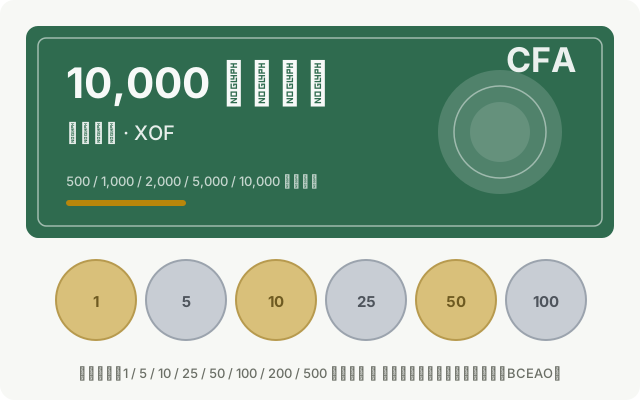
CFA franc banknotes come in denominations of 500, 1,000, 2,000, 5,000, and 10,000. Since 2018, a unified design without national portraits has been introduced across member states, featuring abstract African flora, fauna, labor scenes, and architectural elements. The issuing country is indicated by a watermark or small text on the back. Coins are available in 25, 50, 100, 200, and 500 CFA francs, with 500-franc coins and smaller denominations being most commonly used in everyday transactions.
Cash and Payment Practices
Guinea-Bissau is a predominantly cash-based society. Credit cards are accepted only in a few foreign-affiliated hotels, and ATMs are scarce, mostly found in Bissau, often run out of cash, and have unreliable withdrawal success rates. Daily expenses—such as markets, taxis, street food, and boat tickets—are all paid in cash. Travelers typically exchange euros for CFA francs at banks or authorized exchange offices; US dollars are less widely accepted. Boat fares to the islands and chartered trips can be expensive, so carry sufficient cash in advance. Mobile payment services like Orange Money are increasingly common among locals but are not practical for foreign tourists.
Traveler Tips
- Carry euros in cash as your primary currency, exchanging at banks or authorized outlets—airport rates are usually unfavorable.
- During the cashew season (April–June), cash circulation is high and change may be scarce. Bring plenty of small-denomination 500 and 1,000 CFA franc notes.
- ATM access is extremely limited; do not rely on card withdrawals. Budget for the entire trip in cash and keep emergency funds.
- CFA francs are usable across all WAEMU countries, so no currency exchange is needed when crossing into Senegal or Guinea.
Guinea-Bissau Overview
Country Details »Overview of Guinea-Bissau
Guinea-Bissau is located on the westernmost tip of Africa’s Atlantic coast, bordered by Senegal to the north, Guinea to the east and south, and the Atlantic Ocean to the west. Covering an area of about 36,100 square kilometers, it is one of the smallest countries in West Africa. The capital, Bissau, sits on the Atlantic coast at the mouth of the Geba River and is the country’s only major city and main port. Colonial-era buildings and bustling markets illustrate daily life in this West African nation.
With a population of around 2.1 million, the country is ethnically diverse, including groups such as the Balanta, Fula, and Mandinka. While Portuguese is the official language, the widely spoken Kriol (Creole) serves as the true lingua franca across the nation. The religious landscape is equally varied, with Islam, Christianity, and traditional ethnic beliefs coexisting peacefully.
Geography and Climate
Guinea-Bissau features a low-lying terrain, with gently rolling savannas and hills inland and a coastline marked by estuaries, tidal wetlands, and mangroves. Major rivers, such as the Geba and Corubal, flow southwest into the Atlantic, flanked by extensive mangrove forests along their banks—part of West Africa’s better-preserved coastal wetland systems. The nearby Bijagós Archipelago consists of 88 islands, designated a UNESCO Biosphere Reserve in 1996.
The climate is tropical and monsoonal, with distinct dry and rainy seasons. The rainy season lasts from June to October, bringing high humidity and frequent flooding of waterways and roads. The dry season from November to May brings cooler, drier Harmattan winds from the northeast, making it the ideal time to visit.
Historical Background
In medieval times, the region was influenced by the Ghana Empire and the Kaabu Kingdom, serving as a trade corridor between West Africa’s interior and coast. In the mid-15th century, Portuguese navigators arrived and gradually established trading posts, eventually creating the colony known as Portuguese Guinea. In 1956, Amílcar Cabral founded the African Party for the Independence of Guinea and Cape Verde (PAIGC), leading an armed struggle that declared independence in the guerrilla-held zones in 1973. Portugal formally recognized it in 1974 following its own revolution, making Guinea-Bissau one of the first Portuguese African colonies to gain independence.
Since independence, the country has experienced repeated political instability, including military coups and frequent changes in government, which have repeatedly disrupted national development. Since the 2000s, electoral politics have gradually resumed, though the situation remains fluid, and travelers should stay informed about local security conditions.
Economy and Currency
Guinea-Bissau is predominantly an agricultural economy, with cashews as its economic backbone. Raw cashew exports consistently rank among the world’s highest, accounting for about 90% of the country’s export revenue. The annual cashew harvest season from April to June is the most important economic period in rural areas. Rice cultivation, fishing, and forestry also play key roles in daily life, while industrial infrastructure is extremely limited. In 1997, Guinea-Bissau joined the West African Economic and Monetary Union (WAEMU), replacing its national peso with the West African CFA franc (XOF), pegged to the euro, ensuring currency stability but full dependence on the regional system.
Culture and Society
Guinea-Bissau is a prime example of Creole culture, where Portuguese and West African languages blend into Kriol, giving rise to unique music (like gombe drumming and folk guitar) and festive traditions. The Bissau Carnival, held around February each year, is one of West Africa’s most renowned street festivals, featuring colorful traditional costumes and performances that attract visitors from neighboring countries. Rural communities maintain strong clan ties and traditional spiritual practices, with rituals such as masked ceremonies, initiations, and harvest festivals varying among ethnic groups.
Tourism Overview
The Bijagós Archipelago is the heart of Guinea-Bissau’s tourism appeal. Island-hopping by boat reveals mangrove waterways, pristine beaches, and fishing villages. Orango National Park is home to rare populations of saltwater hippos, while Poilão Island serves as a key nesting site for green turtles between November and February. Salt flats and fishing communities on islands like Canhabaque showcase traditional island life. On the mainland, visitors can explore Bissau’s old town and the markets and ethnic villages around Bafatá and Gabú.
Note that tourism infrastructure is very basic, with limited roads and electricity. Malaria is highly prevalent along the West African coast, so bring mosquito repellent and anti-malarial medication. Flights and border crossings can be affected by the rainy season and operational issues, so allow flexibility in your plans.
Guinea-Bissau Travel Guide
All Guides »Guinea-Bissau Travel Quick Guide: Visa, Malaria Prevention, Seasons & Budget
Three essential pre-trip steps for this West African country: visa and yellow fe...
Guinea-Bissau 7-day itinerary: Bissau – Bolama – Bijagós Archipelago island hopping 7 days
Using Bissau as a base, spend a week exploring the 88-island Bijagós Archipelago...
Guinea-Bissau 4-Day Short Trip: Bissau and the Outskirts, Cashews and Mangroves 4 days
Even with just three or four days, you won’t regret it: cover Bissau’s old town,...
Essential Attractions in Guinea-Bissau: The Bissagos Archipelago and the Estuary Capital
The Bijagós Biosphere Reserve is the absolute highlight, complemented by the his...
Guinea-Bissau Food Guide: Cashews, Grilled Fish, and Peanut Stew
The dining table in the Land of Cashews is simple yet hearty: seafood, peanut sa...
Guinea-Bissau Travel Guide: Getting to Bissau, Island Ferries, and Local Transport
This West African country with no direct flights from many regions and cash-only...