Bahamas Currency Bahamian DollarBSD
What money to use in Bahamas, how notes and coins break down, and the best ways to exchange - get the local cash sorted before you go.
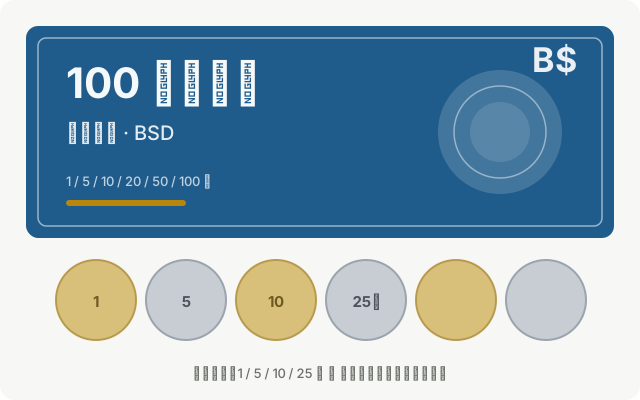
| Currency Name | Bahamian Dollar |
|---|---|
| Currency Code | BSD |
| Currency Symbol | B$ |
| Issuing Country | Bahamas |
| Time Zone | UTC-5 to UTC-4 (UTC−4 during daylight saving time) |
| Dialling Code | +1-242 |
About Bahamian Dollar (BSD)
Currency Overview
The official currency of The Bahamas is the Bahamian Dollar (currency code BSD, symbol B$), issued by the Central Bank of The Bahamas. Since its introduction, it has maintained a fixed 1:1 exchange rate with the U.S. Dollar, and Bahamian law allows both currencies to circulate interchangeably. Travelers can use either Bahamian Dollar cash or U.S. Dollars, both of which are widely accepted in shops, restaurants, and taxis. Due to strict currency issuance backed by U.S. Dollar reserves, the Bahamian Dollar has remained stable for decades, making it one of the most reliable and trusted currencies in the Caribbean. Travelers need not worry about exchange rate fluctuations or depreciation.
Denominations
Paper bills come in denominations of 1/2, 1, 3, 5, 10, 20, 50, and 100 Bahamian Dollars, with the 3-dollar note being a unique feature of The Bahamas. Current banknotes feature designs based on Bahamian historical figures, conch shells, flamingos, and marine life. Coins include 1, 5, 10, 15, 25 cents, and 1 Dollar, often featuring motifs like conch shells, pineapples, starfish, and sailboats. As the Bahamian Dollar is pegged 1:1 with the U.S. Dollar, U.S. coins are also commonly accepted, and it’s normal to receive a mix of both currencies in change.
Cash and Payment Practices
Hotels, restaurants, and shops in Nassau and Paradise Island generally accept Visa, Mastercard, and mobile payments. ATMs are widespread in urban areas and at docks, allowing withdrawals in Bahamian Dollars or U.S. Dollars using foreign cards. On the Out Islands (such as Exuma, Harbour Island, and Andros), cash is more commonly used. Boat tours, small vendors, and taxis often prefer cash in U.S. Dollars or Bahamian Dollars. Due to the fixed exchange rate, there is virtually no currency conversion loss, so many travelers choose to bring U.S. Dollars directly without exchanging.
Traveler Tips
- No need to exchange for Bahamian Dollars—using U.S. Dollars is most convenient. Change may be given in Bahamian Dollars, so spend or exchange it before leaving.
- Nassau taxis do not use meters. Always agree on a fare in U.S. Dollars before getting in, with typical fares around 5–15 USD in the city.
- Restaurant tipping is usually 15%. Some resorts include service charges—check your bill before paying.
- On cruise ship days, Nassau gets crowded. Visit popular restaurants and customs checkpoints during off-peak times.
Bahamas Overview
Country Details »About The Bahamas
The Bahamas (officially the Commonwealth of The Bahamas) is an island nation located to the southeast of the Florida Peninsula and west of the Atlantic Ocean. It consists of around 700 islands and over 2,400 coral cays, stretching southeast from the coast of Florida to north of Haiti. The total land area is approximately 13,900 square kilometers, with vast surrounding waters. Only about 30 islands are permanently inhabited, and the population is around 410,000, with over 70% concentrated in Nassau, the capital on New Providence Island. The Bahamas is one of the higher-income countries in the Caribbean region, with tourism and offshore finance as the two main pillars of its economy.
As a member of the Commonwealth, The Bahamas is a parliamentary democracy with English as its official language. Thanks to its proximity to the United States and stable social environment, it has long been one of the most popular destinations for North American tourists and cruise lines.
Geography and Climate
The Bahama Islands are situated on the Bahama Banks, a shallow carbonate platform. The waters display stunning gradients of blue-green due to the shallow seabed, coral, and sunlight, making it one of the most beautiful marine environments in the world. The terrain is generally flat, with the highest point at only about 63 meters. The land is mostly limestone, and the islands are home to the world’s highest concentration of blue holes—the Dean’s Blue Hole on Andros and Long Island is a mecca for freedivers.
The climate is tropical maritime, influenced by the warm Gulf Stream. Winters are mild and summers are humid and warm, with an average annual temperature of about 24–27°C. The dry season from December to April features calm seas and is the best time to visit; the hurricane season from June to November calls for flexible travel plans and attention to weather warnings. Inter-island travel relies on small planes and ferries, making island-hopping a classic way to explore.
Historical Background
In 1492, Christopher Columbus made his first landfall in the Americas on San Salvador Island in The Bahamas, marking the start of the islands' recorded history. The indigenous Lucayan people, a branch of the Arawak, thrived here for millennia but were nearly wiped out due to disease and enslavement during the early colonial period. By the late 17th and early 18th centuries, The Bahamas became a haven for Caribbean pirates, with Nassau serving as a notorious pirate port. After 1783, British control was established, and during the American Revolutionary War, Loyalists with plantation expertise settled here, shaping the present-day predominantly African-descended population and culture. The Bahamas gained independence from Britain on July 10, 1973, and subsequently achieved economic growth driven by tourism and finance.
Economy and Currency
Tourism contributes about half of The Bahamas’ GDP, attracting millions of visitors annually, most from the U.S. and Caribbean cruise lines. Nassau Harbor is consistently one of the busiest cruise ports in the world. Offshore finance and ship registry are the second-largest industries, with thousands of international companies registered in The Bahamas. The official currency is the Bahamian Dollar (BSD), which has a fixed 1:1 exchange rate with the U.S. Dollar and circulates interchangeably. U.S. Dollars are widely accepted, making transactions very convenient for travelers.
Culture and Society
Bahamian culture is rooted in African traditions, blended with British colonial heritage and American pop culture. The Junkanoo festival, with its lively music and colorful parades, is a major national event held in the early hours of Boxing Day and New Year’s Day in Nassau. Conch is both a staple food and a national symbol featured on the flag. Sports like cricket (similar to rugby-style), rowing, and baseball are popular. The pace of life is relaxed, people are friendly, and most shops close on Sundays as residents attend church—typical of a laid-back British-style island lifestyle.
Tourism Overview
The Bahamas is one of the world’s top island destinations: the Atlantis Resort on Paradise Island and Nassau combines a water park, aquarium, and casino, making it a top choice for family holidays. Pig Beach in the Exumas, famous for its swimming pigs, along with sandbar walks and iguana spotting, is among the most popular day-trip routes. Harbour Island boasts 5 kilometers of pink-sand beaches. Andros is known for its blue holes and the third-largest barrier reef in the Western Hemisphere, attracting divers. Bimini is famed as Hemingway’s fishing paradise. Note that the cost of living in The Bahamas is among the highest in the Caribbean, with dining and transport prices notably higher than in Mexico or the Dominican Republic, so allow extra budget for independent travel. Cruise shore excursions are the easiest and most economical way to explore.
Bahamas Travel Guide
All Guides »Bahamas Travel Quick Guide: Visas, Seasons, Budgets & Etiquette
US dollars are widely accepted, yet the cost of living ranks among the highest i...
Classic 6-Day Bahamas Itinerary: Nassau — Paradise Island — Pig Island — Pink Sands Beach 6 days
Experience four iconic Bahamian highlights in one trip: historic Nassau, Atlanti...
Bahamas 4-Day Short Trip: Nassau + Paradise Island Island-Hopping Tour 4 days
You can still have a great time just exploring the Nassau area: divide your trip...
A must-visit attractions list for the Bahamas: Pig Beach, Pink Sands Beach, and Blue Holes
The beauty of the Bahamas is spread across 700 islands. This list helps you pinp...
Bahamas Food Guide: Long Live Conch and Authentic Fish Fry
Conch is the soul of Bahamian cuisine—whether served raw, fried, or in soup, thi...
Complete Guide to Transportation in the Bahamas: Island-Hopping Flights, Ferries & Getting Around
There are no trains or subways in the Bahamas—get around by small planes, ferrie...