Brazil Currency Brazilian RealBRL
What money to use in Brazil, how notes and coins break down, and the best ways to exchange - get the local cash sorted before you go.
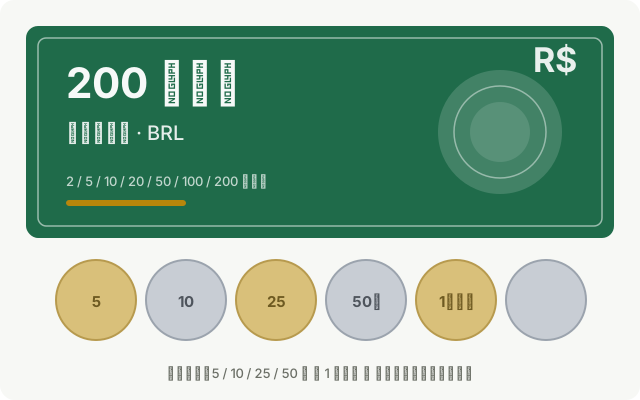
| Currency Name | Brazilian Real |
|---|---|
| Currency Code | BRL |
| Currency Symbol | R$ |
| Issuing Country | Brazil |
| Time Zone | UTC-3 |
| Dialling Code | +55 |
About Brazilian Real (BRL)
Currency Overview
The official currency of Brazil is the real (currency code: BRL, symbol: R$), issued by the Central Bank of Brazil. It was introduced in July 1994 under the Real Plan and successfully curbed the country’s prior hyperinflation. The real uses a decimal system, with one real equal to 100 centavos (plural: reais). It is a freely floating currency, and its exchange rate with other currencies can be volatile — always check the latest rates before departure.
Denominations
There are seven banknote denominations in circulation: 2, 5, 10, 20, 50, 100, and 200 reais. A distinctive feature of Brazilian banknotes is that the front features portraits of notable Brazilian women, while the back showcases representative animals of Brazil: the 2-real note features a loggerhead turtle, the 5-real a heron, the 10-real a blue-and-yellow macaw, the 20-real a golden lion tamarin, the 50-real a jaguar, the 100-real a grouper, and the 200-real a maned wolf. Coins come in five denominations: 5, 10, 25, and 50 centavos, plus 1 real, and are commonly used in small transactions.
Cash and Payment Habits
Brazil is one of the fastest-growing countries in electronic payments globally. The central bank’s Pix instant payment system is accepted almost everywhere — from supermarkets to street vendors — and locals rarely carry large amounts of cash. For foreign travelers, credit cards with international logos (such as Visa and Mastercard) are widely accepted in hotels, restaurants, and malls in larger cities. However, beach vendors, markets, small eateries, and taxis often deal only in cash or Pix, so it’s advisable to carry some cash in denominations of 20–100 reais. Bank ATMs may close at night in certain areas, so it’s best to withdraw cash inside malls or bank branches.
Traveler Tips
- When exchanging money, use airport exchange counters, banks, or licensed exchange services (câmbio). Avoid informal street money changers due to non-transparent rates.
- Restaurant bills usually include a 10% service charge — additional tipping is not required.
- Avoid displaying large amounts of cash in high-crime areas, and store cash and cards separately after shopping.
- It can be difficult to use leftover reais before departure, as exchange options abroad may be limited. It’s best to spend them in Brazil.
Brazil Overview
Country Details »Brazil Overview
Brazil (officially the Federative Republic of Brazil) is located in eastern South America, bordering the Atlantic Ocean to the east. It is the largest and most populous country in South America, covering approximately 8.516 million square kilometers — the fifth-largest in the world. It shares borders with every South American country except Chile and Ecuador. With a population of about 216 million, it is the largest Portuguese-speaking country globally. Its capital, Brasília, is a modern planned city built in 1960 to promote inland development and is a UNESCO World Heritage Site; São Paulo is the largest city, while Rio de Janeiro is its most iconic tourist destination.
Brazil is a federal presidential republic, consisting of 26 states and one federal district. It is a member of both BRICS and the G20, and boasts the strongest overall national power in Latin America.
Geography and Climate
Brazil’s terrain is dominated by the Brazilian Highlands and the Amazon Basin: the northern Amazon Basin is home to the world’s largest tropical rainforest, and the Amazon River has the greatest water discharge of any river on Earth; the central region is covered by the vast Brazilian Highlands; the southwestern Pantanal is the world’s largest tropical wetland; the southern border features the mighty Iguazu Falls on the Argentina border; and the eastern coastline stretches around 7,400 kilometers along the Atlantic Ocean.
The climate varies greatly due to latitude and topography: the equatorial north is hot and rainy year-round; the northeastern interior is semi-arid with scarce rainfall; the central region has a tropical savanna climate with distinct wet and dry seasons; the south has a subtropical climate where frost and even snow can occur in winter. Seasons are opposite to those in the Northern Hemisphere — Brazil’s summer runs from December to March, and winter from June to August.
Historical Background
Brazil was originally home to numerous Indigenous tribes. In 1500, Portuguese navigator Pedro Álvares Cabral arrived, and Portugal subsequently established a colony. The colony went through sugar booms in Pernambuco and Bahia, a gold rush in Minas Gerais during the 18th century, and long relied on African slave labor, forming a deep Afro-Brazilian cultural foundation. In 1808, when Napoleon invaded Portugal, the Portuguese royal family moved to Rio de Janeiro, making Brazil the de facto center of the Portuguese Empire — a unique event in colonial American history.
In 1822, Dom Pedro I declared Brazil’s independence and established an empire; slavery was abolished in 1888, and the monarchy was overthrown in 1889 to form a federal republic. Since the late 19th century, large numbers of Italian, German, and Japanese immigrants have arrived, contributing to the multicultural character of cities like São Paulo. The capital was moved to Brasília in 1960. From 1964 to 1985, the country experienced a military dictatorship, after which it returned to democratic governance. Since then, the economy and society have continued to develop, and today Brazil is a major emerging global economy.
Economy and Currency
Brazil is the largest economy in Latin America and a globally significant agricultural and resource powerhouse. It ranks among the top producers worldwide in soybeans, coffee, sugarcane, beef, and orange juice. It also holds substantial reserves of iron ore and petroleum (especially pre-salt oil fields), and its aerospace manufacturing (Embraer) leads the world in regional jets. The official currency is the real (BRL). The 1994 “Real Plan” introduced the real and ended years of hyperinflation, making it one of the most influential currencies in Latin America. In recent years, the Instant Payment system (Pix) has become deeply integrated into daily life.
Culture and Society
Brazilian culture is a fusion of Portuguese, African, Indigenous, and Eurasian immigrant traditions. Rio’s Carnival and samba school parades are among the largest festivals in the world; bossa nova music spread globally from Ipanema Beach; and Salvador, capital of Bahia, retains the richest Afro-Brazilian culture, where capoeira, Candomblé, and afoxé music blend. Football is a national passion — Brazil has won the FIFA World Cup five times, and the Maracanã Stadium is a hallowed site. Barbecue (churrasco), black bean stew (feijoada), and the caipirinha cocktail are staples of the national cuisine.
Tourism Overview
Brazil offers an incredibly diverse range of attractions: Rio’s Christ the Redeemer statue on Corcovado Mountain and the Sugarloaf Mountain cable car are iconic landmarks, and Copacabana Beach stretches for several kilometers; Iguazu Falls span three countries, with its stunning horseshoe-shaped curtain of 275 individual falls; Manaus serves as the gateway to the Amazon Rainforest, and the meeting of the dark waters of the Rio Negro and the lighter Solimões River creates a striking natural phenomenon; Salvador’s Pelourinho historic district showcases colonial and African heritage. Note that major cities have safety concerns — travelers should remain discreet and safeguard valuables.
Brazil Travel Guide
All Guides »Brazil Travel Quick Guide: Visa, Best Time to Visit, Budget Tips & Safety Notes
Get your e-visa sorted before departure, visit during the dry season, plan your ...
Classic 7-Day Brazil Itinerary: Rio de Janeiro – Iguazu Falls – Salvador 7 Days
This route connects iconic mountain and coastal landmarks, the world’s largest w...
Brazil 4-Day Short Trip: In-Depth Exploration of Rio de Janeiro 4 days
Even with just 4 days in Rio, you can see it all: break up visits to Christ the ...
Top Attractions in Brazil: Christ the Redeemer, Iguazu Falls, and the Amazon Rainforest
A curated list of 15 must-visit attractions in Brazil by region, with highlights...
Brazil Food Guide: A Complete Introduction to Feijoada, Churrasco, and Street Eats
From the national dish feijoada to Sunday barbecue buffets, plus street treats l...
Complete Guide to Transportation in Brazil: Domestic Flights, Airport Transfers, and Getting Around Cities
Brazil is huge, and flights are essential. Learn how to use the three major airl...