South Africa Currency South African RandZAR
What money to use in South Africa, how notes and coins break down, and the best ways to exchange - get the local cash sorted before you go.
| Currency Name | South African Rand |
|---|---|
| Currency Code | ZAR |
| Currency Symbol | R |
| Issuing Country | South Africa |
| Time Zone | UTC+2 |
| Dialling Code | +27 |
About South African Rand (ZAR)
Currency Overview
The official currency of South Africa is the South African Rand (currency code ZAR, symbol R), issued by the South African Reserve Bank. One rand equals 100 cents (cent). The term "Rand" originates from the Witwatersrand (meaning "white waters ridge"), a hill range near Johannesburg where gold was discovered in the late 19th century, laying the foundation for South Africa’s economy. The rand replaced the South African pound when the Republic of South Africa was established in 1961.
Denominations
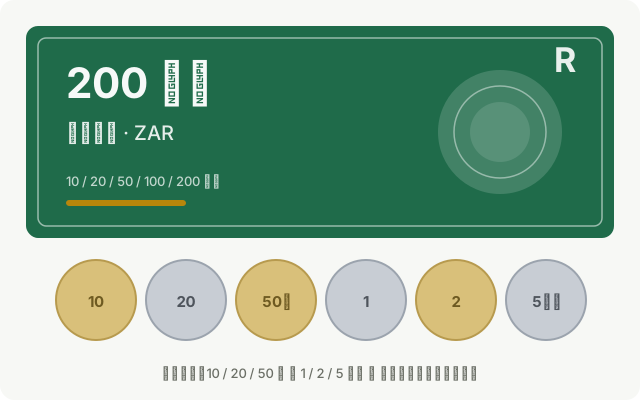
Current banknotes come in denominations of 10, 20, 50, 100, and 200 rand, all featuring a portrait of Nelson Mandela on the front and the "Big Five" animals—rhino, elephant, lion, buffalo, and leopard—on the back. This design has earned the rand the nickname "wildlife currency" among travelers. Coins are issued in 10, 20, and 50 cents, as well as 1, 2, and 5 rand. Older 5-cent coins are no longer minted but remain legal tender. Coin designs typically feature the South African coat of arms or botanical motifs on the front, with the denomination on the back.
Cash and Payment Habits
Credit and electronic payments are widely accepted in South Africa. Major malls, restaurants, hotels, gas stations, and chain supermarkets commonly take international Visa and Mastercard credit and debit cards, with many also supporting contactless and mobile payments. However, cash is still king at street markets, roadside stalls, small eateries, taxis, and parking attendants—carry a small amount of rand for these situations.
ATMs at major banks (like Standard Bank, FNB, Absa, and Nedbank) and airports accept foreign cards, but each transaction incurs a fee and may involve double currency conversion. Withdraw larger amounts when possible to minimize fees. Currency can be exchanged at airports, banks, or authorized exchange bureaus; rates are usually better in city centers than at airports, but prioritize security and legitimacy.
Traveler Tips
- Tipping is customary in South Africa—typically 10%–15% in restaurants, and 10–20 rand for porters, drivers, and guides.
- Avoid carrying large amounts of cash, especially in urban areas with higher crime risks. Distribute money wisely.
- Some merchants may struggle to provide change for 200-rand notes; carry smaller denominations like 50 and 100 rand.
- Rand exchange rates fluctuate significantly—check real-time rates before traveling and budget accordingly.
South Africa Overview
Country Details »Overview of South Africa
South Africa (officially the Republic of South Africa) is located at the southernmost tip of the African continent, bordered by the Indian and Atlantic Oceans to the east, south, and west. It shares land borders with Namibia, Botswana, Zimbabwe, Mozambique, and Eswatini (formerly Swaziland), and completely surrounds the landlocked country of Lesotho. Covering an area of approximately 1.219 million square kilometers with a population of around 62 million, it is one of Africa’s most economically developed and industrialized nations. The country has three capitals: executive capital Pretoria (Tshwane), legislative capital Cape Town, and judicial capital Bloemfontein. This unique arrangement stems from a political compromise during the formation of the Union of South Africa in 1910.
South Africa recognizes 11 official languages, including Zulu, Xhosa, Afrikaans, and English, making it one of the countries with the most official languages in the world. It is often called the "Rainbow Nation," reflecting its diverse ethnicities and cultures. The country operates as a presidential republic, with its executive, legislative, and judicial branches located in three different cities—a distinctive feature of its political system.
Geography and Climate
South Africa’s terrain is dominated by the central interior plateau (Highveld), which sits mostly above 1,200 meters and slopes down to coastal plains. The Drakensberg Mountains in the east form a natural barrier, with peaks exceeding 3,400 meters, while the west features the Namib Desert and the semi-arid Karoo Plateau. The southern tip, marked by Table Mountain on the Cape Peninsula, includes the Cape of Good Hope and is known for its dramatic meeting of two oceans and rugged landscapes.
Climatically, South Africa is in the Southern Hemisphere, so its seasons are opposite to those in the Northern Hemisphere. Cape Town has a Mediterranean climate—dry and hot summers (November to March) and mild, rainy winters (June to August). Inland highland cities like Johannesburg enjoy mild temperatures and abundant sunshine year-round. The east coast around Durban has a subtropical humid climate, while the northwest is arid. Generally, spring (September–November) and autumn (March–May) are the most pleasant and popular travel periods.
Historical Background
The earliest inhabitants of South Africa were the San and Khoikhoi peoples. In 1652, the Dutch East India Company established a supply station at Cape Town, leading to gradual European (Boer) expansion inland. The British took control of the Cape Colony in the 19th century, prompting the Great Trek (1830s) when the Boers moved north to establish their own republics. The discovery of diamonds (1867) and gold (1886) triggered two Boer Wars between the British and the Boers. In 1910, several colonies united to form the Union of South Africa.
In 1948, the National Party implemented apartheid—a system of institutionalized racial segregation. Events like the Sharpeville Massacre (1960) and the Soweto Uprising (1976) drew international sanctions. Nelson Mandela was released in 1990, the African National Congress (ANC) was legalized, and the first democratic elections were held in 1994, leading to Mandela’s presidency. South Africa transitioned to democracy and established the Truth and Reconciliation Commission to address its past.
Economy and Currency
South Africa is Africa’s most industrialized economy, with key sectors including mining (gold, platinum group metals, diamonds, coal), automotive manufacturing, finance, and agriculture. The Johannesburg Stock Exchange is the largest in Africa. The official currency is the South African Rand (ZAR, symbol R), issued by the South African Reserve Bank, with 1 rand equal to 100 cents. The rand is also widely used or serves as a reference currency in the "Common Monetary Area" countries—Lesotho, Eswatini, and Namibia.
In recent years, challenges such as electricity shortages (load shedding) and high unemployment have pressured economic growth, but South Africa remains one of the continent’s most robust markets, with relatively advanced financial services, telecommunications, and retail sectors.
Culture and Society
South African culture blends indigenous African traditions, European influences, and Asian (particularly Indian) heritage. Ethnic groups like the Zulu and Xhosa maintain rich musical, dance, and craft traditions. The Indian community has introduced curries and spices to Durban, while Cape Town’s Malay community has contributed the unique Cape Malay cuisine. Braai (barbecue) is a national social tradition, and iconic foods include bobotie (spiced meat casserole), biltong (dried meat), pap (maize porridge), boerewors (farmers’ sausage), and South African wines.
In sports, rugby (with the national team, the Springboks), soccer, and cricket are hugely popular. South Africa hosted the FIFA World Cup in 2010—the first African nation to do so. Musically, the country has exported jazz, kwaito, and the globally trending amapiano rhythm.
Tourism Overview
South Africa offers diverse attractions: Cape Town is famous for Table Mountain, the Cape of Good Hope, Robben Island, and Boulders Beach’s penguins; Johannesburg provides insight into apartheid history and modern Soweto culture; Kruger National Park is one of Africa’s premier wildlife reserves, home to the “Big Five” (lion, leopard, elephant, rhino, buffalo); the Garden Route links scenic coastal towns like Knysna and Plettenberg Bay; Hermanus is ideal for close-up whale watching (June–November); and Stellenbosch and Franschhoek are top destinations for wine enthusiasts.
Travelers should note that safety varies across cities. Stay in reputable accommodations, use official transport, avoid walking alone at night, and keep valuables discreet. When visiting townships, go with a certified guide. With proper preparation and awareness, South Africa delivers world-class natural and cultural experiences.
South Africa Travel Guide
All Guides »South Africa Travel Quick Guide: Visa Requirements, Best Seasons, Budget Tips & Safety Etiquette
Clarify visa, season, budget, and safety details before departure to avoid commo...
Classic 7-Day South Africa Itinerary: Cape Town, Cape of Good Hope, Wineries & Garden Route 7 days
Starting in Cape Town, this itinerary connects the Cape Peninsula, wine regions,...
South Africa 4-Day Short Trip: Johannesburg, Soweto, and Pilanesberg Game Reserve 4 days
Pack modern cities, apartheid history, and wildlife into four days with this foc...
Essential Attractions in South Africa: From Table Mountain to the Big Five in Kruger
A regional breakdown of South Africa’s top sights, with highlights and recommend...
A Guide to South African Cuisine: Braai BBQ, Bobotie & Cape Malay Dishes
From grilled meats to Cape Malay flavors, South Africa’s dining table is a flavo...
South Africa Transport Guide: Airports, Gautrain, Self-Drive & Ride-Hailing
Master airport transfers, urban transit, ride-hailing, and left-hand driving, an...