Bhutan Currency Bhutanese ngultrumBTN
What money to use in Bhutan, how notes and coins break down, and the best ways to exchange - get the local cash sorted before you go.
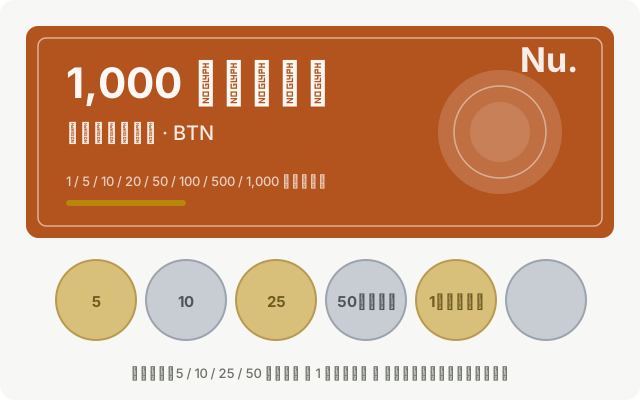
| Currency Name | Bhutanese ngultrum |
|---|---|
| Currency Code | BTN |
| Currency Symbol | Nu. |
| Issuing Country | Bhutan |
| Time Zone | UTC+6 |
| Dialling Code | +975 |
About Bhutanese ngultrum (BTN)
Currency Overview
The official currency of Bhutan is the Bhutanese ngultrum (currency code BTN, symbol Nu.), with 1 ngultrum divided into 100 chetrum. Issued by the Royal Monetary Authority of Bhutan, the ngultrum has been pegged at a fixed 1:1 exchange rate with the Indian rupee since its introduction in 1974, and the two currencies are interchangeable within Bhutan.
Denominations
Circulating banknotes include denominations of 1, 5, 10, 20, 50, 100, 500, and 1,000 ngultrum, often featuring portraits of past kings, dzongs, and religious motifs. The 100, 500, and 1,000 ngultrum notes are the most commonly used in daily transactions. Coins come in 5, 10, 20, 25, 50 chetrum, and 1 ngultrum denominations, though chetrum coins are rarely used for small change.
Cash and Payment Practices
Credit cards and mobile payments are mainly accepted in urban hotels, malls, and some restaurants, while smaller shops, markets, rural eateries, and villages typically operate on a cash-only basis. ATMs are available in towns like Thimphu and Paro, supporting withdrawals with some international cards, though availability is limited. Travelers are advised to carry sufficient U.S. dollars before arrival.
Since travel packages (including the SDF, accommodation, and guides) are usually billed in dollars, most costs are prepaid through the agency. Upon arrival, only a small amount of ngultrum is needed for meals, souvenirs, tips, and minor transport. Currency can be exchanged at banks and authorized exchange counters, with both dollars and Indian rupees accepted.
Traveler Tips
- The ngultrum and Indian rupee are pegged 1:1, and Indian rupees can be used directly in Bhutan.
- Exchanging leftover ngultrum back to dollars may be restricted; convert only what you need in small amounts.
- Travel packages are typically priced and paid in dollars; confirm the included services with your agency in advance.
- Tipping is not mandatory but appreciated; small gratuities for guides, drivers, and hotel staff align with local customs.
Bhutan Overview
Country Details »About Bhutan
Bhutan (officially the Kingdom of Bhutan) is a landlocked mountainous country in the southern Himalayas, bordered by China’s Tibet Autonomous Region to the north and India to the south, east, and west. Covering an area of about 38,000 square kilometers, its capital, Thimphu, is located in a western valley and serves as the nation’s political and administrative center. The country is divided into 20 dzongkhags (districts), with Dzongkha as the official language and Vajrayana Buddhism (Drukpa Kagyu sect) as the state religion.
Bhutan is the only South Asian country that uses Gross National Happiness (GNH) as a guiding principle for governance, emphasizing a balance between economic development, ecological conservation, cultural preservation, and spiritual well-being. Over 70% of the country is forested, and its constitution mandates that forest cover never fall below 60%, making it one of the world’s few carbon-negative nations.
Geography and Climate
Bhutan’s terrain slopes from high in the north to low in the south. The northern region consists of perpetually snow-covered Himalayan peaks, while the central valleys (such as Paro, Thimphu, Punakha, and Trongsa) host most towns and farmland. The southern part features subtropical lowland forests. The country’s highest peak, Gangkhar Puensum (7,570 meters), is believed to be the world’s highest unclimbed mountain, and the central highlands are dotted with numerous trekking routes above 4,000 meters.
Climate varies significantly with altitude: the southern lowlands are hot and humid with a subtropical climate; the central valleys have mild, distinct seasons; and the northern mountains are cold year-round. The monsoon season, from June to September, brings heavy rain and fog, which can disrupt trekking and flights. Spring (March–May), when rhododendrons bloom, and autumn (September–November), with clear skies and visible peaks, are the most ideal travel seasons.
History
Bhutan’s history is deeply intertwined with Tibetan Buddhism. In the 17th century, Tibetan monk Zhabdrung Ngawang Namgyal unified the region, establishing a dual system of governance blending religion and politics, and built numerous dzongs (fortresses) that served both administrative and defensive purposes. In the late 19th century, Bhutan experienced civil strife before transitioning to a hereditary monarchy. In 1907, Ugyen Wangchuck was enthroned as the first king, initiating the Wangchuck dynasty, which continues to this day.
In 1949, Bhutan signed the Treaty of Perpetual Peace and Friendship with India, which influenced its foreign relations and defense for decades. The treaty was revised in 2007 to grant Bhutan greater autonomy. Bhutan joined the United Nations in 1971. In 2008, under the leadership of the fourth king, Jigme Singye Wangchuck, Bhutan adopted a constitution establishing a constitutional monarchy, and Jigme Khesar Namgyel Wangchuck was crowned king that same year.
Economy and Currency
Bhutan’s economy relies on hydropower, agriculture, tourism, and forestry. Its abundant water resources make hydropower the primary export and revenue source, with most electricity exported to India. Agriculture focuses on rice, maize, buckwheat, chili peppers, and dairy products, along with niche crops like apples. Tourism is positioned as a high-value, low-impact industry, contributing significantly to the national economy.
The official currency is the Bhutanese ngultrum (BTN), pegged at a fixed 1:1 exchange rate with the Indian rupee, which is also widely circulated and accepted in Bhutan. While travel packages are often priced in U.S. dollars, most payments for permits and services are made in dollars, with smaller transactions conducted in ngultrum.
Culture and Society
Bhutanese culture centers on Vajrayana Buddhism, with monasteries, dzongs, and festivals (Tshechu) forming the core of social life. Monks hold revered status, and masked dances (Cham) performed during religious festivals are believed to ward off evil and bring blessings. Traditional dress is a key aspect of national identity: men wear the gho (a knee-length robe), and women wear the kira (an ankle-length dress), both required in government offices and formal settings. Concepts like Gross National Happiness, universal healthcare, and free education reflect Bhutan’s unique governance approach.
The cuisine is known for its spiciness, with chili peppers treated as vegetables rather than mere seasonings. Ema datshi (chili and cheese) is the national dish, while staples include red rice, buckwheat, and maize. Archery (dha) is the national sport, with makeshift ranges found in nearly every village.
Tourism Overview
Bhutan follows a high-value, low-volume tourism policy. Foreign visitors must book their trips through licensed Bhutanese agencies, typically travel as part of a group with a certified guide, and pay a daily Sustainable Development Fee (SDF; as of 2023, usually $100 per person per night, with discounted rates for some nationalities). This policy limits visitor numbers while ensuring a peaceful, high-quality experience.
Top destinations include Paro’s Tiger’s Nest Monastery (Taktsang) and Paro Dzong, Thimphu’s Buddha Dordenma statue and National Memorial Chorten, Punakha’s Punakha Dzong and Dochula Pass, ancient dzongs in Trongsa and Bumthang, and Gangtey’s Phobjikha Valley (a winter habitat for black-necked cranes). The country also offers renowned trekking routes like the Druk Path and Jomolhari Treks.
Bhutan Travel Guide
All Guides »Bhutan Travel Snapshot: Group Tour Policy, SDF, Seasons, Budget & Etiquette
Bhutan is not a country you can visit on a whim. Before you go, understand the g...
Bhutan Classic 7-Day Tour: Paro, Thimphu, Punakha, Trongsa & Bumthang 7 days
Travel across Bhutan from west to east, passing dzongs (fortresses), sacred site...
Bhutan 4-Day Short Trip: Classic Triangle of Paro, Thimphu & Punakha 4 Days
This four-day itinerary covers Bhutan’s most iconic dzongs, monasteries, and val...
Bhutan’s Must-Visit Attractions: Tiger’s Nest Monastery, Dzongs, and Alpine Valleys
A region-by-region guide to Bhutan’s top attractions, with highlights and recomm...
Bhutan Food Guide: Cheese Chili, Steamed Dumplings & Butter Tea
A Himalayan table centered around chili and cheese—fiery, rustic, and unforgetta...
Bhutan Travel Guide: Paro Airport, Private Transfers, and Mountain Road Conditions
Bhutan does not offer independent travel transportation. Understanding your arri...