Saint Lucia Currency Eastern Caribbean DollarXCD
What money to use in Saint Lucia, how notes and coins break down, and the best ways to exchange - get the local cash sorted before you go.
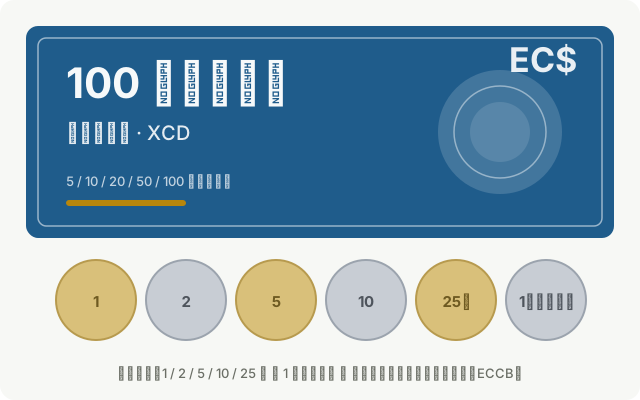
| Currency Name | Eastern Caribbean Dollar |
|---|---|
| Currency Code | XCD |
| Currency Symbol | EC$ |
| Issuing Country | Saint Lucia |
| Time Zone | UTC-4 |
| Dialling Code | +1 758 |
About Eastern Caribbean Dollar (XCD)
Currency Overview
Saint Lucia uses the Eastern Caribbean Dollar (East Caribbean Dollar, currency code XCD, symbol EC$). It is not issued solely by Saint Lucia but is a regional currency managed and issued by the Eastern Caribbean Central Bank (ECCB) for several members of the Organisation of Eastern Caribbean States (OECS). It circulates in Saint Lucia, Antigua and Barbuda, Saint Kitts and Nevis, Dominica, Grenada, Saint Vincent and the Grenadines, as well as two British overseas territories.
The Eastern Caribbean Dollar has been pegged to the U.S. dollar at a fixed rate since 1976—approximately 2.70 XCD to 1 USD (or about 0.37 USD per 1 XCD)—with long-term stability.
Denominations
Banknotes come in denominations of 5, 10, 20, 50, and 100 XCD, distinguished by color. The front designs are consistent across the currency union, while the backs feature unique local landmarks, flora, fauna, or scenes for each member country. Coins are issued in 1, 2, 5, 10, 25 cents and 1 XCD, varying in size and material. The front often shows the monarch’s portrait or the ECCB logo, and the reverse displays local patterns. 1 XCD equals 100 cents.
Cash and Payment Habits
Resorts, hotels, car rental agencies, and larger shops in Saint Lucia commonly accept credit cards (Visa, MasterCard, American Express), and U.S. dollars are often accepted in tourist areas—but change is typically given in Eastern Caribbean Dollars at the fixed rate of around 2.7:1. Street markets, small restaurants, buses, and some attractions only take cash, so it’s advisable to carry small denominations of XCD.
ATMs are available in Castries, Rodney Bay, and the airport, dispensing Eastern Caribbean Dollars, with some also offering U.S. dollars. Be mindful of transaction fees and withdrawal limits. For currency exchange, use authorized banks or airport exchange counters.
Traveler Tips
- The fixed rate is around 1 USD to 2.70 XCD; if a merchant offers a worse rate (e.g. 1:2.5 or lower), paying in local currency is usually better.
- Denominations of 5 and 10 XCD are most useful in markets and on buses—get some small bills before traveling.
- Unused XCD can sometimes be exchanged back to U.S. dollars at the airport, but rates may be unfavorable; only exchange what you need.
- Always check whether credit card transactions incur a 2%–5% surcharge, as some small vendors add extra fees.
Saint Lucia Overview
Country Details »Overview of Saint Lucia
Saint Lucia is an island nation located in the eastern Caribbean and the central part of the Lesser Antilles, one of the Windward Islands. It borders Saint Vincent to the south, the French overseas department of Martinique to the north, the Atlantic Ocean to the east, and the Caribbean Sea to the west. The island stretches about 43 kilometers from north to south and up to 22 kilometers from east to west, covering an area of approximately 617 square kilometers. The capital, Castries, is situated on the northwest coast and serves as the national center for politics, commerce, and cruise ship docking.
Saint Lucia is a member of the Commonwealth and a constitutional monarchy. The British monarch is the head of state, represented by a governor-general, while executive power is held by the prime minister and cabinet. The country has a population of around 180,000, making it one of the less populous island nations in the Caribbean.
Geography and Climate
Saint Lucia is a volcanic island, dominated by central mountains, with the highest peak, Mount Gimie, rising to about 950 meters. The southwest is home to the iconic twin volcanic cones, Gros Piton and Petit Piton, which were inscribed as a UNESCO World Heritage Site in 2004. The island also features Sulphur Springs, one of the few drive-in volcano sites in the world, still active with sulfur vents and hot springs.
The climate is tropical maritime, with temperatures averaging 25–32°C year-round. The dry season runs from December to April, and the rainy and hurricane season from June to November. Influenced by the northeast trade winds, the eastern side is slightly more humid, while the western side is drier and home to most resort areas.
Historical Background
The original inhabitants of Saint Lucia were the Arawak and Carib peoples. Christopher Columbus may have sighted the island during his fourth voyage in 1502, around December 13, the feast day of Saint Lucy, after whom the island is named. Between the 17th and 18th centuries, Britain and France fought repeatedly over the island, which changed hands multiple times, earning it the nickname "Helen of the West Indies." French cultural influence remains strong, and Creole is still widely spoken.
Following the Treaty of Paris in 1814, the island came under British control. It was part of the short-lived West Indies Federation from 1958 to 1962, became an associated state of the UK in 1967, and gained full independence on February 22, 1979, joining the Commonwealth. Independence Day remains the country’s most important national holiday.
Economy and Currency
Saint Lucia’s economy relies heavily on tourism and services, which make up a significant share of GDP and employment. Agriculture centers on bananas, coconuts, and cocoa, with bananas once being the top export. The manufacturing sector is small, mainly involving food processing and beverages. Tourism caters largely to the honeymoon and resort markets, with numerous high-end resorts on the western coast and strong cruise ship traffic.
The official currency is the Eastern Caribbean Dollar (XCD), issued and managed by the Eastern Caribbean Central Bank. It is pegged to the U.S. dollar at a fixed rate of approximately 2.7 XCD to 1 USD, offering stability for travelers’ budgeting.
Culture and Society
Saint Lucian culture blends African, French, British, and Caribbean indigenous elements. English is the official language, but Saint Lucian Creole (Kwéyòl) is widely spoken in daily life, with the annual Creole Festival held in October. The Saint Lucia Jazz Festival in May is a prominent Caribbean music event, and Carnival in July features colorful parades and music such as soca and calypso.
Local cuisine includes dishes like callaloo soup (made with leafy greens, coconut milk, okra, and often pumpkin), green bananas with saltfish, bouyon stew, and Johnny cakes. The island has a longstanding rum-making tradition, an essential part of its culinary experience.
Tourism Overview
Saint Lucia is famed for honeymoons and luxury getaways, earning accolades in international travel rankings. Key destinations include the Pitons, volcano, and Diamond Falls near Soufrière; Rodney Bay, Reduit Beach, and the capital Castries in the northwest; and the scenic Marigot Bay. Access is available by cruise ship or flights from the U.S., Canada, UK, and neighboring Caribbean countries.
Popular activities include diving, rainforest hiking, whale watching, sailing, and volcano mud baths. The peak season aligns with Northern Hemisphere holidays from December to April. English is the main language, and the island is generally safe, though caution is advised when walking alone at night in secluded areas.
Saint Lucia Travel Guide
All Guides »Saint Lucia Travel Quick Guide: Visas, Seasons, Budget & Etiquette
Find out how to get a visa, when to visit for the best weather, how much daily s...
Saint Lucia 7-Day Island Loop: From Rodney Bay to the Pitons 7 days
Connects the northwest resort area with the southwest volcanic landscapes, cover...
Saint Lucia 4-Day Short Trip: In-Depth Exploration of the Northern Resort Area 4 Days
Great Experience Even with Limited Time: Base yourself in Castries and Rodney Ba...
Essential Attractions in Saint Lucia: Volcanoes, Twin Peaks, and Bays
From the UNESCO-listed Pitons twin peaks to a drive-in sulfur volcano, here’s a ...
Saint Lucia Food Guide: Callaloo Soup & Caribbean Flavors
From the national soup callaloo to green bananas with saltfish, sample a mix of ...
Saint Lucia Transportation Guide: Airports, Buses, Ferries, and Car Rentals
A complete guide to choosing between the two airports, getting around the island...