Mozambique Currency Mozambican MeticalMZN
What money to use in Mozambique, how notes and coins break down, and the best ways to exchange - get the local cash sorted before you go.
| Currency Name | Mozambican Metical |
|---|---|
| Currency Code | MZN |
| Currency Symbol | MT |
| Issuing Country | Mozambique |
| Time Zone | UTC+2 |
| Dialling Code | +258 |
About Mozambican Metical (MZN)
Currency Overview
The official currency of Mozambique is the Metical (currency code MZN, symbol MT or MTn). One metical equals 100 centavos, though centavo coins are rarely used in daily transactions. Issued by the Bank of Mozambique (Banco de Moçambique), the metical has undergone multiple reforms and devaluations over the years, with the current series introduced in 2006.
Denominations
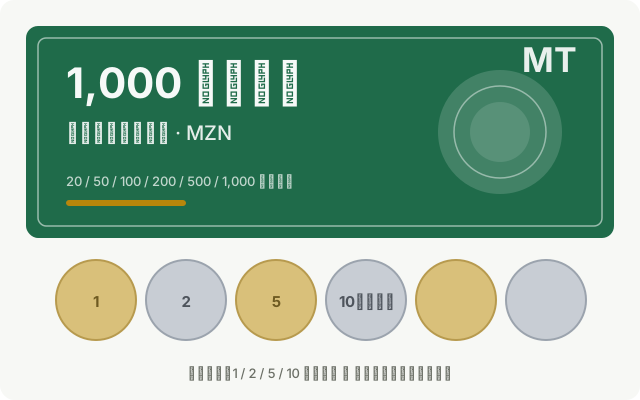
Banknotes currently in circulation come in denominations of 20, 50, 100, 200, 500, and 1,000 meticais, featuring images of Mozambican historical figures and iconic flora and fauna. Coins are available in 1, 2, 5, 10 meticais and 50 centavos, with varying materials and sizes. Due to inflation and everyday transaction habits, 20-, 50-, and 100-metical banknotes are the most widely used.
Cash and Payment Practices
Mozambique is largely a cash-based society. Street markets, small restaurants, taxis, and intercity buses typically only accept cash. Larger cities like Maputo have hotels, malls, and some restaurants that accept international credit cards such as Visa and Mastercard, but acceptance is limited and card declines can occur. ATMs are mainly found in urban areas and shopping malls, dispensing local currency. Withdrawal limits and fees vary by card issuer. U.S. dollars are accepted in some tourist areas, but exchange rates are usually less favorable than at official bureaux de change.
Traveler Tips
- Carry a reasonable amount of U.S. dollars or euros in cash, and exchange for meticais at banks or authorized exchange offices upon arrival.
- Large metical denominations may be difficult to break in small shops, so keep smaller bills and some change handy.
- ATM withdrawals are unreliable in remote areas, so carry enough cash before long trips.
- Tipping is not mandatory in Mozambique, but 5–10% is appreciated for good service in restaurants, with guides and hotel staff.
Mozambique Overview
Country Details »Mozambique Overview
Mozambique (officially the Republic of Mozambique) is located in southeastern Africa, bordering the Indian Ocean. It neighbors Tanzania to the north, Malawi, Zambia, and Zimbabwe to the west, Eswatini and South Africa to the south, and faces Madagascar across the Mozambique Channel, with a coastline of about 2,500 kilometers. The country covers an area of approximately 801,600 square kilometers. Its capital, Maputo, situated in Maputo Bay at the southernmost tip of the country, serves as the political, economic, and transportation hub.
Mozambique is a presidential republic with Portuguese as its official language and is a member of the Community of Portuguese Language Countries. The country is divided into ten provinces and one municipality, with a population of around 33 million. Major ethnic groups include the Makua, Shona, and Tsonga, reflecting a diverse, multilingual society.
Geography and Climate
Mozambique’s terrain is generally divided into three zones from east to west: coastal plains, central plateaus, and western highlands. The narrow coastal plain features extensive mangroves, coral reefs, and sandbanks, especially in the northern and central regions. The central and western areas consist of plateaus and hills, with Mount Binga on the Zimbabwe border reaching approximately 2,436 meters, the country’s highest point. The Zambezi River flows from west to east through the central region before emptying into the sea, forming one of Southern Africa’s largest river systems.
The climate is predominantly tropical savanna, with subtropical characteristics in the south. The year is divided into dry and rainy seasons: May to October is the dry season, with temperatures around 15–28°C and clear, dry weather. November to April is the rainy season, characterized by high heat, humidity, and concentrated rainfall, with tropical cyclones often affecting the central and northern coasts. Seawater temperatures are suitable for swimming and diving year-round, and July to November is the prime whale-watching season as humpback whales migrate through the area.
Historical Background
Mozambique has been inhabited by Bantu-speaking peoples since around the first century AD. During the medieval period, Swahili city-states along the coast engaged in trade with Arab, Persian, and Indian merchants, with Mozambique Island serving as a key node in Indian Ocean commerce. After Portuguese navigator Vasco da Gama arrived in 1498, Portugal gradually strengthened its control, and by the 18th century, the region became part of Portuguese East Africa, enduring nearly five centuries of colonial rule that deeply influenced the local language, religion, and cuisine.
In 1962, the Mozambique Liberation Front (FRELIMO) was established, and armed struggle began in 1964. Mozambique gained independence on June 25, 1975, but descended into a decade-long civil war due to internal and external factors, which ended with the signing of a peace agreement in 1992. Since the 1990s, the country has adopted a multi-party system and market economy. While the economy has gradually recovered in recent years, armed attacks in Cabo Delgado Province since 2017 have impacted local travel safety.
Economy and Currency
Mozambique’s economy is primarily agricultural, with cashews, cotton, sugarcane, and cassava as main crops. In recent years, resource development—such as natural gas, coal, heavy mineral sands, and hydropower—has become a significant growth driver. The official currency is the Mozambican Metical (MZN), issued by the Bank of Mozambique. Exchange rates are volatile, and inflation remains a long-term challenge, so travelers should plan cash usage carefully and monitor daily rates.
Culture and Society
Mozambican culture blends Bantu traditions, Swahili maritime heritage, and Portuguese colonial influences, making it a representative of Creole culture. Music and dance are vibrant, with Marrabenta being the national genre, while the mbira and percussion instruments are common in street performances and festivals. The cuisine combines Portuguese and African flavors, with peri-peri chicken, matapa (cassava leaf stew with coconut milk and peanuts), and Portuguese pão (bread) as standout dishes. Christianity and Islam coexist, with the latter more prevalent along the northern coast.
Tourism Overview
Mozambique is famed for its pristine coastline. Southern Maputo blends colonial architecture with local vibrancy, while Vilankulo serves as a gateway to the Bazaruto Archipelago. The archipelago’s white sands, coral reefs, and marine life—including dugongs, turtles, and humpback whales—offer world-class ocean experiences. The Inhambane region, known as Africa’s Golden Coast, is renowned for diving and surfing. Central Gorongosa National Park has regained its status as a wildlife sanctuary following large-scale ecological restoration. Northern Mozambique Island, with its Stone Town and Fortaleza de Nossa Senhora da Conceição, is a UNESCO World Heritage Site.
Travelers should note that security conditions in Cabo Delgado Province and some remote areas are complex. Always check consular advisories and avoid high-risk zones. Other major tourist areas are generally manageable, but infrastructure and medical services are limited. Travel insurance covering medical care and emergency evacuation is recommended, and it’s best to use licensed local operators.
Mozambique Travel Guide
All Guides »Mozambique Travel Quick Guide: Visa, Seasons, Budget & Safety Tips
How to get a visa, choose between dry and rainy seasons, how much to budget per ...
Classic 7-Day Mozambique Itinerary: Maputo – Inhambane – Vilanculos and Bazaruto Archipelago 7 days
From the colonial streets of the capital to the diving towns along the Golden Co...
Mozambique 4-Day Short Trip: In-Depth Exploration of Maputo City and Its Suburbs 4 Days
Discover Maputo Even with Limited Time: Colonial Architecture, Seaside Markets, ...
Must-visit attractions in Mozambique: From Maputo to Bazaruto and Mozambique Island
A region-by-region guide to Mozambique’s top sights, with highlights and recomme...
Mozambique Food Guide: Peri-Peri Chicken, Matapa, and Indian Ocean Seafood
Portuguese cuisine meets African spices and Indian Ocean seafood—the Mozambican ...
Mozambique Transport Guide: Airport Transfers, Domestic Flights & Car Rental
Mozambique is vast and sparsely populated, so domestic flights and private trans...