Trinidad and Tobago Currency Trinidad and Tobago dollarTTD
What money to use in Trinidad and Tobago, how notes and coins break down, and the best ways to exchange - get the local cash sorted before you go.
| Currency Name | Trinidad and Tobago dollar |
|---|---|
| Currency Code | TTD |
| Currency Symbol | TT$ |
| Issuing Country | Trinidad and Tobago |
| Time Zone | UTC-4 |
| Dialling Code | +1-868 |
About Trinidad and Tobago dollar (TTD)
Currency Overview
The official currency of Trinidad and Tobago is the Trinidad and Tobago dollar (currency code TTD, symbol TT$, commonly referred to as “dollar” by locals). The subunit is the cent, with 1 dollar equal to 100 cents. The currency is issued by the Central Bank of Trinidad and Tobago. The TTD has maintained a relatively stable exchange rate against the US dollar, with 1 US dollar approximately equal to 6.7–6.8 TTD. Compared to other Caribbean currencies that can fluctuate dramatically, the TTD offers more straightforward conversions. However, note that the term “dollar” locally may refer to either the TTD or the US dollar—always confirm which currency is being referenced before making a purchase.
Denominations
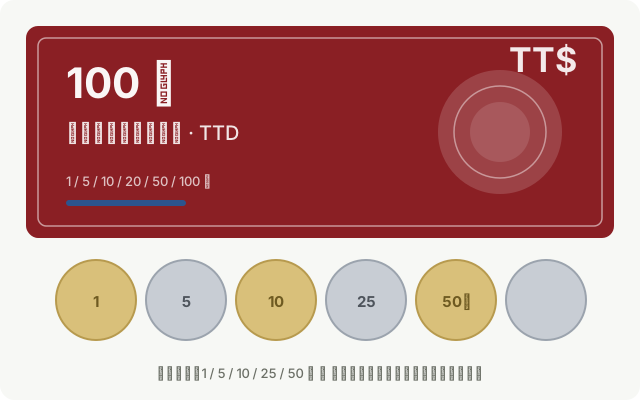
Circulating banknotes come in denominations of 1, 5, 10, 20, 50, and 100 dollars. In recent years, these have been updated to polymer plastic notes, which offer better security features and are more resistant to moisture. The designs on both sides feature birds, the national coat of arms, and historical-cultural scenes. Coins are available in 5, 10, 25, and 50 cents, as well as 1 dollar, with the 1-dollar coin having largely replaced the paper note. Larger denominations like the 100-dollar note are less commonly used in daily transactions, and small shops or taxis may struggle to provide change. Trinidadian banknotes are well known for their bird-themed designs, a tradition continued in the polymer series, with each note’s front featuring a different species of Trinidadian bird—making them popular among collectors.
Cash and Payment Habits
In shopping malls, supermarkets, and chain restaurants in Port of Spain, Chaguanas, and San Fernando, Visa and Mastercard credit cards are widely accepted. There are plenty of bank ATMs where foreign cards can be used to withdraw TTD directly. However, street food vendors (such as those selling doubles), maxi-taxis, local taxis, and rural shops in Tobago still primarily deal in cash, so it’s advisable to carry small bills and coins. US dollars may be accepted at some Tobago resorts and travel agencies, but the exchange rate is usually less favorable than if you first convert your dollars to TTD.
Tips for Travelers
- It’s recommended to exchange a small amount of TTD cash at Piarco Airport or a bank for transportation and small purchases.
- During Carnival, ATM lines are long and many shops close, so make sure to have enough cash in advance.
- The TTD is not widely accepted internationally, so use up or exchange any remaining notes before leaving the country to avoid being unable to convert them.
- Some gas stations and restaurants may add a credit card fee or only accept cash—check before paying.
Trinidad and Tobago Overview
Country Details »Overview of Trinidad and Tobago
Trinidad and Tobago is a twin-island nation located at the southern end of the Caribbean Sea, separated from Venezuela by the Gulf of Paria, and lying just about 11 kilometers from the South American mainland — the closest point of the Caribbean archipelago to the continent. The country consists of Trinidad Island (approximately 4,828 square kilometers), Tobago Island (about 300 square kilometers), and several smaller islets, covering a total area of around 5,130 square kilometers, making it one of the larger and more populous English-speaking countries in the Caribbean. The capital, Port of Spain, is situated on the northwest coast of Trinidad Island and serves as the political, economic, and cultural hub, as well as a key financial and shipping center in the Caribbean. English is the official language, though due to the large Indo-Trinidadian population, Trinidadian Creole English and some Hindi words can also be heard on the streets.
Geography and Climate
Trinidad Island features mainly low hills and plains, with the Northern Range mountains reaching around 940 meters in elevation in the north, while the south is home to oil fields and asphalt mining areas. The island boasts the world’s largest natural asphalt lake, Pitch Lake. Tobago, by contrast, is smaller and more picturesque, with coral reefs along its southwestern coast and rainforests and waterfalls in the east. Both islands have a tropical maritime climate, with temperatures typically ranging between 23–31°C year-round. The dry season runs from January to May, and the rainy season from June to November. Hurricanes usually bypass this island chain to the south, so the region is less affected by hurricanes compared to other Caribbean destinations. Sites such as the Caroni Bird Sanctuary and the Asa Wright Nature Centre are globally recognized locations for observing rare birds like the scarlet ibis and hummingbirds.
Historical Background
Trinidad and Tobago was originally inhabited by the Arawak and Carib indigenous peoples. Columbus arrived in Trinidad in 1498. For over 300 years, it was a Spanish colony before being captured by the British in 1797. In 1889, Trinidad and Tobago were merged into a single British colony. During the colonial period, many enslaved Africans were brought to work on sugar plantations. After the abolition of slavery in 1834, large numbers of indentured laborers from India began arriving in 1845, leading to today’s multicultural population, where people of African and Indian descent each make up roughly a third, alongside mixed-race, European, Chinese, and Syrian communities. Trinidad and Tobago gained independence on August 31, 1962, and became a republic in 1976. It is also home to the Secretariat of the Caribbean Community (CARICOM), playing a significant role in regional affairs.
Economy and Currency
Trinidad and Tobago is one of the strongest economies in the Caribbean, having built substantial wealth through its oil and natural gas industries. It is a leading global exporter of ammonia and methanol, with petrochemicals, energy, and downstream processing accounting for a major share of export earnings. The official currency is the Trinidad and Tobago dollar (TTD), issued by the Central Bank of Trinidad and Tobago, with an exchange rate that has remained relatively stable at around 6.7–6.8 TTD per US dollar. Port of Spain’s skyline, dotted with high-rise office buildings, is a rare urban landscape in the Caribbean, and the cost of living is relatively affordable compared to other Caribbean nations.
Culture and Society
Trinidad and Tobago is a powerhouse of Caribbean culture. The world-famous Trinidad Carnival, held annually before Lent, transforms the entire city into two days of street parties that showcase Soca music, Calypso songs, steelpan performances, and elaborate costumes. The steelpan, created in the 1930s–40s in the working-class neighborhoods of Port of Spain, is a unique instrument crafted from oil drums and is hailed as the only acoustic musical instrument invented in the 20th century. It is now a national symbol. The cuisine also reflects a blend of Indian and African influences: dishes such as curry crab, roti, doubles (curry chickpea sandwiches), and callaloo vegetable soup offer distinctive flavors, and the street food scene is exceptionally vibrant.
Tourism Overview
The tourism appeal of Trinidad and Tobago differs from that of typical Caribbean resort islands. Trinidad Island excels in urban experiences, ecology, and culture, with birdwatching, Carnival, and nightlife as its core highlights. Tobago, on the other hand, is a tranquil English-speaking island getaway, praised for its coconut-fringed white sands at Pigeon Point, snorkeling at Buccoo Reef, and the fine sand massages at Nylon Pool. Its diving conditions rank among the best in the Caribbean. The two islands are connected by domestic flights and ferries. Travelers accustomed to bustling beach resorts often choose Trinidad and Tobago as a next-level destination for deeper Caribbean exploration.
Trinidad and Tobago Travel Guide
All Guides »Trinidad and Tobago Pre-Travel Essentials: Visa, Best Time to Visit, Daily Budget, and Etiquette
How to get a visa, whether to go during Carnival, how much to budget per day, an...
Classic 7-Day Itinerary in Trinidad and Tobago: Port of Spain — Pitch Lake — Tobago Island-Hopping 7 days
Cover both the cultural and resort islands in one trip: urban nightlife, birdwat...
Trinidad Island 4-Day Short Itinerary: Capital Culture, North Coast Wetlands, and Southern Wonders 4 days
Exploring just Trinidad Island can still offer varied experiences: structured ar...
Must-visit attractions in Trinidad and Tobago: Pitch Lake, Scarlet Ibis wetlands, and Tobago’s white-sand beaches
From the world’s largest natural asphalt lake to some of the Caribbean’s best sh...
Trinidad and Tobago Food Guide: How to Eat Curry Crab, Doubles Snacks, and Shark Sandwiches
A Caribbean Kitchen of Indo-African Fusion: Where to Eat, What to Order, and Pri...
Complete Guide to Transportation in Trinidad and Tobago: How to Travel Between the Two Islands, Maxi-Taxi Tips, and Car Rental Essentials
How to get from Piarco Airport to the city, whether to take a ferry or flight be...