Eritrea Currency Eritrean nakfaERN
What money to use in Eritrea, how notes and coins break down, and the best ways to exchange - get the local cash sorted before you go.
| Currency Name | Eritrean nakfa |
|---|---|
| Currency Code | ERN |
| Currency Symbol | Nfk |
| Issuing Country | Eritrea |
| Time Zone | UTC+3 |
| Dialling Code | +291 |
About Eritrean nakfa (ERN)
Currency Overview
Eritrea’s official currency is the nakfa (currency code ERN, symbol Nfk), issued by the Bank of Eritrea. It was officially introduced in November 1997, replacing the Ethiopian birr previously in use. The currency is named after Nakfa, a town that served as a key base during the independence struggle, carrying strong symbolic significance. One nakfa equals 100 cents. Since 2005, the official exchange rate has been fixed at 1 USD = 15 ERN, though a significant gap exists between the official and market rates, with foreign exchange transactions tightly controlled by the state.
Denominations
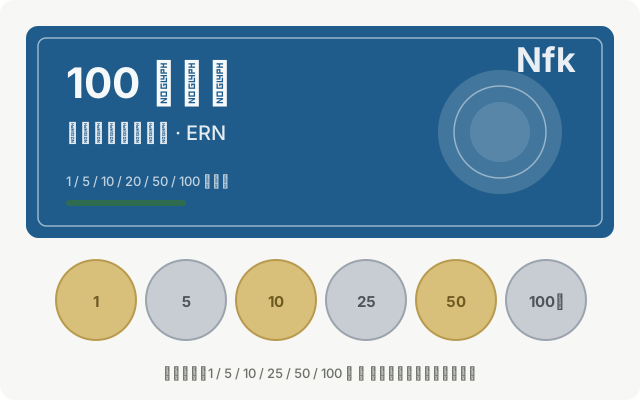
Nakfa banknotes come in six denominations: 1, 5, 10, 20, 50, and 100. The obverse features portraits of Eritrean ethnic figures, labor scenes, and Asmara architecture, while the reverse often depicts highland landscapes and Red Sea fishing boats. Coins are issued in six denominations: 1, 5, 10, 25, 50, and 100 cents, with smaller transactions commonly using coins. While the banknote designs highlight national identity, their printing and security features are basic, so check for differences between old and new versions. In late 2015, Eritrea replaced some banknote denominations and set a deadline for exchanges, with frequent changes to cash regulations.
Cash and Payment Practices
Eritrea is a predominantly cash-based economy: international ATMs are virtually nonexistent, and credit cards or mobile payments are unreliable. Hotels, restaurants, taxis, and cafes all require cash. Travelers must declare foreign currency upon entry and may be questioned about discrepancies when leaving. US dollars and euros in cash are the most widely accepted, and some foreigner-oriented hotels or travel agencies may quote prices directly in USD. Exchanges can only be done at banks or authorized outlets at official rates—avoid unofficial street exchanges, which carry severe penalties.
Traveler Tips
- Plan your entire budget in cash: Credit cards and ATMs are unavailable, so carry sufficient USD or euros in small denominations.
- Declare the exact amount of foreign currency you bring in; significant discrepancies at departure may prompt inquiries.
- Official and market exchange rates differ greatly—use banks or authorized channels for currency exchange, not private dealers.
- Nakfa cannot be exchanged abroad—spend or dispose of leftover cash according to regulations before leaving.
Eritrea Overview
Country Details »Eritrea Overview
Eritrea is located in northeastern Africa along the western coast of the Red Sea, bordered by Sudan to the north, Ethiopia to the west, Djibouti to the southeast, and facing Yemen across the Red Sea. With a coastline stretching about 1,900 kilometers, it is a strategic gateway to the Red Sea and the Mandeb Strait. The country covers approximately 117,600 square kilometers, with its capital, Asmara, situated over 2,300 meters above sea level on the central highlands. Asmara enjoys a cool and pleasant climate and serves as the national political and cultural center.
Eritrea has a population of about 3.7 million, with the Tigrinya and Tigre peoples as the main ethnic groups. The official languages are Tigrinya, Arabic, and English. The country gained independence through a referendum in 1993 and is one of Africa’s youngest nations. Its current political system is highly centralized, and its social and economic openness remains low compared to other African countries.
Geography and Climate
Eritrea’s terrain is divided into three levels: the narrow Red Sea coastal plain in the east, which is hot and arid; the central highlands, an extension of the East African Rift and Ethiopian Highlands, where agriculture and population are concentrated; and the western region, which transitions toward the Sudanese plains and Danakil Depression. The southeastern Danakil extension is one of the hottest and driest areas on Earth. The country lacks perennial major rivers, and water resources are extremely limited.
The climate varies significantly with altitude: highland cities like Asmara remain cool year-round with large diurnal temperature variations, while Red Sea ports such as Massawa experience extreme hot and dry conditions, with summer temperatures often exceeding 40°C, making it one of the hottest coastal cities globally. The rainy season is concentrated in June–August, with precipitation mainly occurring in the highlands.
Historical Background
Eritrea’s coastal region has long been a key node in Red Sea trade, with close ties to the Arabian Peninsula since the Aksumite Kingdom era. From the 16th century, the Ottoman Empire and Egypt successively ruled the coastal areas. By the late 19th century, Italian colonizers gradually expanded their control, and in 1890, the colony of "Eritrea" was officially established, with Asmara developed into one of Africa’s most modernized cities at the time. After Italy’s defeat in 1941, Britain briefly administered the territory, and in 1952, the United Nations federated it with Ethiopia. The federation was dissolved in 1962.
From 1961, the Eritrean People’s Liberation Forces waged a 30-year armed struggle, gaining control of the entire territory by 1991. Eritrea officially gained independence in 1993 following a UN-supervised referendum. A border war with Ethiopia resumed in 1998–2000, leading to prolonged tensions and a shift toward inward-focused governance. Relations between the two countries normalized in 2018.
Economy and Currency
Eritrea’s economy relies on agriculture, mining, and remittances. Gold, copper, and zinc mines have seen gradual development in recent years, and the Red Sea offers rich but underutilized fishing resources. Due to long-standing restrictions and sanctions, the economy has low openness, and the private sector remains weak. The official currency is the nakfa (ERN), introduced in 1997 with a strictly fixed official exchange rate. Foreign currency exchange is tightly regulated, international bank cards are largely unusable, and travelers must rely on cash foreign currency exchanged through designated channels.
Culture and Society
Eritrea is home to nine major ethnic groups, with Tigrinya culture as the dominant influence. Christianity and Islam coexist. The Italian colonial legacy left a lasting coffee culture: espresso bars line Asmara’s streets, where people often sit outdoors sipping macchiato in the afternoon. War memories have shaped a strong national identity, reflected in sites like Nakfa town, Independence Day celebrations, and war memorials.
Tourism Overview
Eritrea boasts unique tourism assets in Africa: Asmara, known as the "African City of Modernism," was inscribed as a UNESCO World Heritage Site in 2017, with well-preserved Bauhaus and Art Deco-style cinemas, gas stations, and churches. Massawa’s old town features Ottoman-era Red Sea architecture, and the Dahlak Archipelago offers significant coral reef diving potential. The railway and historic cable car from Asmara to Massawa are engineering marvels.
However, Eritrea’s security situation and travel restrictions severely impact tourism. Even with entry permission, foreign travelers typically need advance authorization to leave the capital and must rely almost entirely on licensed travel agencies for arrangements. Always verify the latest consular alerts and entry policies before traveling.
Eritrea Travel Guide
All Guides »Eritrea Travel Quick Guide: Safety Alerts, Visa Requirements, Seasons & Budget
Traveling to Eritrea is unlike visiting most other countries: safety alerts, tra...
Eritrea 7-Day Itinerary: Asmara – Keren – Massawa – Dahlak 7 days
Classic route within permitted and safe areas: modernist highland capital, mount...
4-Day Eritrea Short Trip: Asmara In-Depth and Red Sea Descent 4 Days
When time is limited, focus on two highlights: immerse yourself in Asmara’s arch...
Essential Attractions in Eritrea: A Modernist City and Red Sea Coral
UNESCO-listed architecture in Asmara, the historic old town of Massawa, and the ...
Eritrea Food Guide: Injera, Red Sea Seafood & Espresso
Tigrinya cuisine, Italian colonial legacy, and Red Sea catches create one of Afr...
Eritrea Transport Guide: Permits, Long-Distance Buses, and the Red Sea Railway
In Eritrea, the key to travel planning isn’t buying tickets—it’s securing permit...