Guatemala Currency Guatemalan quetzalGTQ
What money to use in Guatemala, how notes and coins break down, and the best ways to exchange - get the local cash sorted before you go.
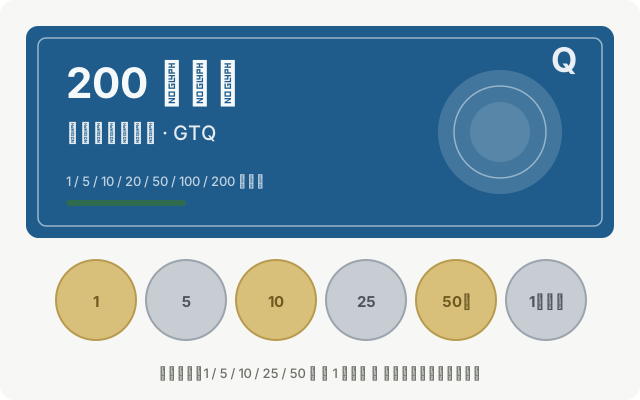
| Currency Name | Guatemalan quetzal |
|---|---|
| Currency Code | GTQ |
| Currency Symbol | Q |
| Issuing Country | Guatemala |
| Time Zone | UTC-6 |
| Dialling Code | +502 |
About Guatemalan quetzal (GTQ)
Currency Overview
The official currency of Guatemala is the quetzal (currency code: GTQ, symbol: Q), issued by the Banco de Guatemala (Bank of Guatemala). The quetzal is named after Guatemala’s national bird, which also appears prominently on the national flag and coat of arms, symbolizing freedom—as legend says it would rather die than be caged. One quetzal equals 100 centavos. Since its introduction in the 1920s, the quetzal has been one of the more stable currencies in Central America, maintaining a moderate float against the U.S. dollar. Guatemala has not adopted the U.S. dollar as official currency, and the quetzal remains the sole legal tender. However, U.S. dollars are widely accepted in tourist areas, hotels, travel agencies, and some larger businesses, resulting in a dual-currency circulation system.
Denominations
Quetzal banknotes come in denominations of 1, 5, 10, 20, 50, 100, and 200 quetzales. Each denomination features prominent Guatemalan figures or landmarks, such as politicians, writers, musicians, the quetzal bird, and Tikal ruins, rendered in vivid colors and distinctive designs. Coins are issued in 1, 5, 10, 25, 50 centavo, and 1 quetzal denominations, often depicting the quetzal bird, Maya glyphs, and the national coat of arms. In everyday transactions, coins under 1 quetzal are considered small change. Most supermarkets and formal vendors handle change without issue, but smaller market stalls may prefer rounded amounts.
Cash and Payment Practices
Both cash and cards are commonly used for daily transactions in Guatemala. Major supermarkets, hotels, chain restaurants, car rental companies, and tour operators generally accept international credit cards such as Visa and Mastercard, with some also accepting UnionPay. Traditional markets, Maya craft markets, street food vendors, rural buses, and small guesthouses typically operate on a cash-only basis. ATMs are widely available in towns and cities across the country and dispense quetzales, with some also offering U.S. dollars. However, ATM transactions usually incur fees and have withdrawal limits. While U.S. dollars are accepted directly in tourist zones and upscale venues—often exchanged at rates close to the market rate—change is typically given in quetzales, and the exchange rate may be slightly less favorable. Travelers are advised to prioritize settling payments in quetzales when possible.
Tips for Travelers
- The quetzal is the official currency; U.S. dollars are only widely accepted in tourist areas. It is recommended to use quetzales for daily transactions.
- Maya markets, street food vendors, and intercity buses only accept cash. Carry sufficient small-denomination quetzales.
- ATM withdrawals incur per-transaction fees, and some machines have low withdrawal limits. It is advisable to withdraw larger amounts at once and to safeguard your card and PIN.
- When paying in U.S. dollars, always confirm the exchange rate and the currency in which change is given to avoid miscalculations or unfavorable rates.
Guatemala Overview
Country Details »Overview of Guatemala
Guatemala (officially the Republic of Guatemala) is located in northern Central America. It borders Mexico to the west and northwest, Belize and the Gulf of Honduras (part of the Caribbean Sea) to the northeast, Honduras and El Salvador to the east, and the Pacific Ocean to the south. With an area of approximately 109,000 square kilometers, it is the most populous country in Central America, with around 17 million people. The capital, Guatemala City, lies in the central highland valleys and serves as the country’s political, economic, and transportation hub. It is also one of the largest cities in Central America.
Guatemala is one of the core areas of the Maya civilization. A significant number of Maya indigenous descendants still live in the country today, speaking various Maya languages. The official language is Spanish, and the currency is the Guatemalan quetzal (GTQ). The country’s name comes from the Nahuatl language, meaning “land of many trees.”
Geography and Climate
Guatemala features diverse terrain, which can be divided from south to north into the Pacific coastal plains, the central volcanic highlands, the Caribbean lowlands, and the northern Petén tropical rainforest. The central highlands are the most densely populated region, characterized by numerous volcanoes, including Volcán Tajumulco (4,220 meters), the highest peak in Central America, and Volcán de Fuego, one of the world’s most active volcanoes. The northern lowland rainforests of Petén are dense and home to the ancient Maya city of Tikal.
The climate varies significantly with altitude. The Pacific coast and Petén lowlands have a hot, humid tropical climate, while the central highlands, at elevations of 1,500–2,500 meters, enjoy a mild climate often described as springlike year-round, earning Guatemala the nickname “the land of eternal spring.” The country experiences distinct wet and dry seasons: the dry season runs from November to April, and the rainy season from May to October, with frequent afternoon showers.
Historical Background
Guatemala is one of the heartlands of the ancient Maya civilization. Starting around 2000 BCE, the Maya settled in the region. During the Classic Period (approximately 250–900 CE), city-states such as Tikal and Palenque flourished, leaving behind numerous pyramids and stelae. Although the Maya civilization in the Petén lowlands gradually declined afterward, Maya communities in the highlands have endured to the present day. In 1524, the Spanish conquistador Pedro de Alvarado conquered the region, establishing colonial rule. Antigua was founded as the capital in 1543, and colonial architecture along with Catholic culture became deeply rooted here.
In 1821, Guatemala gained independence from Spain along with the rest of Central America. It briefly joined the Central American Federation before becoming an independent republic in 1839. Throughout the 20th century, Guatemala experienced long periods of military rule and a civil war from 1960 to 1996, which ended with the signing of a peace agreement in 1996. Since then, the country has gradually moved toward democratization and economic development. Antigua was designated a UNESCO World Heritage Site in 1979, and Tikal has long been Guatemala’s most important archaeological and tourism destination.
Economy and Currency
Guatemala is the largest economy in Central America, with agriculture, light industry, mining, and services as its main sectors. Key export crops include coffee, sugar, bananas, and cardamom, and Guatemalan coffee is especially noted for its quality. Textile and garment manufacturing, food processing, and the rapidly growing business process outsourcing (BPO) sector are also expanding. Remittances from abroad are an important income source for many families. The national currency is the quetzal (GTQ), named after the country’s national bird, with 1 quetzal equal to 100 centavos. U.S. dollars are widely accepted in tourist areas, hotels, and some businesses, but quetzales remain the primary currency for daily transactions and pricing, with both currencies circulating concurrently.
Culture and Society
Guatemalan culture reflects a blend of indigenous Maya traditions and Spanish colonial influences. About 40% of the population are of Maya descent, with groups such as the K’iche’, Kaqchikel, and Mam preserving their languages, textile arts, weaving, and religious practices. Catholicism introduced during the colonial period coexists and intermingles with Maya beliefs in many areas, creating a unique folk religious landscape. The Maya market in Chichicastenango is a vivid representation of this cultural fusion, and the K’iche’ epic Popol Vuh originated here.
The cuisine is based on corn, beans, and chili peppers. Huevos rancheros (ranch-style eggs) is a classic breakfast dish consisting of fried eggs served on tortillas topped with tomato-chili sauce. Cacao, used in both drink and ritual by the Maya, remains an important ingredient, and chocolate and cacao beverages are widely available. Colorful textiles and handicrafts are among the country’s most popular souvenirs.
Tourism Overview
Guatemalan tourism focuses on four main themes: ancient cities, lakes, rainforests, and markets. Antigua, once the colonial capital, features cobblestone streets, Baroque churches, and a dramatic volcano backdrop. During Semana Santa (Holy Week), the city is adorned with vibrant carpets of colored sawdust and flowers, hosting one of the Americas’ most celebrated religious festivals. Lake Atitlán is encircled by volcanoes and dotted with Maya villages. Chichicastenango is famous for its Maya market and the Church of Santo Tomás. Deep in the Petén jungles, the Tikal pyramids offer visitors the chance to watch the sunrise over the canopy—an iconic experience. Overall, Guatemala combines natural beauty with deep cultural heritage, though safety varies by location. Travelers should be mindful of regional risks, travel times, and stay updated with advisories from their home country’s foreign affairs departments.
Guatemala Travel Guide
All Guides »Guatemala Travel Quick Guide: Visa, Seasons, Budget & Safety Tips
How to reach the Maya sites, when to go, and how much to spend per day — get the...
Classic 8-Day Guatemala Itinerary: Antigua, Lake Atitlán & Tikal 8 Days
Colonial cities, volcanic lakes, Mayan markets, and jungle pyramids—all the high...
Guatemala 4-Day Itinerary: Antigua and Lake Atitlán 4 days
With limited time, focus on two highland highlights: the colonial city of Antigu...
Must-visit attractions in Guatemala: ancient cities, lakes, and Maya ruins
Organized by theme—from the colonial streets of Antigua to the jungle pyramids o...
Guatemala Food Guide: Tortillas, Ranch-Style Eggs, and Cocoa
Corn, beans, and chili peppers form the everyday flavors of Guatemala, while hue...
Guatemala Transportation Guide: Airports, Shuttles, Chicken Buses, and Domestic Flights
Getting into Guatemala City, intercity options for tourists, local chicken buses...