Italy Currency EuroEUR
What money to use in Italy, how notes and coins break down, and the best ways to exchange - get the local cash sorted before you go.
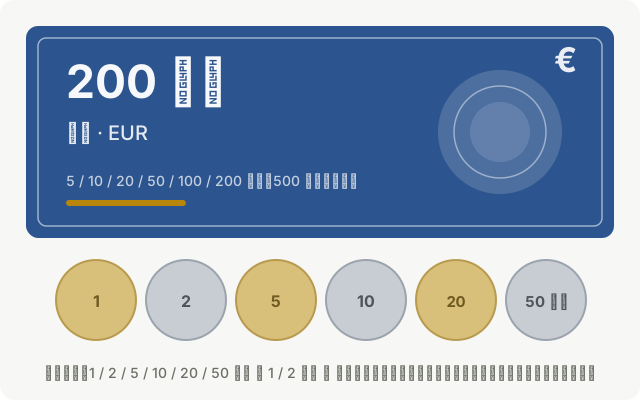
| Currency Name | Euro |
|---|---|
| Currency Code | EUR |
| Currency Symbol | € |
| Issuing Country | Italy |
| Time Zone | UTC+1 (6 hours during daylight saving time) |
| Dialling Code | +39 |
About Euro (EUR)
Currency Overview
The official currency of Italy is the euro (currency code EUR, symbol €), issued by the Eurosystem and managed by the European Central Bank. The euro was introduced as a virtual currency on January 1, 1999, and euro banknotes and coins officially entered circulation on January 1, 2002, replacing the former Italian lira. One euro equals 100 cents (cent), and the euro symbol € is also one of the most recognizable symbols of the EU and the Eurozone.
Denominations
Euro banknotes are uniformly designed by the European Central Bank and come in seven denominations: €5, €10, €20, €50, €100, €200, and €500. Each denomination is distinguished by different colors and architectural styles—€5 (grey), €10 (red), €20 (blue), €50 (orange), €100 (green), €200 (yellow-brown), and €500 (purple). Note that the European Central Bank has stopped issuing the €500 note, but existing notes remain legal tender and can be exchanged at banks. Commonly used denominations in daily transactions are €5, €10, €20, and €50. Larger notes above €100 may be refused by some smaller shops.
Euro coins come in eight denominations: €1, €2, and 1, 2, 5, 10, 20, and 50 cents. The common side (obverse) of the coins features a unified design, while the national side (reverse) is unique to each member state. Italian euro coins feature culturally significant designs: 1 cent (Montecatini Castle), 2 cents (Mole Antonelliana in Turin), 5 cents (Colosseum in Rome), 10 cents (Botticelli’s Venus), 20 cents (Boccioni’s sculpture), 50 cents (Marcus Aurelius equestrian statue), €1 (Vitruvian Man by Leonardo da Vinci), and €2 (portrait of Dante by Raphael).
Cash and Payment Habits
Italy has a relatively high cash usage rate compared to other Eurozone countries. Street-side cafes, small grocery stores, traditional markets, tobacco shops (Tabacchi), and some restaurants still prefer cash. However, credit cards and mobile payments (Apple Pay, Google Pay) are widely accepted in cities and tourist areas. Tobacco shops in Italy, in addition to selling cigarettes, also offer bus tickets, stamps, and utility bill payments, making them practical convenience outlets.
It is recommended to carry around €50–€100 in small bills for coffee, ice cream, markets, and small transport costs. For larger purchases, use cards when possible. Foreign currency can be exchanged at banks, airports, and authorized exchange offices. Private exchange services near city-center attractions often offer poor exchange rates, so prioritize banks. When using ATMs, choose machines displaying the Cirrus or Plus logo and watch out for cross-border transaction fees.
Tips for Travelers
- Some restaurants add a “cover charge” (coperto) and bread fee to the bill, which is a local practice.
- Italy does not have a strong tipping culture. Leaving €1–€2 or rounding up the bill is appreciated but not required if you’re satisfied.
- Smaller shops may refuse large bills (€100 or more), so carry enough small denominations.
- Exchange rates and fees at kiosks near train stations, airports, and attractions vary greatly—always ask before exchanging money.
- When paying by card, check whether the merchant uses Dynamic Currency Conversion (DCC). Opting to pay in euros is usually more cost-effective.
Italy Overview
Country Details »Overview of Italy
Italy (Italian Republic) is located on the northern shore of the Mediterranean in southern Europe. Its territory consists mainly of the Apennine Peninsula, the Po Plain, and the two large islands of Sicily and Sardinia, covering an area of about 301,300 square kilometers with a population of approximately 58.9 million. It borders France, Switzerland, Austria, and Slovenia to the north across the Alps, faces the Adriatic Sea to the east, the Tyrrhenian Sea to the west, and looks toward Tunisia and Malta to the south. The capital, Rome (Roma), is situated along the Tiber River in the central-western part of the peninsula and serves as the nation’s political, cultural, and tourism hub. It is also one of the cities with the highest density of UNESCO World Heritage Sites in the world.
Italy operates as a parliamentary republic, with the president as the head of state and the prime minister holding executive power. The country is divided into 20 regions, five of which are autonomous special regions with greater self-governance. As a founding member of the European Union, as well as a member of the Schengen Area and the Eurozone, Italy is also part of the Group of Seven (G7) and NATO. Its economy consistently ranks among the top in Europe.
Geography and Climate
Italy’s geography varies greatly between the north and the south: the north features the Alps and the Po Plain, with the Po River being the longest in the country and the plain supporting highly developed agriculture; the central and southern parts are traversed by the Apennine Mountains, characterized by rolling hills; the south and the islands are home to active volcanoes, including Mount Etna on Sicily, the highest and most active volcano in Europe, and Mount Vesuvius near Naples, which erupted in 79 AD and buried the ancient city of Pompeii. The peninsula has a rugged and intricate coastline, featuring famous coastal landscapes such as the Amalfi Coast and Cinque Terre. The Dolomites, known for their limestone peaks, are a UNESCO World Natural Heritage Site.
Climatically, the Po Plain experiences a temperate continental climate, with cold, foggy winters and hot summers. The central region, including Tuscany, enjoys a mild climate. The south and the islands have a typical Mediterranean climate, with hot, dry summers and warm, humid winters. The Alpine regions in the north receive ample snowfall in winter, making them popular ski destinations like the Dolomites. The best times to visit are April–June and September–October, when the weather is pleasant and the summer crowds are avoided. July–August can be extremely hot in the south, with many local shops closing for holidays. During the national holiday Ferragosto around August 15, cities may feel particularly empty.
Historical Background
Italy is a cradle of European civilization. In 753 BC, Rome was founded, transitioning from a monarchy to a republic, and then under Julius Caesar and Augustus, it became a vast empire spanning Europe, Asia, and Africa, leaving behind grand legacies such as the Colosseum, Pantheon, and Pompeii. After the fall of the Western Roman Empire in 476 AD, the peninsula entered the medieval period, marked by numerous city-states. Maritime and commercial republics such as Venice, Florence, Genoa, and Milan rose to prominence. Between the 14th and 16th centuries, the Renaissance began in Florence, producing cultural giants like Leonardo da Vinci, Michelangelo, Raphael, and Dante, who profoundly influenced European thought and art.
In the 19th century, driven by figures like Count Cavour and Giuseppe Garibaldi, the Kingdom of Italy was unified in 1861, with Rome becoming the capital in 1871. In the first half of the 20th century, Benito Mussolini established a fascist regime and involved Italy in World War II. In 1946, a national referendum abolished the monarchy, and the Italian Republic was established. After the war, Italy rapidly industrialized, becoming one of the world’s major economies and a strong advocate for European integration.
Economy and Currency
Italy is a highly developed industrial nation, excelling in sectors such as machinery manufacturing, automotive production (Fiat, Ferrari, Lamborghini), shipbuilding, fashion (Milan), furniture design, chemicals, and food processing, with a strong presence of small and medium-sized enterprises. In agriculture, Italy is a leading producer of wine, olive oil, and cheese, with iconic foods like Parma ham, Parmesan cheese, pasta, and espresso. The service and tourism sectors make up a significant portion of the national economy, with Milan being a major hub for fashion and finance in Europe.
As a member of the Eurozone, Italy’s official currency is the euro (EUR, symbol €). The euro was introduced as a virtual currency in 1999 and officially circulated in banknotes and coins starting January 1, 2002, replacing the former Italian lira. One euro equals 100 cents (cent), and the euro symbol € is also one of the most recognizable symbols of the EU and the Eurozone. For details on euro banknote denominations, coin designs, and payment habits, see the currency section.
Culture and Society
Italian culture is profoundly rich: the country is home to approximately 60 UNESCO World Heritage Sites, the highest number in the world. Opera originated here, with timeless works by Verdi, Puccini, Rossini, and others. Milan’s La Scala is a global opera mecca. Football is the national sport, and Serie A has a far-reaching influence. In daily life, espresso is at the heart of social interactions, and standing at the bar for a quick coffee is a local custom. The Slow Food movement, originating in Italy in 1986, has since influenced global attitudes toward food and tradition.
Society places great importance on family and community ties. Meals follow structured courses (starter, first course, main course, dessert), and dining times are long, especially dinners. Catholic culture permeates festivals and the urban-rural landscape, and the independent city-state of Vatican City lies within Rome. Etiquette emphasizes dressing appropriately; greetings often involve handshakes or cheek kisses, and modest attire (long pants or knee-length skirts with shoulders covered) is required when entering churches.
Tourism Overview
Italy is one of the world’s most popular tourist destinations, offering an incredibly dense array of attractions: the Colosseum and Roman Forum in Rome, St. Peter’s Basilica and the Sistine Chapel in Vatican City, the Uffizi Gallery and Florence Cathedral in Florence, Venice’s canals and St. Mark’s Square, Milan’s cathedral and “The Last Supper,” the countryside and medieval hill towns of Tuscany, Cinque Terre, the Amalfi Coast, the ruins of Pompeii, and the island landscapes of Sicily and Sardinia—all forming a comprehensive destination covering history, art, cuisine, and nature.
Italy’s high-speed rail network (Frecciarossa, Italo) connects major cities such as Rome, Florence, Bologna, Milan, Venice, and Naples, making intercity travel efficient and convenient. There is also a dense network of regional trains and long-distance buses. Whether for a classic first trip to Europe or an in-depth journey through art and cuisine, Italy is an excellent choice.
Italy Travel Guide
All Guides »Italy Travel Quick Guide: Visa, Seasons, Budget & Local Etiquette
Before you go, get familiar with your Schengen visa, the best travel season, dai...
Classic 7-Day Italy Itinerary: Rome – Florence – Venice – Milan 7 days
The most reliable first-time itinerary in Italy: Ancient Rome, the Renaissance, ...
Italy 4-Day Itinerary: In-Depth Tour of Rome and the Vatican 4 Days
Even with limited time, you can fully experience Rome: explore by theme—Ancient ...
Essential Attractions in Italy: From Ancient Rome to the Cinque Terre
A curated list of Italy’s top classic sights organized by northern, central, and...
A Guide to Italian Cuisine: From Pasta and Pizza to Handmade Gelato
Savor Italy layer by layer: from €1 espresso to regional signature pasta and des...
Italy Transport Guide: High-Speed Trains, Metro, and Water Buses
Understand Frecciarossa, Italo, and city transport tickets — a complete guide to...