French Guiana Currency EuroEUR
What money to use in French Guiana, how notes and coins break down, and the best ways to exchange - get the local cash sorted before you go.
| Currency Name | Euro |
|---|---|
| Currency Code | EUR |
| Currency Symbol | € |
| Issuing Country | French Guiana |
| Time Zone | UTC-3 |
| Dialling Code | +594 |
About Euro (EUR)
Currency Overview
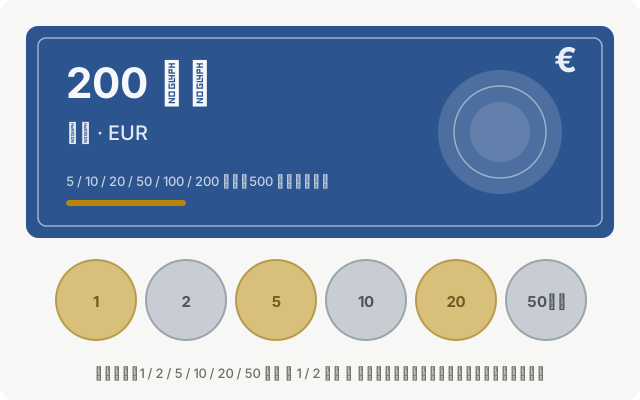
As a French overseas department and part of the EU, the official currency of French Guiana is the euro (Euro, currency code EUR, symbol €), with 1 euro = 100 cents (cent). The euro is issued by the Eurosystem, and the banknotes circulating in French Guiana are identical to those used in mainland France and other eurozone countries. The banking system is integrated with that of mainland France and regulated by French and EU financial authorities. There is no need to exchange currency locally.
Denomination System
Euro banknotes are uniform across the eurozone, with denominations of 5, 10, 20, 50, 100, 200, and 500 euros. Their designs are themed around European architectural styles from different periods and do not vary by country. Coins come in denominations of 1, 2, 5, 10, 20, and 50 cents, as well as 1 and 2 euros. The obverse side is common to all eurozone countries, featuring a map of Europe, while the reverse side is designed individually by each issuing country. French Guiana uses the French version of euro coins, with reverse designs including the effigy of Marianne representing the French Republic, the Semeuse (seeder) design, and the Tree of Life encircled in a hexagon on the 1 and 2 euro coins.
Cash and Payment Habits
Payment habits in French Guiana are similar to those in mainland France. Debit and credit cards are widely accepted in supermarkets, restaurants, hotels, and petrol stations, and international Visa and Mastercard cards are also commonly used. However, in rural markets, small vendors, and some eco-lodges, cash is still the main form of payment, so it is advisable to carry some cash. ATMs are available locally, but they are less widespread than in continental Europe, and withdrawing cash in remote areas can be challenging.
Traveler Tips
- The local currency is the euro. Exchange it in France or another eurozone country before departure—no need for additional exchanges locally.
- Card payments are widespread, but carry cash for markets and rural shops.
- Prices are higher than in mainland France, so adjust your budget for meals and accommodation accordingly.
- ATMs are readily available in Cayenne and Kourou, but stock up on cash before venturing into the rainforest or river areas.
French Guiana Overview
Country Details »Overview of French Guiana
French Guiana (Guyane française, English: French Guiana) is located in northeastern South America, bordered by the Atlantic Ocean to the north, Suriname to the west, and Brazil to the east and south. It covers an area of about 84,000 square kilometres. It is not an independent country but a French overseas department (département d’outre-mer): since 1946, it has been a provincial-level administrative division outside mainland France and is now a single territorial collectivity, part of both French territory and the EU. The euro is used locally, and the region is governed jointly by a prefect appointed by the French central government and a local assembly. Its legal, educational, and administrative systems are aligned with those of mainland France. Residents are French citizens and also hold EU citizenship. The capital, Cayenne, serves as the administrative and commercial hub.
Geography and Climate
French Guiana lies on the eastern edge of the Guiana Shield, featuring rolling hills, with its highest point at about 851 metres. Over 90% of the country is covered by the Amazon tropical rainforest, with a dense network of rivers, making it one of the most forested regions in South America. The northern coastal area consists of alluvial plains and mangroves, while the central and southern regions are dominated by pristine rainforests and nature reserves. The Guiana Amazonian Park, established in 2007, is France’s largest national park.
The climate is tropical rainforest, with high temperatures and abundant rainfall year-round. Average annual temperatures range from 26–28°C, and humidity is very high. The year is roughly divided into a rainy season (December to July, with a brief dry spell in February–March) and a dry season (August to November), with the latter being more suitable for road travel and rainforest exploration.
Historical Background
In 1498, Christopher Columbus sailed along this coastline. From the 17th century, France began establishing colonial outposts here, which were subsequently contested repeatedly with the Netherlands, Britain, and Portugal. In 1848, France abolished slavery in the territory, and the emancipated Afro-descendant population, along with immigrants from the Caribbean, gradually formed the core of society. Between 1852 and 1953, France operated penal colonies (bagne) in French Guiana, the largest being the transportation camp in Saint-Laurent-du-Maroni and the nearby Devil’s Island. Alfred Dreyfus, the famous wrongfully convicted figure, was imprisoned on Devil’s Island from 1895 to 1899. This history also inspired the novel Papillon.
In 1946, French Guiana became a French overseas department and gradually gained greater autonomy, with the establishment of a single territorial collectivity in 2015. After World War II, immigrants from Haiti, Brazil, Laos (Hmong), China, and other regions settled here, contributing to its multicultural society.
Economy and Currency
French Guiana’s economy is based mainly on public services, the space industry, fishing, and forestry. The Guiana Space Centre (Centre Spatial Guyanais), established in Kourou in 1968, is a major launch site for the European Space Agency. Rockets such as Ariane and Vega are launched here, benefiting from the proximity to the equator, which provides launch efficiency advantages. The space industry and related services provide significant employment and financial support. The euro (EUR) is used, with banking services provided by the French and EU banking systems. Prices are generally higher than in mainland France, and industrial goods and food rely on imports.
Culture and Society
French Guiana has a population of about 300,000, with a highly diverse composition: Afro-descendants and Creoles, Maroons (descendants of escaped slaves, mainly living along the Maroni River), indigenous peoples such as the Kali'na and Wayana, a Hmong community from Laos, Chinese people, Brazilian and Haitian immigrants, as well as civil servants and technical personnel from mainland France. The official language is French, while Guianese Creole and various immigrant languages are commonly spoken. Culturally, Creole traditions predominate, and Carnival is the most important festival, with lively and Caribbean-influenced parades in Kourou and Cayenne. The cuisine blends Creole, Amazonian, and immigrant influences, with representative dishes including awara stew (bouillon d’awara), colombo curry, and river fish soup blaff.
Tourism Overview
Tourism in French Guiana focuses on space, history, and the rainforest. The Guiana Space Centre in Kourou offers scheduled visits and designated viewing points for rocket launches, which is a major draw for many visitors. Offshore, the Salvation Islands (Îles du Salut) and Devil’s Island preserve penal colony ruins and can be reached by boat from Kourou. The transportation camp in Saint-Laurent-du-Maroni and canoe trips on the Maroni River showcase colonial and immigrant history. The beaches of Awala-Yalimapo are key nesting sites for leatherback and green turtles, where close turtle-watching is possible on summer nights from April to July. The mangroves and caimans of the Kaw Swamp, along with rainforest trails and the Amazonian Park, are ideal for eco-tourism. Due to limited infrastructure, flight options, and higher prices, trips usually require advance planning, and attention must be paid to health requirements such as the yellow fever vaccine.
French Guiana Travel Guide
All Guides »Quick Guide to Traveling to French Guiana: Visa, Vaccines, Seasons & Budget
French Guiana is part of France and the European Union but not part of the Schen...
7-Day Classic Route in French Guiana: Cayenne – Kourou – Saint-Laurent 7 days
A complete 7-day itinerary in French Guiana, weaving together three main themes:...
French Guiana 4-Day Short Trip: Cayenne and the Guiana Space Centre 4 days
When your holiday is short, focus on two key themes—space exploration and penal ...
Essential Attractions in French Guiana: Space, Penal Colonies, and Rainforest
From the European Space Agency launch site to the ruins of Devil’s Island, and f...
French Guiana Food Guide: Creole and Amazonian Flavors
Braised awara, colombo curry, and river fish soup — explore the region’s diverse...
Travel Guide to Transportation in French Guiana: Flights, Car Rentals, and River Boats
Public transportation is limited, so renting a car or booking a boat are the mai...