Laos Currency Lao KipLAK
What money to use in Laos, how notes and coins break down, and the best ways to exchange - get the local cash sorted before you go.
| Currency Name | Lao Kip |
|---|---|
| Currency Code | LAK |
| Currency Symbol | ₭ |
| Issuing Country | Laos |
| Time Zone | UTC+7 |
| Dialling Code | +856 |
About Lao Kip (LAK)
Currency Overview
The official currency of Laos is the Lao Kip (currency code LAK, symbol ₭, often written as ₭N). Issued by the Bank of the Lao PDR, 1 Kip = 100 att, though the att is no longer in circulation and there are no smaller coins or notes used today. The Kip is not freely convertible internationally and is generally not available for direct exchange abroad. Travelers usually exchange US Dollars, Thai Baht, or other foreign currencies for Kip upon arrival in Laos.
Denominations
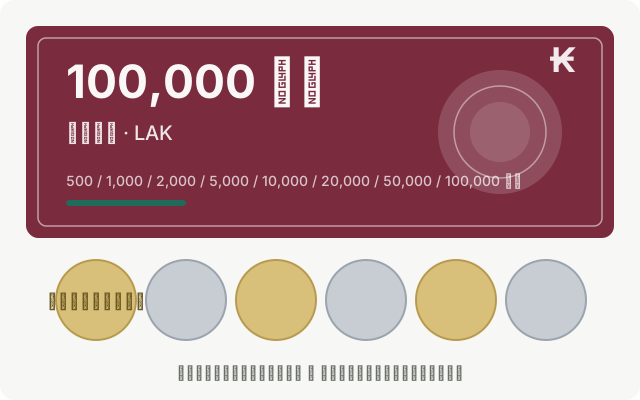
Kip banknotes currently in circulation come in denominations of 500, 1,000, 2,000, 5,000, 10,000, 20,000, 50,000, and 100,000 Kip. The notes feature images of Lao historical figures, temples, stupas, and daily life scenes. Coins are rarely seen in daily transactions, appearing only occasionally in collections or as small change. Because the Kip has a very low value per unit and prices have been rising, travelers often end up handling large stacks of banknotes. Always count your money carefully before paying.
Cash and Payment Practices
Laos is largely a cash-based society. Street food vendors, night markets, tuk-tuks, songthaews (shared taxis), temples, and entrance fees usually accept only cash. Upscale hotels, chain restaurants, travel agencies, and some shopping malls in Vientiane and Luang Prabang may accept credit cards (Visa, Mastercard), but a 2% to 3% surcharge is common, and UnionPay acceptance is limited. In tourist areas, Thai Baht and US Dollars are often used alongside the Kip: larger expenses such as hotel stays or multi-day tours may be quoted in Dollars or Baht, while smaller purchases are settled in Kip, with change frequently given in Kip.
It’s advisable to bring some US Dollars or Thai Baht in cash for exchange at banks, authorized exchange counters, or reputable jewelry shops. ATMs are available in major cities such as Vientiane, Luang Prabang, and Pakse, but they are limited in number, have low withdrawal limits, and charge around 20,000 to 40,000 Kip per transaction. To minimize fees, withdraw larger amounts when possible.
Tips for Travelers
- Kip notes have large denominations and long numbers—always double-check the amount before handing over cash to avoid overpaying or underpaying.
- US Dollars and Thai Baht are widely accepted in tourist areas, but exchange rates and change policies vary, so confirm the currency before paying.
- Kip exchange rates fluctuate, so exchange money in smaller amounts rather than carrying large sums.
- ATM fees are high, so try to withdraw enough cash in one go and have backup funds in case of card issues.
Laos Overview
Country Details »About Laos
Laos (officially the Lao People's Democratic Republic) is located in the northern part of the Indochinese Peninsula in Southeast Asia and is the region’s only landlocked country. It borders China to the north, Vietnam to the east, Cambodia to the south, and Thailand and Myanmar to the west, across the Mekong River. Covering an area of about 236,800 square kilometers, the country stretches over 1,700 kilometers from north to south but is less than 150 kilometers wide at its narrowest point. Its capital, Vientiane, lies on the northern bank of the Mekong River, directly opposite Thailand’s Nong Khai Province, and serves as the national center for politics, economy, and transportation.
Laos is a socialist state led by the Lao People’s Revolutionary Party and is divided into 17 provinces and one prefecture-level city. With a population of about 7.6 million, it is one of the least densely populated countries in Southeast Asia. The nation is home to more than 50 ethnic groups, commonly grouped into three main categories: Lao Loum (lowland Lao), Lao Theung (midland Lao), and Lao Soung (highland Lao), with the Lao Loum making up over half the population. Theravada Buddhism is the dominant religion and has a profound influence on daily life.
Geography and Climate
Laos is generally high in the north and low in the south, with mountains and plateaus covering over 70% of the country, earning it the nickname “the Roof of Indochina.” The mountainous regions of Xiangkhouang in the north and the northwest are rugged, and the country’s highest peak, Phou Bia, rises to about 2,820 meters. In the central and southern parts, basalt plateaus such as the Khammouane and Bolaven Plateaus feature fertile soil and are key areas for coffee and tea cultivation. The Mekong River flows over 1,900 kilometers from north to south through Laos, serving as both a vital lifeline and a natural border with Thailand and Myanmar.
The climate is tropical monsoon, with three distinct seasons: the cool season from November to February, characterized by dry and pleasant weather, with cooler nights in the northern highlands—it’s the most comfortable time to visit; the hot season from March to May, when temperatures often exceed 35°C and the Mekong’s water level drops noticeably; and the rainy season from June to October, marked by frequent afternoon showers and potential landslides on mountain roads. Most travelers prefer the period from November to March, when conditions are ideal in Vientiane and Luang Prabang, and outdoor activities in Vang Vieng are especially enjoyable.
Historical Background
Laos’ history dates back to the 14th century. In 1353, King Fa Ngum unified the principalities to establish the Lan Xang Kingdom (“Land of a Million Elephants”), with its capital in Luang Prabang. Buddhism was declared the state religion, marking the first unified feudal state in Lao history. In the 16th century, King Setthathirath moved the capital to Vientiane, and the kingdom enjoyed a period of prosperity. However, after the 18th century, it split into three separate states—Luang Prabang, Vientiane, and Champasak—and gradually declined.
By the late 19th century, Laos became a French protectorate and was incorporated into French Indochina. The French left behind colonial architecture, baguettes, and a coffee culture. Laos declared independence in 1945, and formally gained freedom from France under the 1954 Geneva Accords. In December 1975, the Lao People's Democratic Republic was established. Since 1986, the country has pursued reforms and gradually integrated into the regional economy. In December 2021, the China–Laos Railway was fully opened, allowing a day trip by train from Kunming to Vientiane and significantly transforming Laos’ transport landscape.
Economy and Currency
Laos’ economy is primarily agricultural, with rice as the main crop. Coffee, rubber, and bananas are important export products. Thanks to its abundant hydropower resources from the Mekong River and its tributaries, Laos has developed significant hydroelectric capacity and exports electricity primarily to Thailand and Vietnam, earning the nickname “the Battery of Southeast Asia.” Key mineral resources include copper, gold, tin, and potash. In recent years, the construction of the China–Laos Railway and Economic Corridor has boosted trade and tourism along the route.
The official currency is the Lao Kip (LAK), issued by the Bank of the Lao PDR. Due to a relatively weak economic base and high external debt, the Kip has depreciated significantly against the US Dollar and Thai Baht in recent years, and domestic inflation is a concern. In tourist cities like Vientiane and Luang Prabang, Thai Baht and US Dollars are often used alongside the Kip, and hotels and multi-day tours typically quote prices in Dollars or Baht.
Culture and Society
Laos is a deeply Theravada Buddhist nation, with temples scattered across urban and rural areas. It’s common for men to become monks for a period in their lives, even if just for a few days or months. Each morning in Luang Prabang, streets fill with lines of monks collecting alms, as locals kneel to offer food—a religious ritual and one of Laos’ most iconic cultural scenes. Life moves at a gentle pace, and the phrase “bo pen nyang” (meaning “it’s okay” or “no worries”) reflects the laid-back, courteous nature of the people.
Laos is home to many ethnic groups, each with distinctive weaving, clothing, and festivals. The Lao New Year, or Pi Mai, is celebrated in mid-April with water fights, sand stupas, and merit-making. The staple diet includes sticky rice, often eaten by hand, accompanied by dishes like green papaya salad, larb (minced meat salad), and refreshing Lao beer.
Tourism Overview
Laos’ charm lies in its slowness. The ancient capital of Luang Prabang, a UNESCO World Heritage Site since 1995, features landmarks such as Wat Xieng Thong, the Royal Palace Museum, and Phu Si Hill’s sunset views. Nearby highlights include Kuang Si Waterfall and Pak Ou Caves. Vientiane, the capital, boasts the gilded That Luang stupa, the Arc de Triomphe-inspired Patuxai, and the quirky Buddha Park (Xieng Khuan).
Lying between Vientiane and Luang Prabang, Vang Vieng is a hotspot for young travelers, known for its karst hills, blue lagoons, tubing on the Nam Song River, and hot air balloons. In the south, Pakse is the gateway to the Bolaven Plateau and its waterfalls, while Si Phan Don (Four Thousand Islands) offers a chance to see Mekong River dolphins and enjoy serene sunsets. The China–Laos Railway has made overland routes from Kunming to Luang Prabang to Vientiane more convenient than ever, establishing Laos as an affordable and emerging destination in Southeast Asia.
Laos Travel Guide
All Guides »Laos Travel Quick Guide: Visa Requirements, Best Time to Visit, Budget Tips, and Cultural Etiquette
Before you go, get familiar with Laos visa requirements, the best travel seasons...
Classic 7-Day Laos Itinerary: Vientiane–Vang Vieng–Luang Prabang via China-Laos Railway 7 days
This itinerary connects three classic cities—Vientiane, Vang Vieng, and Luang Pr...
Laos 4-Day Short Trip: In-Depth Exploration of Luang Prabang Ancient City, Mekong River, and Kuang Si Waterfall 4 days
Centered around Luang Prabang Ancient City and divided by direction, this 4-day ...
Essential Attractions in Laos: Vientiane, Luang Prabang, Vang Vieng, and Hidden Gems in the South
This guide outlines Laos’s top attractions along four key routes—Vientiane, Luan...
Laos Food Guide: A Deep Dive into Sticky Rice, Laap, Noodles, and Beer
Lao cuisine, centered around sticky rice, is tangy, refreshing, and ranges from ...
Complete Guide to Transportation in Laos: Experience the China-Laos Railway, Tuk-Tuks, and Mekong River Cruises
The Laos-China Railway has transformed travel across Laos. Within cities, rely o...