Palestine Currency Israeli new shekel (ILS), Jordanian dinar (JOD)ILS
What money to use in Palestine, how notes and coins break down, and the best ways to exchange - get the local cash sorted before you go.
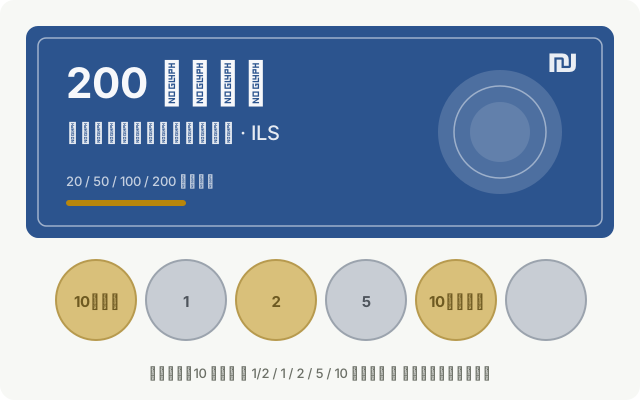
| Currency Name | Israeli new shekel (ILS), Jordanian dinar (JOD) |
|---|---|
| Currency Code | ILS |
| Currency Symbol | ₪ |
| Issuing Country | Palestine |
| Time Zone | UTC+2 to UTC+3 (UTC+3 during daylight saving time) |
| Dialling Code | +970 |
About Israeli new shekel (ILS), Jordanian dinar (JOD) (ILS)
Currency Overview
Palestine does not have its own official currency or central bank for issuing money. The Palestinian Monetary Authority (PMA) regulates banking and financial stability but does not print currency. The Israeli new shekel (currency code ILS, symbol ₪) is the most widely used currency in daily transactions. The Jordanian dinar (JOD) is also widely accepted in the West Bank, and U.S. dollars (USD) are commonly used in tourism, hotels, and some larger transactions.
Denominations
Since the Israeli new shekel is commonly used, common banknotes are in denominations of 20, 50, 100, and 200 ILS, with coins of 0.1, 0.5, 1, 2, 5, and 10 ILS (with 10 ILS mostly in coin form). Jordanian dinar banknotes come in denominations of 1, 5, 10, 20, and 50, with 1 dinar equal to 100 piastres. The dinar has higher value and purchasing power, often used for larger transactions. U.S. dollar bills are typically in denominations of 1, 5, 10, 20, 50, and 100.
When all three currencies are in use, pay close attention to the type of currency given as change and exchange rates to avoid confusion.
Cash and Payment Habits
Palestine is a cash-heavy society. Markets, small shops, taxis, and street vendors generally only accept cash. Local banks and ATMs are more common in major cities like Ramallah and Bethlehem but are scarce in remote areas and near checkpoints. Credit cards may be accepted in hotels, restaurants, and some shops, but availability is limited and can be affected by regional instability.
The Israeli new shekel is widely accepted in both the West Bank and Gaza Strip, while the Jordanian dinar is more commonly used in the West Bank than in Gaza. It’s advisable to bring a supply of Israeli new shekels and some U.S. dollars as backup.
Traveler Tips
- Carry plenty of small-denomination Israeli new shekel notes for everyday purchases.
- Check with your bank before using ATMs abroad, and be aware of any withdrawal fees.
- In remote areas, cash may be hard to access—stock up in major cities before heading out.
- Double-check the currency and exchange rate when receiving change in dinars or dollars.
Palestine Overview
Country Details »Overview of Palestine
Palestine (known in Arabic as فلسطين) is a political entity located on the eastern Mediterranean coast of Western Asia. It declared independence in 1988. In November 2012, the United Nations General Assembly passed a resolution granting Palestine non-member observer state status. As of recent years, over 140 UN member states have recognized its statehood, though some have not, and its final status remains an international issue to be resolved through negotiation. The territory claimed by Palestine includes the West Bank (including East Jerusalem) and the Gaza Strip, totaling about 6,020 square kilometers, with the West Bank covering approximately 5,655 square kilometers and the Gaza Strip around 365 square kilometers.
The declared capital of Palestine is Jerusalem, but its status is internationally disputed. The administrative center of the Palestinian National Authority is located in Ramallah in the West Bank. Some areas of the West Bank have limited self-governance under the Palestinian National Authority, while the governance and security situation in the Gaza Strip remains complex and fluid. These political and administrative arrangements are subjects of ongoing international attention. This description is provided for factual context only.
Geography and Climate
The West Bank is predominantly hilly and mountainous: the western part consists of coastal plains, which transition eastward into the highlands around Jerusalem and Hebron, then drop sharply into the Jordan Valley, leading down to the Dead Sea, the lowest point on Earth’s land surface (about 430 meters below sea level). The Gaza Strip is a narrow coastal plain along the eastern Mediterranean, approximately 41 kilometers long and 6 to 12 kilometers wide.
The region has a Mediterranean climate, characterized by hot, dry summers and cool, wet winters. Coastal areas enjoy milder conditions, while higher elevations may see occasional snow in winter. The Jordan Valley and Jericho area remain warm year-round, making them important for off-season agriculture. The best times to visit are typically spring and autumn.
Historical Background
The Palestinian region is one of the oldest continuously inhabited areas in the world. Jericho is believed to have been settled for over 10,000 years and is among the world’s earliest agricultural settlements. In ancient times, it was successively ruled by the Canaanites, the Kingdom of Israel, Assyria, Babylon, Persia, Greece, and Rome. After the rise of the Arab Caliphate in the 7th century, the region gradually became Arabized and Islamized. It later came under the rule of the Crusaders, Mamluks, and Ottoman Empire for nearly four centuries.
After World War I, the League of Nations placed Palestine under British Mandate. In 1947, the United Nations adopted a partition plan, and in 1948, the State of Israel was established, leading to wars that displaced many Palestinians. Following the 1967 Six-Day War, the West Bank and Gaza Strip came under Israeli occupation. In 1988, the Palestine National Council declared the establishment of the State of Palestine. The 1993 Oslo Accords established limited self-rule, and in 2012, Palestine was granted non-member observer state status by the United Nations.
Economy and Currency
Palestine’s economy is primarily based on services, agriculture, and construction. Olive cultivation and olive oil production play an important role, and remittances from overseas Palestinians, along with international aid, are significant sources of income. Since Palestine does not have its own national currency, the Israeli new shekel (ILS) is widely used, the Jordanian dinar (JOD) is commonly accepted in the West Bank, and U.S. dollars are often used in tourism and large transactions. The Palestinian Monetary Authority (PMA) does not issue currency but oversees the local banking sector.
Due to restrictions on the movement of people and goods, infrastructure limitations, and other factors, economic development faces significant challenges. Price levels in some cities are comparable to those in nearby countries, and travelers should budget for mid-to-upper-range travel costs.
Culture and Society
Palestinian society is predominantly Arab, with the majority of residents practicing Islam. There is also a sizable Christian community, with Bethlehem and the Old City of Jerusalem being important Christian holy sites. Different religious communities generally coexist in daily life. Traditional crafts such as embroidery (tatreez), olive wood carving, and pottery are distinctive, while the local cuisine features olive oil, za’atar spice mix, hummus, grilled meats, and desserts like knafeh.
Family values are strong, and hospitality is warm. Arabic coffee and mint tea are staples for welcoming guests. Arabic is the official language, English is widely spoken in tourist areas and among younger people, and public signage is often displayed in Arabic, Hebrew, and English.
Tourism Overview
Palestine offers rich religious and historical attractions: the Church of the Nativity in Bethlehem is one of the world’s oldest churches and a UNESCO World Heritage Site, believed to be the birthplace of Jesus; Jericho is an ancient city and archaeological hub; Ramallah’s markets, cultural centers, and government institutions reflect contemporary Palestinian life; the Old City of Hebron, Nablus, and Jenin retain distinct local character; and the Dead Sea coastline and Jordan Valley provide unique natural experiences.
It is important to note objectively that the local security situation is subject to significant uncertainty due to regional developments. Before traveling, consult security advisories from your country’s foreign ministry (e.g., the Consular Protection Center of your country’s foreign ministry) and carefully assess your itinerary. Prioritize areas with relatively stable conditions and use licensed guides. Comply with local regulations and avoid remote or unclear areas. Most travelers enter via Israel or Jordan, so allow ample time for border procedures.
Palestine Travel Guide
All Guides »Quick Guide to Traveling to Palestine: Permits, Best Seasons, Budget, and Safety Tips
Clarify your travel permits, the best travel seasons, your budget range, and rel...
7-Day Classic Palestine Itinerary: In-Depth Tour of Ramallah, Bethlehem, and Jericho 7 Days
Centered on the central West Bank, this itinerary connects Ramallah, Bethlehem, ...
4-Day Short Trip to Palestine: A Relaxed Journey Through Bethlehem and Jericho 4 days
When time is limited, focus on the highlights: religious sites in Bethlehem, anc...
Must-visit attractions in Palestine: A tour of religious sites in Bethlehem and ancient cityscapes
From the Church of the Nativity in Bethlehem to the ancient city of Jericho, and...
Palestinian Food Guide: Olive Oil, Hummus, and Knafeh Dessert
Mediterranean flavors with olive oil at their heart—from everyday dishes to mark...
Travel Guide to Transportation in Palestine: Border Crossings, Shared Taxis Between Cities, and Private Car Hire
This guide explains how to cross into Palestine through border checkpoints, how ...