Paraguay Currency Paraguayan GuaraniPYG
What money to use in Paraguay, how notes and coins break down, and the best ways to exchange - get the local cash sorted before you go.
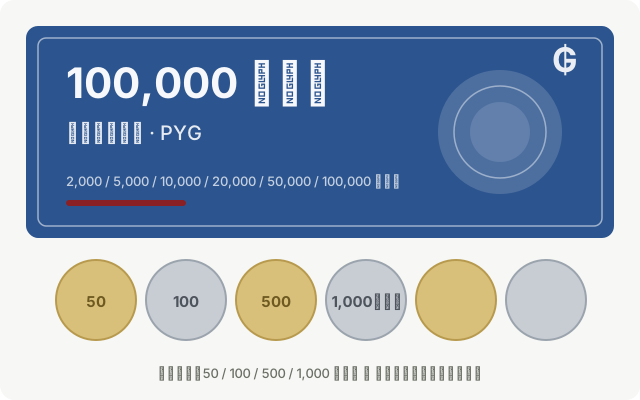
| Currency Name | Paraguayan Guarani |
|---|---|
| Currency Code | PYG |
| Currency Symbol | ₲ |
| Issuing Country | Paraguay |
| Time Zone | UTC-3 |
| Dialling Code | +595 |
About Paraguayan Guarani (PYG)
Currency Overview
The official currency of Paraguay is the Guaraní (currency code: PYG, symbol: ₲), named after the indigenous Guaraní people. It is issued by the Banco Central del Paraguay (Central Bank of Paraguay). The Guaraní is one of the highest-denomination currencies in South America, with roughly 7,000 Guaraníes to one US dollar (exchange rates vary daily), so prices are often in the tens of thousands, which may take some getting used to. The smallest unit, the centavo (céntimo), is no longer in circulation due to its extremely low value.
Denominations
Common banknotes in circulation include denominations of 2,000, 5,000, 10,000, 20,000, 50,000, and 100,000 Guaraníes. Each denomination varies in color and size. Banknote fronts typically feature portraits of historical figures, while backs depict landmarks or historical scenes. Coins come in 50, 100, 500, and 1,000 Guaraníes, with smaller coins of 1, 5, and 10 Guaraníes rarely seen in use. Due to low value, coins are mostly used for small change, and many shops or markets provide coin wrappers.
Cash and Payment Habits
Cash remains the primary form of payment in Paraguay. Small vendors, markets, buses, and taxis usually only accept cash. Credit cards can be used in larger malls, chain restaurants, and hotels, though it’s advisable to confirm whether foreign cards are accepted. The Ciudad del Este shopping district has higher acceptance of US dollars and foreign cards, while Asunción has more limited options. ATMs are available in urban areas and malls, but withdrawal fees tend to be high, so it’s best to withdraw larger amounts at once. As the Guaraní is not freely convertible, it is wise to spend or exchange remaining currency before leaving the country.
Tips for Travelers
- Prices often omit the last three zeros—e.g., “20” means 20,000 Guaraníes. Always confirm before paying.
- US dollars may be accepted in tourist areas, but change is usually given in Guaraníes, often at less favorable rates than banks.
- ATMs typically have low withdrawal limits and high fees, so withdraw larger amounts when possible.
- Large 100,000 Guaraní bills may be difficult to break in small shops, so carry smaller denominations.
Paraguay Overview
Country Details »Overview of Paraguay
Paraguay (officially the Republic of Paraguay) is a landlocked country in central South America, bordered by Brazil to the east, Argentina to the south and southwest, and Bolivia to the northwest. Covering an area of approximately 407,000 square kilometers, it is one of only two landlocked countries in South America. Its capital, Asunción, is located on the left bank of the Paraguay River and serves as the nation’s political, economic, and cultural center, with a metropolitan population of around 2.5 million. The country is divided into 17 departments and one capital district. The official languages are Spanish and Guaraní, making Paraguay unique in the Americas as the only country where an indigenous language is both official and widely spoken in daily life.
Paraguay is a presidential republic with an economy based primarily on agriculture, livestock, hydropower, and border trade. It is known for relatively low prices and a slow-paced lifestyle in South America, and enjoys generally stable social security outside major cities.
Geography and Climate
The Paraguay River runs north to south through the country, dividing it into eastern and western regions. The eastern part, known as Región Oriental, accounts for about 40% of the territory but is home to over 90% of the population. This region features a mix of hills, grasslands, and subtropical forests, and includes major cities such as Asunción, Ciudad del Este, and Encarnación. The western part, known as the Chaco region (Región Occidental), makes up about 60% of the country and consists of dry savannas and wetlands with a sparse population. It is primarily used for livestock grazing and soybean cultivation.
The climate is subtropical and humid. Summers (November to March) are hot and rainy, with temperatures in Asunción often exceeding 38°C. Winters (June to August) are mild, with occasional cool nights. Annual precipitation decreases from east to west, with the eastern region receiving around 1,400–1,800 mm and the Chaco region only 400–800 mm. The most comfortable travel period is during the dry season from May to September.
Historical Background
Paraguay was originally inhabited by the Guaraní people. After the arrival of the Spanish in the 16th century, the area became part of the Viceroyalty of the Río de la Plata. Between 1609 and 1768, Jesuit missionaries established a series of missions (reducciones) along the upper Paraná and Uruguay rivers, organizing the Guaraní people into settled communities where they farmed, made music, and practiced crafts. These missions have left behind heritage sites such as Trinidad and Jesús de Tavarangue, which were inscribed as UNESCO World Heritage Sites in 1993.
On May 14, 1811, Paraguay declared independence. The country subsequently experienced the isolationist rule of José Gaspar Rodríguez de Francia, followed by modernization efforts under the López family. The War of the Triple Alliance (1864–1870), fought against Brazil, Argentina, and Uruguay, caused massive loss of life and territory, marking the darkest chapter in Paraguayan history. The Chaco War (1932–1935) against Bolivia ended in victory for Paraguay. From 1954 to 1989, the country was under the long rule of Alfredo Stroessner before gradually transitioning to democracy, and is now one of the more politically stable nations in South America.
Economy and Currency
Paraguay’s economy relies heavily on agriculture, livestock, and electricity exports. Soybeans and beef are its two main exports. The country co-owns two major hydroelectric dams with neighboring countries—the Itaipú Dam with Brazil and the Yacyretá Dam with Argentina. Itaipú is one of the largest hydroelectric plants in the world by capacity, generating over 90% of Paraguay’s electricity needs, with surplus power sold abroad. The tri-border area between Ciudad del Este and the borders of Brazil and Argentina is a well-known duty-free shopping destination in South America. The national currency is the Paraguayan Guarani (PYG), whose large denominations contribute to generally affordable travel costs.
Culture and Society
Paraguayan culture is a blend of Guaraní indigenous traditions and Spanish colonial influences. Guaraní is not only an official language but also the everyday language for most households, often mixed with Spanish in daily conversation. Musically, the Paraguayan harp (arpa paraguaya) and traditional Guaraní songs are iconic, while ñandutí lace—a type of spiderweb-like embroidery produced in Itauguá—is a nationally treasured handicraft. The cuisine is based on cassava, corn, and cheese, with common dishes including chipa (cassava and cheese bread), sopa paraguaya (cornbread), and mbejú (cassava pancakes), often served at breakfast or with tea. Tereré, a cold-brewed maté tea, is a national beverage often shared among people using thermoses and small cups on the street.
Tourism Overview
Although not a mainstream destination in South America, Paraguay offers a quiet and authentic travel experience. In Asunción, visitors can explore the Palacio de los López, the National Pantheon of the Heroes, and the riverside promenade. Southern Encarnación is home to key Jesuit mission ruins, a major cultural highlight. The eastern border city of Ciudad del Este is ideal for shopping and offers easy access to the Brazilian side of Iguazú Falls. The Chaco region provides opportunities to experience Mennonite immigrant communities, wetlands, and wildlife. Transportation mainly relies on road and long-distance buses. Infrastructure and English proficiency are limited, making it suitable for travelers with some Spanish or Portuguese skills who enjoy slow-paced, immersive journeys.
Paraguay Travel Guide
All Guides »Paraguay Travel Quick Guide: Visa, Seasons, Budget & Etiquette
Sorting out your visa, travel season, budget, currency exchange, and social etiq...
Classic 7-Day Paraguay Itinerary: Asunción – Encarnación – Ciudad del Este 7 days
From the riverside old town of the capital to the Jesuit World Heritage Sites in...
4-Day Paraguay Itinerary: Asunción and Jesuit Missions 4 Days
When time is limited, base yourself in Asunción and string together a relaxed sh...
A must-visit attractions list in Paraguay: Asunción, Jesuit ruins, and border areas
A guide to over ten of the most worthwhile attractions in Paraguay by region, in...
Paraguay Food Guide: Chipa, Tereré, and Grilled Meats
From street cheese breads to hearty grilled meats, use this list to explore Para...
Paraguay Transportation Guide: Long-Distance Buses, Airport Transfers, and Private Cars
Intercity travel in Paraguay mainly relies on long-distance buses, while within ...