Honduras Currency Honduran LempiraHNL
What money to use in Honduras, how notes and coins break down, and the best ways to exchange - get the local cash sorted before you go.
| Currency Name | Honduran Lempira |
|---|---|
| Currency Code | HNL |
| Currency Symbol | L |
| Issuing Country | Honduras |
| Time Zone | UTC-6 |
| Dialling Code | +504 |
About Honduran Lempira (HNL)
Currency Overview
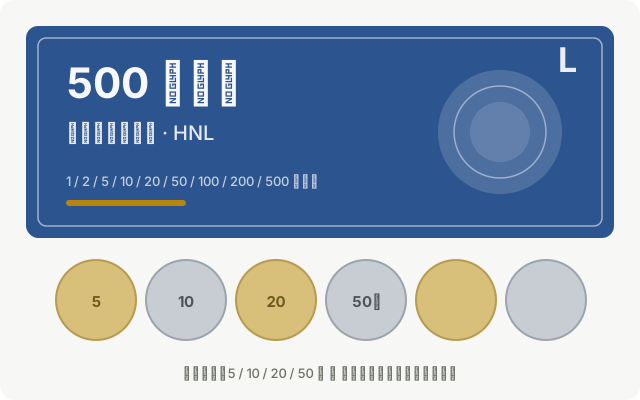
The official currency of Honduras is the Lempira (currency code: HNL, symbol: L), issued by the Central Bank of Honduras (Banco Central de Honduras). One lempira is equal to 100 centavos. The currency is named after Lempira, a 16th-century Lenca leader who resisted Spanish conquest—an unusual case in Latin American currency naming, as it honors an Indigenous leader. Banknotes and coins often feature his portrait and the national coat of arms. Honduras maintains a managed floating exchange rate set and regulated by the central bank. The lempira has shown a gradual depreciation against the U.S. dollar, historically hovering near 20:1, but in recent years it has adjusted to around 24–26 lempiras per dollar. Always check the current rate before traveling. Banknotes are issued by the central bank, while coins are minted under its authorization. Both old and new versions of banknotes and coins may circulate together, though some older denominations have been phased out over time.
Denominations
Commonly circulating banknotes include denominations of 1, 2, 5, 10, 20, 50, 100, 200, and 500 lempiras. The 1 and 2 lempira notes are less commonly seen, while 20, 100, 200, and 500 lempira notes are the most widely used. Banknote designs typically feature historical figures and landmarks on the front, and scenic or cultural motifs on the back—larger denominations may include Maya cultural elements. Coins come in 5, 10, 20, and 50 centavos, as well as 1, 2, 5, and 10 lempiras, often displaying the coat of arms and Lempira’s image. Different colors and patterns help distinguish denominations for easy recognition. When receiving change, pay attention to the note versions. Higher denominations like 200 and 500 lempiras should be checked carefully for counterfeits, and suspicious bills can be exchanged for verified ones.
Cash and Payment Practices
Cash remains the primary payment method in Honduras. Markets, street food stalls, buses, and rural shops generally only accept cash, as do taxis and minibuses. Major malls, hotels, and restaurants in Tegucigalpa and San Pedro Sula may accept international credit cards like Visa and Mastercard, but coverage is limited. UnionPay acceptance is minimal, so it’s advisable to exchange U.S. dollars for cash locally. The U.S. dollar is widely accepted in coastal tourist areas and on Roatán, but change is usually given in lempiras at a merchant-set exchange rate, which may be below the official bank rate. For larger purchases, it’s wise to confirm the payment terms in advance. Around holidays like Holy Week and Christmas, banks and exchange services may have reduced hours, so plan cash needs in advance.
Traveler Tips
- It’s recommended to carry U.S. dollars and exchange them for lempiras at banks or authorized exchange bureaus (casas de cambio); airport and tourist-area rates are usually less favorable.
- ATMs are available in major cities and tourist zones, but due to safety concerns, use machines inside malls or banks and avoid withdrawing cash at night. Don’t count money on the street after withdrawing.
- For small transactions, try to use bills close to the amount needed, as vendors may struggle to provide change for large bills.
- Keep receipts secure after card payments and avoid using credit cards in isolated locations. Try to use up lempiras before leaving the country, as exchanging them abroad can be difficult.
Honduras Overview
Country Details »Honduras at a Glance
Honduras is located in northern Central America, covering an area of about 112,500 square kilometers, making it the second-largest country in the region. It borders the Caribbean Sea to the north, the Gulf of Fonseca on the Pacific Ocean to the south, Guatemala to the west, El Salvador to the southwest, and Nicaragua to the southeast. The capital, Tegucigalpa, is situated in the Choluteca Valley of the central highlands and serves as the nation’s political, economic, and cultural center. It is also one of the higher-altitude capitals in Central America. Spanish is the official language, and the population is around 10.5 million, predominantly mestizo (of mixed Indigenous and European descent).
Honduras is a presidential republic divided into 18 departments. San Pedro Sula, the country’s second-largest city and a hub for commerce and industry, lies on the Caribbean coast in the north. It is also a traditional center for banana and coffee distribution. The Bay Islands (Islas de la Bahía), including Roatán and Utila, are world-renowned for diving and cruise tourism. With coastlines on both the Pacific Ocean and the Caribbean Sea, this geographic feature is also reflected in the blue and white stripes of the national flag.
Geography and Climate
Honduras is predominantly mountainous, with rugged ranges stretching across the central and western regions. The country can be divided into three main geographic zones: the hot and humid lowland plains along the northern Caribbean coast (including the expansive Mosquito Coast), the central highlands, and the southern Pacific coastal region along the Gulf of Fonseca. The country has numerous rivers, with the Ulúa River being the longest on the Caribbean side, while Lake Yojoa is the largest natural lake, popular for birdwatching and ecotourism.
The climate is tropical overall: the coastal lowlands are hot and humid year-round, with average temperatures between 25–30°C. The central highlands are more temperate, with Tegucigalpa averaging around 20–24°C and cooler mornings and evenings. The year is divided into a dry season (November to April) and a rainy season (May to October), with afternoon thunderstorms common during the latter. The northern Caribbean coast and the Bay Islands are prone to hurricanes from June to November, with the highest risk from September to October. The best time to visit is during the dry season from December to April, when road conditions and sea travel are most favorable.
Historical Background
The area now known as Honduras was part of the ancient Maya civilization. The western city of Copán flourished between the 5th and 9th centuries, becoming one of the most important city-states in the southern Maya region during the Classic Period. It left behind world-famous hieroglyphic stairways, ball courts, and temple complexes. After the 9th century, Copán declined, and the center of Maya civilization shifted northward. In 1502, Christopher Columbus reached the Caribbean coast during his fourth voyage, and the Spanish gradually conquered the region. By 1524, colonial settlements were established, and Honduras became a Spanish colony in Central America. Lempira, a leader of the Lenca people, led resistance against the Spanish in the 1530s and became a national hero, with the national currency named in his honor.
In 1821, Central America gained independence from Spain. From 1823 to 1838, Honduras was part of the Federal Republic of Central America before becoming an independent nation in 1838. During the late 19th and 20th centuries, U.S. fruit companies developed large banana plantations along the northern coast, leading to Honduras being nicknamed the “Banana Republic,” with its economy long dominated by foreign investment and single-crop exports. The 20th century saw multiple military coups and periods of political instability, until civilian government was restored in 1982. Since then, issues such as public security, gang violence, and economic development have remained major challenges.
Economy and Currency
Honduras is a mid-sized economy in Central America, with agriculture, manufacturing, and remittances forming the backbone of its economy. Key exports include coffee, bananas, shrimp, palm oil, cigars, and textiles and apparel. Coffee and cigars are particularly well-regarded in international markets, with tobacco from the Copán region serving as a premium ingredient for cigars, helping Honduras become one of the world’s leading cigar producers. Several maquiladoras (export processing zones) in the north provide jobs in textile and garment assembly. Remittances—mainly from the United States—make up a significant portion of GDP and are an important income source for many families.
The national currency is the Honduran Lempira (HNL, symbol L), issued by the Central Bank of Honduras. One lempira is equal to 100 centavos. Honduras has long maintained a managed floating exchange rate, with the lempira gradually depreciating against the U.S. dollar. While the dollar is not officially legal tender, it is widely accepted in tourist areas, especially in the Bay Islands and major resorts.
Culture and Society
Honduras is a multi-ethnic society. Mestizos make up the majority of the population, alongside several Indigenous groups. The Lenca people are the most prominent Indigenous group, living in the western and central-southern highlands. Along the northern Caribbean coast live the Garifuna, an Afro-Caribbean Indigenous people who speak Garifuna and are known for their drum music and dance. In 2001, the Garifuna language, dance, and music were recognized by UNESCO as Intangible Cultural Heritage of Humanity.
Honduran culture blends Spanish colonial traditions with Indigenous and Caribbean elements. Catholicism is widespread, and religious festivals are vibrant, such as celebrations in Garifuna villages in the north and Catholic Holy Week processions. Staple foods include tortillas, beans, rice, plantains, white cheese, and grilled meat, while coastal cuisine features seafood and coconut. Hondurans are known for their warmth and hospitality, with family and festivals playing central roles in social life. Football (soccer) is the most popular sport.
Tourism Overview
Honduras is famed for its Maya heritage, Caribbean islands, and diving opportunities. The Copán Maya ruins in the west are the country’s only UNESCO World Heritage Site, celebrated for their intricate carvings, hieroglyphic stairways, and ball courts. The Bay Islands—Roatán, Utila, and Guanaja—feature coral reefs that are part of the Mesoamerican Barrier Reef (the second-largest in the world), making them premier destinations for diving and snorkeling. The Garifuna villages along the Caribbean coast and inland attractions like Lake Yojoa and Lancetilla Botanical Garden offer a mix of nature and cultural experiences.
It should be noted that some Honduran cities face elevated levels of violent crime and gang activity (notably from groups like MS-13 and Barrio 18), especially in urban centers and along major transit routes, where risks are higher at night. In contrast, resort areas like Roatán and the Bay Islands, as well as the Copán archaeological sites, are relatively safer, often operating through chartered flights, cruises, or closed-off resort arrangements. Travelers should stay informed of the latest travel advisories, avoid going out at night, refrain from carrying large amounts of cash or valuables, and choose reputable tour operators and secure tourist areas if they decide to visit.
Honduras Travel Guide
All Guides »Honduras Travel Quick Guide: Visas, Seasons, Budget, Etiquette & Safety
Make sure you understand the visa requirements, dry season window, cost range, a...
Classic 7-day Honduras itinerary: Tegucigalpa — Copán — Lake Yojoa — Roatán 7 days
From the highland capital to Maya ruins and Caribbean coral islands, this route ...
Honduras 4-Day Short Trip: Roatán and the Bay Islands for Diving and Island-Hopping 4 days
For those who just want to enjoy the sea and dive, spend all four days in the Ca...
Must-visit attractions in Honduras: Mayan ruins, coffee plantations, and Caribbean islands
From the hieroglyphic stairway in Copán to the coral reefs of Roatán, here’s a r...
Honduras Food Guide: From Baleadas to Caribbean Seafood
Corn tortillas, refried beans, coconut, and seafood form the foundation of Hondu...
Complete Guide to Transportation in Honduras: Airports, Long-Distance Buses, Ferries, and Local Transit
Three major international airports, reputable bus companies, and Gulf Islands fe...