Montenegro Currency EuroEUR
What money to use in Montenegro, how notes and coins break down, and the best ways to exchange - get the local cash sorted before you go.
| Currency Name | Euro |
|---|---|
| Currency Code | EUR |
| Currency Symbol | € |
| Issuing Country | Montenegro |
| Time Zone | UTC+1 |
| Dialling Code | +382 |
About Euro (EUR)
Currency Overview
The official currency of Montenegro is the euro (currency code: EUR, symbol: €). However, it’s important to note: Montenegro is neither an EU member nor part of the eurozone. It unilaterally adopted the euro in 2002—previously using the German mark after hyperinflation rendered the Yugoslav dinar unusable in 1999. As a result, Montenegro does not have its own central bank issuing euros, nor can it mint euro coins with national designs. All circulating coins come from various eurozone member states, distinguishing it fundamentally from countries like France or Italy.
Denominations
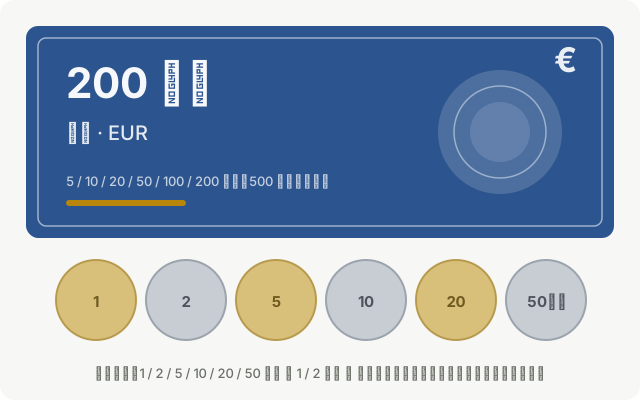
Seven euro banknote denominations are in circulation: €5, €10, €20, €50, €100, €200, and €500, all featuring the standardized "European-style" design used across the eurozone. Coins come in denominations of €1, €2, and 1, 2, 5, 10, 20, and 50 cents. Since Montenegro does not mint its own coins, a mix of coins from Germany, France, Italy, Greece, and other eurozone countries circulates, making coin collecting a minor pastime for travelers. In daily transactions, €500 notes are rarely accepted—stick to denominations below €50.
Cash and Payment Habits
Montenegro has a generally good card payment environment: restaurants, hotels in Kotor and Budva, and shops in Podgorica widely accept Visa/Mastercard, and ATMs are ubiquitous in towns. However, local buses, taxis, beachside stalls, farmers' markets, and rural konobas (taverns) still primarily deal in cash. Some guesthouses may also require cash payment during the summer peak season. It’s advisable to carry €30–€60 in cash per person per day, with the rest on cards. At beach attractions and Kotor’s city walls entrance, only euro cash or cards are accepted—keep small bills handy. Prices at coastal destinations, especially Budva, can be nearly double those in inland towns like Nikšić during the summer peak season.
Traveler Tips
- Montenegro does not issue its own currency, so there’s no need to exchange money—bring euros or withdraw them abroad.
- Some ATMs (especially Euronet machines near the coast) have high fees and poor exchange rates; prioritize bank branches.
- Always carry small bills (€5/€10/€20) for night markets, buses, and taxis, as change for larger bills is often refused.
- Leftover euro coins cannot be exchanged at most places before departure—spend them at cafes or supermarkets beforehand.
Montenegro Overview
Country Details »Overview of Montenegro
Montenegro (Montenegrin: Crna Gora, meaning "Black Mountain") is located in the central-western part of the Balkan Peninsula in southeastern Europe. It borders the Adriatic Sea to the southwest and shares land borders with Croatia, Bosnia and Herzegovina, Serbia, Kosovo, and Albania. The country covers an area of approximately 13,812 square kilometers, with a coastline of about 293 kilometers, making it one of Europe’s smaller yet geographically diverse nations. With a population of around 620,000, its capital, Podgorica, serves as the political, economic, and transportation hub. The former royal capital, Cetinje, holds the nation’s historical legacy, while the coastal cities of Kotor and Budva are its most renowned travel gateways.
In May 2006, Montenegro held a referendum in which 55.3% voted in favor of ending its state union with Serbia, restoring its status as an independent nation. It is now a member of the United Nations and NATO and has initiated EU accession negotiations. The official language is Montenegrin, and the main ethnic groups include Montenegrins, Serbs, Bosniaks, and Albanians, making it a quintessential multiethnic small country.
Geography and Climate
Montenegro’s landscape encapsulates the essence of the Balkans: its coastal region features a narrow Mediterranean strip, with the famous Bay of Kotor extending nearly 30 kilometers inland, flanked by cliffs over a thousand meters high—making it one of the most winding and picturesque bays in the Adriatic. The majority of the country consists of inland mountains, with Bobotov Kuk in Durmitor National Park standing as the highest peak at 2,525 meters. The Tara River Canyon, with a depth of about 1,300 meters, is one of Europe’s deepest river gorges. Lake Skadar, shared with Albania, is the largest lake in the Balkans, and Biogradska Gora National Park preserves one of Europe’s last remaining primeval rainforests and glacial lakes.
The climate is distinctly divided: the coastal area enjoys a Mediterranean climate with hot, dry summers and mild, rainy winters, offering a swimming season from May to October. The inland mountainous regions have a temperate continental or even alpine climate, with cold, snowy winters—Žabljak is a well-known ski destination in the Balkans. Summers in the mountains are cool and pleasant, with temperature differences of over 10°C compared to the coast.
Historical Background
The Montenegrin region was originally inhabited by the Illyrians in antiquity and became part of the Roman province of Dalmatia. Between the 6th and 7th centuries, Slavs migrated into the area. During the Middle Ages, the states of Duklja and Zeta emerged. Coastal areas like Kotor have been under Venetian rule since 1420, leaving a strong Venetian architectural influence. The inland mountains were never fully conquered by the Ottoman Empire, and the theocratic system of the Prince-Bishops (vladikas) in Cetinje helped preserve Montenegrin independence. Petar II Petrović-Njegoš, both a religious leader and the author of the epic *The Mountain Wreath*, is revered as a national symbol.
In 1852, Montenegro became a secular principality, and its independence was formally recognized at the Congress of Berlin in 1878. It was proclaimed a kingdom in 1910. After World War I, it joined the Kingdom of Serbs, Croats, and Slovenes, later becoming part of the Kingdom of Yugoslavia, then enduring World War II and the socialist Yugoslav era. Following the breakup of Yugoslavia in 1992, Montenegro formed a union with Serbia, which was restructured as "Serbia and Montenegro" in 2003 before gaining independence through a 2006 referendum. Montenegro joined NATO in 2017 and has since been an EU accession candidate.
Economy and Currency
Montenegro is a small upper-middle-income economy with a strong services sector. Tourism contributes about a quarter of GDP, with distinct summer (coastal) and winter (mountain) seasons. Key industries include aluminum (Podgorica Aluminum Plant), energy, and agriculture (wine, smoked ham, olive oil). Notably, although not an EU member, Montenegro unilaterally adopted the euro as its official currency in 2002—having previously replaced the Yugoslav dinar with the German mark in 1999 due to hyperinflation. This makes it one of the few "euroized" non-EU countries without a central bank issuing its own currency. In recent years, the real estate sector and "citizenship-by-investment" programs have attracted foreign investment, with the economy heavily reliant on tourism and external investment.
Culture and Society
Montenegro is a multiethnic, multireligious society: Eastern Orthodox Christianity predominates in the east and north, mosques are concentrated in areas like Ulcinj, Bar, and the New Pazari direction, while coastal towns such as Kotor and Perast feature numerous Catholic churches—often with all three types of religious architecture visible in the same view. Social life revolves around family, coffee, and kafanas (traditional restaurants). It’s common for hosts to offer rakija (fruit brandy), ham, and cheese to guests. Njegoš’s *The Mountain Wreath* is regarded as a national literary masterpiece, and Cetinje’s palaces, monasteries, and national museums are essential for understanding Montenegrin history.
Tourism Overview
Montenegro’s tourism industry is well-developed: the Old Town of Kotor with its nearly 5-kilometer-long walls, Perast and Our Lady of the Rocks island, the Budva Riviera and Sveti Stefan island form a classic coastal route; inland, Durmitor National Park’s Black Lake, the Tara River Canyon Bridge (prototype of the bridge in the Yugoslav film *The Bridge* and a renowned European rafting spot), and Ostrog Monastery showcase the country’s mountains and faith. May–June and September–October offer comfortable weather and moderate prices and crowds, while July–August sees high prices and limited parking at the coast. Montenegro is also often combined with Croatia’s Dubrovnik, Albania, and Bosnia and Herzegovina in Balkan road trip itineraries, ideal for self-drive exploration.
Montenegro Travel Guide
All Guides »Montenegro Travel Quick Guide: Visa Policy, Best Seasons, Budget Planning & Etiquette Taboos
Before heading to Montenegro, get up to speed on visa-free entry requirements, e...
Classic Montenegro 7-Day Itinerary: Kotor Bay – Budva – Cetinje – Durmitor – Lake Skadar 7 days
Experience the highlights of Montenegro in one trip: the ancient seaside town of...
Montenegro 4-Day Coastal Short Trip: Kotor – Perast – Budva – Sveti Stefan 4 Days
Explore Kotor Bay Even on a Short Holiday: Base yourself at a guesthouse in the ...
Must-visit attractions in Montenegro: From the ancient town of Kotor Fjord to Durmitor and Tara River Canyons
A curated list of 13 top attractions in Montenegro, organized by coastal, mounta...
Montenegro Food Guide: Adriatic Seafood, Mountain Grills, and Njeguški Cured Ham
Montenegrin cuisine is split between sea and mountain: enjoy fresh seafood in Ko...
Complete Guide to Transportation in Montenegro: Two Major Airports, Intercity Buses, and Scenic Mountain Driving
Montenegro has no direct flights from most countries. Most travelers arrive via ...