Romania Currency Romanian LeuRON
What money to use in Romania, how notes and coins break down, and the best ways to exchange - get the local cash sorted before you go.
| Currency Name | Romanian Leu |
|---|---|
| Currency Code | RON |
| Currency Symbol | lei |
| Issuing Country | Romania |
| Time Zone | UTC+2 to UTC+3 |
| Dialling Code | +40 |
About Romanian Leu (RON)
Currency Overview
The official currency of Romania is the Romanian Leu (plural Lei; currency code RON, symbol lei, often written as 10 lei). One leu is equal to 100 bani. The leu is issued by the National Bank of Romania (BNR), and in 2005, a currency reform was implemented, exchanging 10,000 old lei for 1 new leu. It is important to note that although Romania is an EU member and part of the Schengen Area, it has not adopted the euro and still uses its national currency. Do not assume that euros are widely accepted when traveling to Romania.
Denomination System
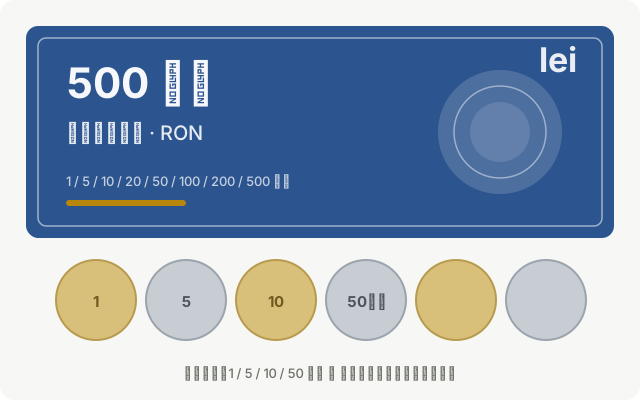
Current banknotes are all made of polymer and come in denominations of 1, 5, 10, 20, 50, 100, 200, and 500 lei. The figures featured on the notes include writers, scientists, and musicians, such as the poet Mihai Eminescu on the 5-lei note and the mathematician Alexandru Macedonski on the 10-lei note. Transparent windows and tactile marks are among their distinguishing features. Coins are available in 5, 10, and 50 bani, and while 1-leu coins are still legally in circulation, they are less commonly seen. The most commonly used denominations in daily transactions are 10, 50, and 100-leu banknotes.
Cash and Payment Habits
Romania has one of the highest rates of card payments in Europe: restaurants, supermarkets, gas stations, and even street food vendors in cities like Bucharest, Cluj, and Sibiu generally accept Visa/Mastercard and contactless payments. However, cash is still essential at rural markets, intercity minibuses, some guesthouses, and parking lots in old towns. ATMs are widespread in urban areas and commercial districts, and foreign cards can be used to withdraw lei. It is advisable to withdraw cash directly from ATMs rather than exchanging money in your home country, as the exchange rates are more favorable.
Exchange offices at airports and train stations usually offer poor rates, while those in city centers and authorized exchange bureaus are better. The leu is generally not available for exchange within many countries, so it is recommended to use up any remaining cash before departure. Overall, preparing around 100–150 lei per person per day in cash will cover most situations, with the rest of your expenses easily payable by card.
Traveler Tips
- Romania is not part of the eurozone; prices and transactions are in lei, so do not ask merchants to quote in euros.
- The adoption of the euro has been repeatedly postponed, so keep an eye on the latest official announcements before your trip.
- Cash is often required at rural markets, intercity minibuses, and old-town parking lots, so carry sufficient small denominations (10–50 lei).
- When using ATMs, prioritize bank-owned machines and avoid those from unknown sources with high fees.
- Restaurant bills generally do not include a service charge, but leaving around 5–10% as a tip for good service is customary.
Romania Overview
Country Details »Overview of Romania
Romania is located in southeastern Europe, in the northeastern part of the Balkan Peninsula. It borders Ukraine and Moldova to the north, Hungary and Serbia to the west, Bulgaria to the south, and the Black Sea to the southeast. The country covers an area of approximately 238,400 square kilometers and is one of the larger countries in the EU in terms of both area and population. Its capital, Bucharest, is situated on the Wallachian Plain in the southern part of the country and serves as Romania’s political, economic, and cultural center, with a population of around 1.8 million.
Romania is a semi-presidential republic and joined the European Union in 2007. Its official language is Romanian, an Eastern Romance language derived from Latin, making Romania a unique bastion of Roman heritage in Eastern Europe. The country’s name also directly originates from ancient Rome.
Geography and Climate
Romania’s terrain is distributed in concentric circles: the Carpathian Mountains, which form an arc, extend across the central-northern part of the country, with the highest peak, Moldoveanu, reaching 2,544 meters above sea level. Surrounding the mountains are the Transylvanian Plateau and the Moldavian and Dobrujan hills. The southern and western parts consist of the Danube Plain and the Tisza Plain. The Danube River, Europe’s second-longest, forms one of the best-preserved river deltas in Europe—the Danube Delta—in the eastern region, which has been designated a UNESCO World Natural Heritage site.
The climate is temperate continental, with distinct seasons: summers (June to August) are hot on the plains and cool in the mountains; winters (December to February) are cold and snowy, with the Carpathian Mountains being a popular destination for skiing. Spring and autumn have mild temperatures, making them ideal for city and rural exploration. The famous Transfăgărășan mountain road is only fully open from around July to October each year, making it a seasonal highlight for driving enthusiasts.
Historical Background
Romania’s history dates back to the Dacians. In 106 AD, Emperor Trajan incorporated the region into the Roman Empire, forming the ancestral memory of the Daco-Roman people. From the Middle Ages, the three principalities of Wallachia, Moldavia, and Transylvania coexisted. Vlad III, Prince of Wallachia (known as Vlad the Impaler), known for his harsh methods and resistance against the Ottoman Empire, became the prototype for the later Dracula legend. His connection to Bran Castle has made Transylvania the birthplace of global vampire literature.
In 1600, the three principalities were briefly unified. In 1859, Wallachia and Moldavia merged to form the United Principalities of Romania, and independence was declared in 1877. After World War I, Transylvania was incorporated, forming Greater Romania. After World War II, the country entered a socialist period under Nicolae Ceaușescu’s nearly 25-year rule, which ended with the 1989 revolution. The Palace of the Parliament, completed in Bucharest in 1991, remains the world’s second-largest administrative building and is the most controversial legacy of that era. Romania joined NATO in 2004 and the European Union in 2007.
Economy and Currency
Romania is a medium-sized economy within the EU, with key industries including automobile manufacturing (Dacia), IT and software outsourcing, agriculture, and energy. Bucharest and Cluj-Napoca have become well-known technology hubs in Central and Eastern Europe. The official currency is the Romanian Leu (RON), with 1 leu equal to 100 bani. Romania has not yet adopted the euro and continues to use its national currency. Plans to join the eurozone have been repeatedly postponed, so leu is the primary currency for transactions during travel.
Culture and Society
Romanian culture is a melting pot of Latin, Slavic, Greek, Hungarian, and German traditions. The fortified churches and church villages of Transylvanian Saxons, the painted monasteries of northern Moldavia, and the woodcarvings and embroidery preserved in village museums are all testaments to this diverse heritage. Folklore and traditional customs remain strong, with rural markets, traditional costume festivals, and Easter egg-painting customs still thriving.
The cuisine reflects Balkan and Central European influences, with national dishes such as sarmale (cabbage rolls), mămăligă (polenta), mici (grilled sausages without casings), and ciorbă de burtă (tripe soup). Meals are often followed by Țuică, a plum brandy. Romanians are hospitable and family-oriented, with Orthodox Christianity being the predominant religion. Easter and Christmas are the most important holidays of the year.
Tourism Overview
Romania is an exceptionally value-for-money travel destination in Europe. Highlights include the Palace of the Parliament and tree-lined boulevards of Bucharest, medieval cities like Sibiu and Sighișoara in Transylvania, Bran Castle and Peleș Castle, the birdwatching paradise of the Danube Delta, and the winding mountain road of Transfăgărășan. Coupled with accommodation and dining costs that are roughly half of those in Western Europe, Romania is a prime choice for “affordable in-depth travel in Europe,” particularly appealing to driving enthusiasts and lovers of ancient cities.
Romania Travel Guide
All Guides »Romania Travel Quick Guide: Schengen, Seasons, Budget & Taboos
Romania is part of the Schengen Area but still uses the leu. Get your visa, moun...
Classic 8-Day Romania Itinerary: Bucharest – Castles – Transylvania 8 days
Visit the capital’s palaces, Bran Castle, the historic towns of Sighișoara and S...
Romania 4-Day Short Trip: Bucharest and Transylvania Highlights 4 days
Even with just 4 days, you can experience the essence of Romania: two days in th...
Essential Attractions in Romania: Palaces, Castles, and Natural Wonders
From the world’s second-largest building to a vampire castle, and on to the Danu...
Romanian Cuisine Guide: Sarmale, Mămăligă, and the BBQ Culture
Stuffed cabbage rolls, cornmeal porridge, and skinless grilled sausages define t...
Complete Guide to Transportation in Romania: Airports, Trains, Buses, and Driving
Trains are slow, buses are fast, and driving is fun — understand Romania’s three...