Liberia Currency Liberian DollarLRD
What money to use in Liberia, how notes and coins break down, and the best ways to exchange - get the local cash sorted before you go.
| Currency Name | Liberian Dollar |
|---|---|
| Currency Code | LRD |
| Currency Symbol | L$ |
| Issuing Country | Liberia |
| Time Zone | UTC+0 (Greenwich Mean Time) |
| Dialling Code | +231 |
About Liberian Dollar (LRD)
Currency Overview
The official currency of Liberia is the Liberian Dollar (currency code LRD, symbol L$), issued by the Central Bank of Liberia. The Liberian Dollar replaced the British West African pound in 1943 and has undergone several value adjustments since. Current banknotes and coins are uniformly printed and issued by the Central Bank. The most unique aspect today is that the US Dollar (USD) also circulates freely and has legal tender status, creating a dual-currency system rarely seen in Africa, a legacy of colonial and immigrant history.
Denominations
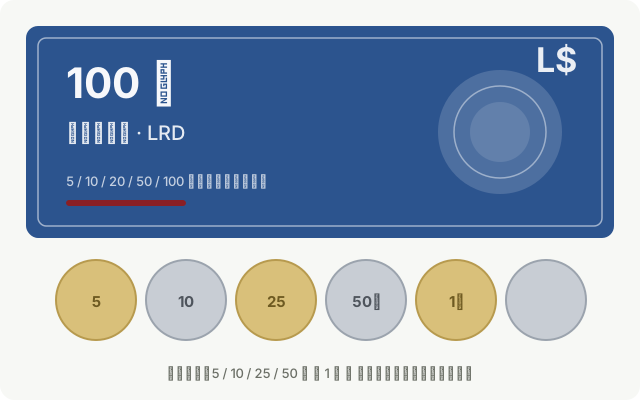
Circulating Liberian Dollar banknotes come in denominations of 5, 10, 20, 50, 100, and 500, featuring the national emblem, historical figures, and local cultural designs, with clear color distinctions among denominations. Coins are issued in 5, 10, 25, 50 cents, and 1 Dollar, but due to their low value and high circulation costs, coins are rarely used in daily transactions, mostly appearing in small change. Banknotes feature themes of national history and nature, with the 500 Dollar note being a higher denomination but having limited purchasing power, often requiring carrying bundles of cash when traveling.
Cash and Payment Habits
Electronic payments and card usage are not widespread in Liberia, and most transactions require cash, so visitors must carry sufficient amounts. In practice, USD is used for hotels, long-distance car rentals, formal restaurants, and larger purchases, with merchants converting USD to LRD for change based on the day’s approximate exchange rate. LRD is used for markets, street food, taxis, and small daily expenses. As both currencies are used interchangeably, always confirm the pricing currency with merchants before paying to avoid confusion. The same item may be priced in USD or local currency at different stalls, so it’s best to ask the price first and then choose the appropriate currency. When exchanging or receiving change in foreign-facing venues, also check whether the exchange rate is reasonable.
Traveler Tips
- It’s recommended to carry USD cash and exchange some into LRD upon arrival, with smaller denominations (1, 5, 10 USD) being most practical.
- USD banknotes should be newer issues; older bills issued before 2006 or those with markings and damage are often refused.
- Liberian Dollars can be exchanged at airports, banks, and authorized exchange points in the city, but private street exchanges should be approached with caution and counted in person.
- Liberian Dollar exchange rates fluctuate significantly, so try to use or exchange remaining LRD back to USD before departure.
- Markets and street vendors often accept both USD and local currency, so confirming the currency beforehand can save trouble.
Liberia Overview
Country Details »Overview of Liberia
Liberia is located in West Africa, bordering the Atlantic Ocean, with Sierra Leone to the northwest, Guinea to the north, and Côte d'Ivoire to the east. Covering an area of approximately 111,400 square kilometers, its capital Monrovia is the country’s largest city and political and economic center. English is the official language, and dozens of local languages such as Kpelle and Bassa are also widely spoken. Liberia is the earliest established republic in Africa, declaring independence in 1847, more than a century earlier than most African nations.
The name Liberia comes from the Latin word 'liber,' meaning free, and the country’s founding is closely tied to the American abolitionist movement. In the early 19th century, the American Colonization Society promoted relocating freed Black people to the West African coast. The first group of immigrants landed on Providence Island in 1822, gradually establishing settlements, and declared independence on July 26, 1847, becoming Africa’s first republic. This unique history has influenced many details of Liberia’s flag, political system, and social structure.
Geography and Climate
Liberia has higher elevations in the north and lower in the south, roughly divided into three regions from southwest to northeast: coastal plains, inland hills, and northern plateaus. With a coastline of about 580 kilometers featuring many sandbars and lagoons, its interior is covered by vast tropical rainforests, with the Nimba Mountains being an important biodiversity hotspot in West Africa. Sapo National Park is the country’s largest protected area, preserving pristine lowland rainforests and diverse wildlife including primates and forest elephants.
The climate is tropical monsoon, characterized by high temperatures and humidity year-round, with distinct dry and rainy seasons. The dry season runs from November to April, with December to February being the driest and most ideal time to visit. The rainy season from May to October features concentrated rainfall and muddy roads, particularly in coastal areas. Average annual temperatures hover around 25°C, with high humidity, so sun protection and mosquito prevention are necessary year-round.
Historical Background
In 1822, the first group of freed Black immigrants organized by the American Colonization Society landed on Providence Island near Monrovia, and subsequently established multiple settlements. Liberia declared independence in 1847, becoming Africa’s first republic. In the early 20th century, rubber cultivation and iron ore mining drove the economy, and Monrovia was once an important port city in West Africa.
From 1989, Liberia endured over a decade of civil war, which severely damaged infrastructure and livelihoods until a peace agreement was reached in 2003. In 2005, Ellen Johnson Sirleaf was elected president, becoming Africa’s first democratically elected female head of state, and she was awarded the Nobel Peace Prize in 2011. The 2014 West African Ebola outbreak severely impacted Liberia, and the country has since been in a challenging and ongoing process of reconstruction, with gradual improvements in security and infrastructure in recent years.
Economy and Currency
Liberia’s economy is primarily based on primary industries, with natural rubber, iron ore, timber, palm oil, and gold as main exports. Agriculture and mining employ a large portion of the workforce. Due to weak industrial infrastructure, daily necessities heavily rely on imports, resulting in relatively high prices. The Liberian Dollar (LRD) and US Dollar circulate side by side domestically, forming a rare dual-currency system in Africa: larger transactions, hotels, and foreign-facing businesses generally use USD, while small daily purchases often use LRD, with mixed change given.
Culture and Society
Liberia is home to over ten ethnic groups including Kpelle, Bassa, Gio, and Mano, each preserving their own music, dance, oral traditions, and secret societies. Drumming and choral singing are central to festivals and ceremonies. Religiously, Christianity and Islam coexist, with traditional beliefs still holding influence. The overall pace of life is relaxed, with strong family and community ties and warm hospitality, though public services and social security remain relatively weak due to past conflicts.
The staple diet includes rice, cassava, and plantains, accompanied by palm oil stews, peanut soup, and pepper fish. Common street foods like fried bananas and grilled corn are affordable and delicious. Coastal areas offer abundant seafood, and Monrovia’s fish markets and night markets are great places to sample local flavors.
Tourism Overview
Liberia’s tourism industry is still in its early stages, offering untouched natural beauty and fewer crowds. Key attractions include Providence Island and the National Museum in Monrovia, surfing spots at Sangu Beach in Robertsport, coastal scenery in Buchanan and Harper, and rainforest hikes in Sapo National Park. Overall, Liberia has limited road, accommodation, and medical facilities, with risks of infectious diseases like malaria and typhoid. Travelers should prepare thoroughly, follow official travel advice, prioritize visiting cities with adequate services, and avoid nighttime or remote solo travel.
Liberia Travel Guide
All Guides »Liberia Travel Quick Guide: Visa, Seasons, Budget & Safety Etiquette Essentials
Get clarity on visa requirements, seasonal timing, budgeting, and safety before ...
Liberia 7-Day Classic Route: Monrovia – Robertsport – Sapo Rainforest 7 days
This long-distance itinerary weaves together the capital’s culture, coastal surf...
Liberia 4-Day Short Trip: A Relaxed Getaway to Monrovia and Sango Beach 4 days
Based in the capital, this itinerary combines Liberian history and Atlantic coas...
Essential Attractions in Liberia: From Monrovia’s Coast to Sapo’s Pristine Rainforest
A curated list of Liberia’s top destinations by city and natural landscape, incl...
Liberia Food Guide: Palm Oil Stews, Cassava Staples, and Coastal Seafood
From street stalls to seaside fish markets, explore Liberia’s flavor map and foo...
Liberia Transportation Guide: Airport Transfers, Shared Taxis, and Intercity Car Hire
Road conditions are limited and cash is king — get clear on three types of trans...