Spain Currency EuroEUR
What money to use in Spain, how notes and coins break down, and the best ways to exchange - get the local cash sorted before you go.
| Currency Name | Euro |
|---|---|
| Currency Code | EUR |
| Currency Symbol | € |
| Issuing Country | Spain |
| Time Zone | UTC+1 (GMT+1) |
| Dialling Code | +34 |
About Euro (EUR)
Currency Overview
The official currency of Spain is the euro (currency code EUR, symbol €), issued by the Eurosystem of the European Central Bank. The Banco de España (Bank of Spain) is a member of the Eurosystem. The euro has been in use as a virtual currency since 1999 and officially introduced as banknotes and coins in 2002, replacing the former Spanish peseta. One euro is equal to 100 cents.
Denominations
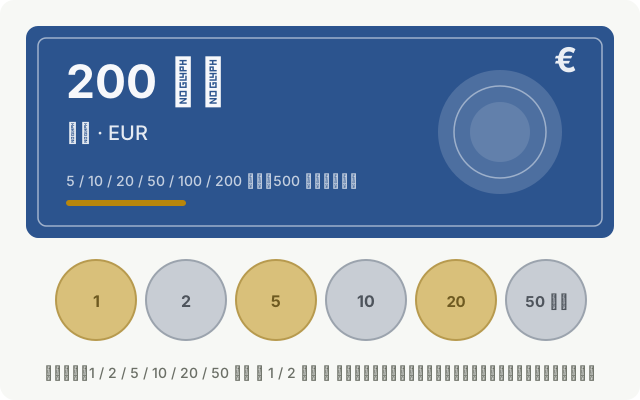
Euro banknotes have a unified design across the Eurozone and come in seven denominations: €5, €10, €20, €50, €100, €200, and €500. They are distinguished by different colors and architectural styles representing various periods in European history—€5 (grey), €10 (red), €20 (blue), €50 (orange), €100 (green), €200 (yellow-brown), and €500 (purple). The €500 note is no longer issued but remains legal tender and can be exchanged. The most commonly used denominations for travelers are €5, €10, €20, and €50. Larger denominations (€100 and above) may not be accepted at smaller shops.
Euro coins come in eight denominations: €1, €2, and 1, 2, 5, 10, 20, and 50 cents. The common side of the coins is the same across all Eurozone countries, while the national side is unique to each member state. On Spanish coins, the national side features: the Santiago de Compostela Cathedral on the 1, 2, and 5-cent coins; writer Miguel de Cervantes on the 10, 20, and 50-cent coins; and portraits of the Spanish king (previously Juan Carlos I, now updated to Felipe VI) on the €1 and €2 coins. Different versions from various years may co-circulate.
Cash and Payment Habits
Cash is still widely used in Spain, especially in small bars, traditional markets, bakeries, and rural shops. However, credit and mobile payments are increasingly common in cities and tourist areas. Visa, Mastercard, and UnionPay cards are accepted at most merchants. When ordering a beer with tapas at a bar, many locals still prefer to pay in cash. Spain has a dense network of bank branches, and cash can be withdrawn from ATMs. Look for machines marked with Cirrus or Plus symbols.
It is advisable to carry around €50–100 in small bills for snacks, public transport, and markets, while using cards for other expenses. Exchange cash at banks or authorized exchange offices, as rates at tourist-area kiosks are often unfavorable. Some ATMs may offer Dynamic Currency Conversion (DCC)—always choose to be charged in euros to save money.
Traveler Tips
- Some restaurants in Spain charge extra for terrace seating, and bread or snacks included without request may incur additional fees.
- Tipping is not mandatory but appreciated. Leave small change or round up the bill. In upscale restaurants, 5% is reasonable for good service.
- Shops, especially in small towns, often have long lunch breaks, typically from 14:00 to 17:00.
- ATMs and card machines may prompt Dynamic Currency Conversion—always opt to pay in euros.
- Tax-free shopping is available at stores displaying the Global Blue or Tax Free signs. Get your refund stamped or processed at the airport before departure.
Spain Overview
Country Details »Overview of Spain
Spain (the Kingdom of Spain) is located on the Iberian Peninsula in southwestern Europe, covering about five-sixths of the peninsula. It borders the Mediterranean Sea to the east, faces Morocco across the Strait of Gibraltar to the south, neighbors Portugal to the west, and is bordered by France to the northeast via the Pyrenees mountain range. Its territory also includes the Balearic Islands in the Mediterranean, the Canary Islands in the Atlantic Ocean, as well as the North African enclaves of Ceuta and Melilla. The country covers an area of approximately 506,000 square kilometers, with a population of around 48 million. The capital, Madrid, is situated on a plateau in the central part of the country and serves as the national political, economic, and transportation hub.
Spain is a constitutional monarchy, with the king as the head of state, and both parliament and the prime minister share executive power. The country is divided into 17 autonomous communities and 2 autonomous cities. Regions such as Catalonia, the Basque Country, and Galicia have strong linguistic and regional identities. Spain is a member of the European Union, the Schengen Area, and the Eurozone, as well as NATO. Its economy is among the largest in the Eurozone.
Geography and Climate
Spain’s landscape is dominated by plateaus and mountains: the central region is a vast plateau known as the Meseta, surrounded by mountain ranges. The Pyrenees lie to the northeast, and the Sierra Nevada to the south, where Mulhacén, the highest peak on the Iberian Peninsula (approximately 3,479 meters above sea level), is located. Major rivers include the Tagus, Ebro, and Guadalquivir. The extensive coastline is divided into the Mediterranean coast, the Atlantic coast, and the Bay of Biscay coast, each with its own distinct character.
The climate varies significantly by region: the central plateau has a continental climate, with cold winters, hot summers, and large diurnal temperature variations; the northern and northwestern regions, including Galicia, are influenced by the Atlantic, resulting in a humid, rainy climate with cool summers; the eastern and southern Mediterranean coastal areas and Andalusia experience hot, dry summers and mild winters, typical of the Mediterranean climate; the Canary Islands, located off the northwest coast of Africa, enjoy year-round warmth and are known as the "Land of Eternal Spring." The best travel seasons are from March to May and September to October. Avoid prolonged outdoor activities under the midday sun in southern Spain during peak summer.
Historical Background
The earliest inhabitants of the Iberian Peninsula included the Iberians and Celts. Later, the Phoenicians, Greeks, and Carthaginians successively settled here. The Roman Empire ruled the peninsula for several centuries starting from the 3rd century BC, leaving behind relics such as the Aqueduct of Segovia and the Theatre of Mérida. In 711 AD, Muslim Moors from North Africa crossed the sea and conquered the peninsula, establishing nearly eight centuries of Islamic rule. The Caliphate of Córdoba and the Nasrid Dynasty of Granada created the brilliant Andalusian civilization, leaving iconic landmarks such as the Great Mosque of Córdoba and the Alhambra.
The Christian Reconquista (Reconquest) of the peninsula culminated in 1492 with the capture of Granada. In the same year, Columbus reached the Americas, marking the beginning of Spain’s golden age of exploration and empire-building, with territories spanning Europe, Asia, Africa, and the Americas. After the defeat of the Spanish Armada in 1588, the country’s power gradually declined, and most of its American colonies gained independence in the early 19th century. The 20th century saw the Spanish Civil War (1936–1939) and the long dictatorship of Francisco Franco. Monarchy was restored in 1975, a democratic constitution was enacted in 1978, and Spain joined the European Economic Community (now the EU) in 1986, embarking on a path of modernization.
Economy and Currency
Spain is one of the leading economies in the Eurozone, with tourism being a longstanding pillar of the national economy. Other competitive sectors include automobile manufacturing, renewable energy (wind and solar power), agriculture (olive oil, wine, citrus fruits), textiles, and fashion retail (including global brands like Zara under the Inditex group). Spain also boasts one of the most extensive high-speed rail networks in Europe. Seafood and olives are two iconic staples of Spanish cuisine.
Spain uses the euro (EUR, symbol €), which has been in official circulation since 2002, replacing the former Spanish peseta. Euro banknotes feature a unified design across the entire Eurozone, while coins have a common reverse side but a national obverse side designed by each member state. Spanish euro coins feature the Santiago de Compostela Cathedral and writer Miguel de Cervantes on smaller denominations, and portraits of the current king (originally Juan Carlos I, now updated to Felipe VI) on the 1- and 2-euro coins. Details on denominations and payment practices can be found in the currency section.
Culture and Society
Spanish culture is vibrant and diverse: flamenco, originating in Andalusia, combines singing, guitar, and dance, and was inscribed on UNESCO’s Intangible Cultural Heritage list in 2010. Bullfighting is a traditional activity but has been restricted or banned in regions like Catalonia. Culinary highlights include paella (originating from Valencia), tapas (ubiquitous small plates), jamón (cured ham), and sangría. Spaniards tend to eat late—lunch is often around 14:00–15:00, and dinner typically starts after 21:00. The traditional midday siesta is still widely observed.
In the arts, Spain has produced renowned painters such as Goya, Picasso, Dalí, and Miró, while architect Antoni Gaudí’s works, including the Sagrada Família and Casa Milà, have transformed Barcelona’s skyline. In literature, Miguel de Cervantes’ Don Quixote is considered a foundational work of modern fiction. Spanish is the second most spoken native language in the world, and the predominant religion is Catholicism.
Tourism Overview
Spain consistently ranks among the world’s most visited countries, offering a wealth of attractions spanning art, history, cuisine, and island getaways. Madrid boasts the Prado Museum and the Royal Palace, Barcelona features the Sagrada Família, Casa Batlló, and La Rambla, Seville is home to its grand cathedral and royal palace, Granada showcases the Alhambra, Córdoba features the awe-inspiring Great Mosque, and the northern city of Santiago de Compostela hosts the famous Camino de Santiago pilgrimage route. The coastal areas, including the Costa del Sol, whitewashed villages, and the Balearic and Canary Islands, provide excellent beach holidays. San Sebastián and Bilbao are popular among foodies and design enthusiasts.
Spain’s high-speed rail network (including AVE and Ouigo services) efficiently connects Madrid with cities such as Barcelona, Seville, Valencia, and Málaga. Urban metro and bus systems are also well-developed. With its combination of sunshine, art, and gastronomy, Spain is ideal for both short city breaks and longer, multi-destination trips.
Spain Travel Guide
All Guides »Spain Travel Essentials: Visa, Seasons, Budget & Local Customs
How to apply for a Schengen visa, the best time to visit, daily costs, and key l...
Classic 7-Day Spain Itinerary: Madrid – Seville – Granada – Barcelona 7 days
From the capital, an ancient Andalusian city, to Gaudí’s city, high-speed rail a...
4-Day Spain Short Break: Madrid and Nearby UNESCO World Heritage Cities 4 days
Based in Madrid, this four-day itinerary covers the capital and historic cities ...
Must-visit attractions in Spain: from the Alhambra to Sagrada Família
A curated list of Spain’s top attractions, organized by four key regions: Madrid...
A Guide to Spanish Cuisine: Paella, Tapas, and Jamón Ibérico
From the national dish of paella to Basque pintxos, explore Spain’s food scene b...
Spain Transportation Guide: AVE High-Speed Rail, Metro, and City Passes
Understand AVE and Ouigo high-speed trains, city transport cards, and airport tr...