Kosovo Currency EuroEUR
What money to use in Kosovo, how notes and coins break down, and the best ways to exchange - get the local cash sorted before you go.
| Currency Name | Euro |
|---|---|
| Currency Code | EUR |
| Currency Symbol | € |
| Issuing Country | Kosovo |
| Time Zone | UTC+1 (6 hours in summer) |
| Dialling Code | +383 |
About Euro (EUR)
Currency Overview
Kosovo’s official currency is the euro (currency code EUR, symbol €), but like Montenegro, it practices unilateral euroization. Kosovo is neither a member of the EU nor the Eurozone and has no central bank that issues euros. After the UN took over administration in 1999, the German mark replaced the Yugoslav dinar, and when euro banknotes and coins were introduced on January 1, 2002, Kosovo simply transitioned to using the euro directly. Since then, its currency system has been fully aligned with the euro. As a result, Kosovo does not issue its own euro coins or commemorative coins—all circulating coins come from Eurozone countries.
Denominations
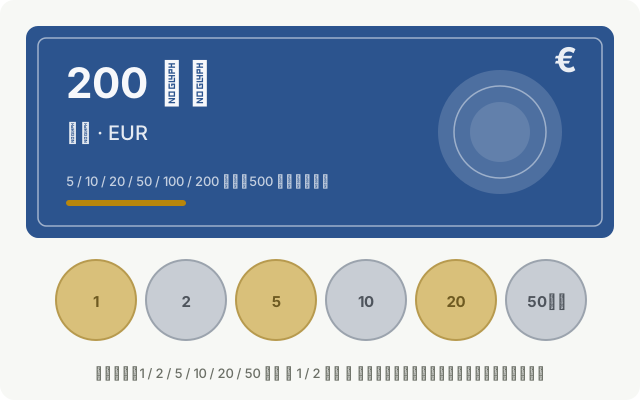
Euro banknotes in circulation follow standard Eurozone denominations: €5, €10, €20, €50, €100, €200, and €500. Coins come in denominations of €1, €2, and 1, 2, 5, 10, 20, and 50 cents. Daily transactions typically involve €5–€50 banknotes, while €500 notes are usually not accepted in regular shops. Owing to low prices (a macchiato costs around €1–1.5, and a serving of ćevapi is about €4–6), coins and €5/€10 banknotes are used far more frequently than in Western Europe, so carry plenty of small change.
Cash and Payment Habits
Restaurants, supermarkets, and venues in Pristina, Prizren, and Peja commonly accept Visa/Mastercard. ATMs are widespread in city centers. However, markets, taxis, intercity minibuses, and rural restaurants almost exclusively deal in cash. On average, international travelers should carry €20–40 per day for meals and minor transport. Note that most Kosovan bank cards cannot be used for direct online payments abroad (international payment channels are limited). Locals often rely on cash or local e-wallets, but this shouldn’t affect travelers. The Serbian dinar is only used in shops in northern Serbian-majority areas (like northern Mitrovica). For most visitors, using euros throughout the trip is simplest.
Traveler Tips
- You only need euros; there’s no need to exchange any local currency. There’s no need to carry large amounts of cash before arrival, as getting cash is easy.
- Bank ATMs (such as ProCredit, Raiffeisen) offer better exchange rates and lower fees than independent street ATMs.
- Markets and taxis only take cash, so always have €5/€10 notes and euro coins handy.
- Prices are low, but mountain guesthouses in peak season may require a cash deposit in advance—confirm with hosts when booking.
Kosovo Overview
Country Details »About Kosovo
Kosovo (known as Kosovo in English, Kosovë in Albanian, and Косово in Serbian) is a landlocked region in the interior of the Balkan Peninsula. It borders Montenegro and Serbia to the northwest and northeast, North Macedonia to the southeast, and Albania to the southwest, covering an area of approximately 10,887 square kilometers with a population of around 1.8 million. It is one of Europe’s more densely populated and youngest regions, with a median age of about 30. The capital, Pristina, is the political and economic center, while the cultural city of Prizren is known for its scenic beauty.
To state its political status objectively: Kosovo was formerly an autonomous province within the Republic of Serbia. On February 17, 2008, it unilaterally declared independence. To date, over 100 countries have diplomatically recognized Kosovo, which has also joined institutions such as the World Bank and the International Monetary Fund. However, some countries, including Serbia and China, do not recognize it, and Kosovo is not a member of the United Nations. Its northern Mitrovica region, where ethnic Serbs form a majority, remains closely linked to Serbia. Travelers should be aware of this when planning their itineraries.
Geography and Climate
Kosovo’s terrain is mainly mountainous and basin-like: the Kosovo Plain and Metohija Plain form the inland core where population and agriculture are concentrated. The region is surrounded by mountains, with the Accursed Mountains (known locally as Bjeshkët e Nemuna), whose highest peak, Đeravica, rises 2,656 meters above sea level. The Šar Mountains in the southeast are known for their meadows, ski resorts, and wildflowers, while Rugova Canyon lies close to Peja, featuring dramatic red cliffs. The White Drin River originates here and flows into the Adriatic Sea basin.
The climate is continental: summers are hot and winters are cold in the plains. In Pristina, temperatures can exceed 33°C in July and drop to -5°C in January. The mountains receive abundant precipitation, with long snow cover in the Šar range. Spring and autumn are ideal for travel, while summer retreats in the mountains are a traditional local vacation style.
Historical Background
In ancient times, Kosovo was inhabited by the Dardani, an Illyrian people. During the Roman era, it lay at the border of the provinces of Dalmatia and Moesia. From the 6th century onward, Slavs migrated into the area. During the Middle Ages, the Serbian Kingdom and the Nemanjić dynasty established Kosovo as their heartland. Eastern Orthodox structures such as Gračanica Monastery (1321), Visoki Dečani Monastery (14th century), and the Patriarchate of Peć were built during this period and are now collectively listed as UNESCO World Heritage Sites. After the Battle of Kosovo in 1389, the Ottoman Empire gradually took control, and over the next five centuries, Albanians became the majority population, with Islam spreading widely.
Following the Balkan Wars in 1912, Kosovo was incorporated into Serbia. It then entered the Yugoslav era: in 1946, it was designated an autonomous region, and in 1974, a new constitution granted it near-republic status. In 1989, Serbia revoked this autonomy, prompting Albanians to establish parallel systems. The Kosovo War broke out from 1998 to 1999, leading to extensive NATO airstrikes on the Federal Republic of Yugoslavia. After the war, Kosovo was administered by the United Nations Interim Administration Mission in Kosovo (UNMIK). On February 17, 2008, Kosovo unilaterally declared independence, with governance later supported by international presences such as EULEX. Relations with Serbia remain under ongoing negotiation.
Economy and Currency
Kosovo has one of the smallest economies in Europe. Key sectors include energy (brown coal power generation), agriculture, construction, information services, and remittances from the diaspora (which account for around 15% of GDP). Unemployment remains high, with many young people working in Western Europe. As for currency, Kosovo has used the euro as its sole currency since January 1, 2002, despite not being a member of the Eurozone or having an issuing central bank. It began using the German mark under UN administration in 1999. All circulating euro banknotes and coins in Kosovo come from Eurozone countries. Prices are significantly lower than in Western Europe—for example, a coffee in Pristina costs roughly half of what it does in Paris.
Culture and Society
About 92% of Kosovo’s population is ethnic Albanian, with minorities including Serbs (mainly in the north and around monasteries), Turks, Roma, Bosniaks, and Gorani. Most Albanians are Muslim but highly secular, while Serbs are Eastern Orthodox, and Catholics are concentrated in the west. Café culture is deeply rooted, with espresso and macchiato enjoyed from morning until night, forming the core of social life. Family values are strong, with traditional celebrations for weddings, Eid al-Fitr, and Orthodox Christmas. Modern landmarks such as Pristina’s “NEWBORN” monument (unveiled on Independence Day and repainted annually) and the Clinton statue on Bill Clinton Boulevard reflect the aspirations of this young entity.
Tourism Overview
Kosovo’s tourism is still niche but increasingly well-equipped. Highlights include Pristina’s NEWBORN monument, Clinton statue, and uniquely shaped National Library; Prizren’s Old Town stone bridge, Sinan Pasha Mosque, and Kalaja Fortress overlooking the city; UNESCO-listed monasteries like Gračanica, Visoki Dečani, and the Patriarchate of Peć; hiking and climbing in Rugova Canyon; and skiing at Brezovica in the Šar Mountains. These sites form the basis of compact 4–7 day itineraries. Most international travelers arrive via Skopje (North Macedonia) or Tirana (Albania), though Pristina International Airport also offers flights to major European cities.
Kosovo Travel Guide
All Guides »Kosovo Travel Quick Guide: Entry Requirements, Best Time to Visit, Budget Tips & Sensitive Topics
Before traveling to Kosovo, understand visa and entry procedures, the euro cash ...
Kosovo Classic 7-Day Itinerary: Pristina – Gračanica – Prizren – Peć – Rugova Canyon 7 days
This 7-day route connects Kosovo’s UNESCO-listed monasteries, the stunning old t...
Kosovo 4-Day Short Trip: Three Highlights in Pristina + In-Depth Exploration of Prizren’s Old Town 4 Days
A Quick Two-City Itinerary for a Short Break: Spend two days in Pristina explori...
Must-visit attractions in Kosovo: the NEWBORN Monument, the Old Town of Prizren, and UNESCO-listed monasteries
A comprehensive list of highlights across Kosovo — from the capital’s landmarks ...
Kosovo Food Guide: Qebap Grilled Meat, Flija Layered Pancakes & All-Day Coffee Culture
Kosovo offers great food at low prices: line up for qebap at old-town grill shop...
Kosovo Transportation Guide: Pristina Airport, Intercity Minibuses, and Monastery Private Transfers
Kosovo has no passenger rail service. Intercity ground transport mainly relies o...