Albania Currency Albanian lekALL
What money to use in Albania, how notes and coins break down, and the best ways to exchange - get the local cash sorted before you go.
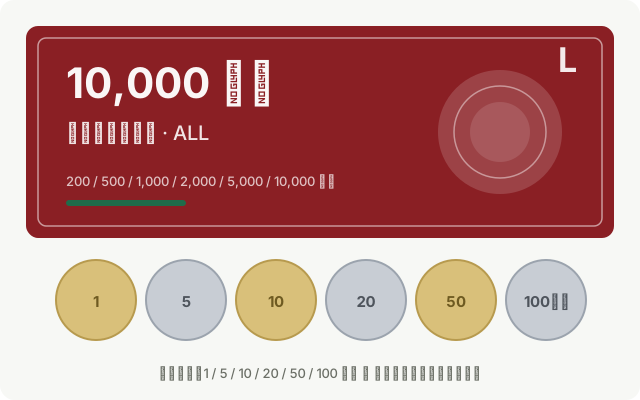
| Currency Name | Albanian lek |
|---|---|
| Currency Code | ALL |
| Currency Symbol | L |
| Issuing Country | Albania |
| Time Zone | UTC+1 to UTC+2 (UTC+2 in summer) |
| Dialling Code | +355 |
About Albanian lek (ALL)
Currency Overview
The official currency of Albania is the Albanian lek (currency code: ALL; symbol: L), issued by the Bank of Albania (Banka e Shqipërisë). One lek is divided into 100 qindarka, though qindarka coins are no longer in common circulation, and transactions are typically made in whole lek amounts. The lek is not a fully convertible currency, and its exchange rate fluctuates with market conditions. In recent years, it has remained relatively stable despite fluctuations in the euro and US dollar, but travelers should focus on practical aspects such as cash exchange and card payment availability.
Denominations
Common banknotes in circulation include denominations of 200, 500, 1,000, 2,000, and 5,000 lek. Older 100 lek notes may still occasionally appear. Banknotes feature themes related to national historical figures, architecture, and landscapes, with colors ranging from brown, blue, green, to purple. Coins come in denominations of 1, 2, 5, 10, 20, 50, and 100 lek, with 5, 10, and 20 lek coins being most commonly used for small change. The 100 lek coin is thicker and can be useful for small purchases. Both old and new versions of banknotes and coins are in circulation.
Cash and Payment Practices
Cash is the primary method of payment in Albania, especially at street vendors, markets, public transport, taxis, rural restaurants, and most guesthouses, where only lek is accepted. In tourist cities like Tirana and Saranda, hotels, newer restaurants, and supermarkets are increasingly accepting international credit cards such as Visa and Mastercard, though coverage is still not as widespread as in Western Europe. UnionPay cards have limited acceptance. It is advisable to carry cash as your main payment method and an international credit card for hotels and car rentals.
For currency exchange, banks and authorized exchange offices in Tirana and coastal cities generally offer better rates than hotels or tourist spots. Some businesses may accept euros in cash and provide change in lek based on their own exchange rates, but these rates may not be favorable. It is generally better to exchange money into lek first. ATMs are widely available in major cities, but watch out for transaction fees and withdrawal limits.
Tips for Travelers
- Prices are displayed and change is given in lek; euros are not widely accepted, and even when they are, change is usually provided in lek.
- It is recommended to carry around 3,000–6,000 lek per person per day for meals, transport, and entrance fees. Use cards for hotels and car rentals.
- Exchange money at banks or authorized exchange points, and avoid unofficial street exchanges without proper signage.
- Service charges are generally not included in restaurant bills. For upscale dining, a 5–10% tip is appreciated, while rounding up the bill is common in casual eateries.
Albania Overview
Country Details »About Albania
Albania (Albanian: Shqipëri, meaning "Land of the Eagles") is located in the southwestern part of the Balkan Peninsula in southeastern Europe. It borders the Adriatic and Ionian Seas to the west, across from Italy, and is surrounded by Montenegro to the north, Kosovo to the northeast, North Macedonia to the east, and Greece to the south. The country covers an area of approximately 28,700 square kilometers, with its capital, Tirana, situated on the central plain. Tirana serves as the political, economic, and cultural center of the nation.
With a population of around 2.8 million, the majority ethnic group is Albanian. The official language is Albanian, and the country is notable for its religious diversity, with Islam, Eastern Orthodoxy, and Catholicism coexisting. This has fostered a relatively tolerant religious atmosphere. Albania is a member of NATO and has been granted EU candidate status. The national currency is the Albanian lek (ALL), and the black double-headed eagle featured on the national emblem and flag is the country’s most iconic symbol.
Geography and Climate
Albania’s terrain is predominantly mountainous and hilly, with about 70% of the country covered by mountains. The eastern and northern regions are rugged, while the western coastal areas consist of narrow plains and sandy beaches. The coastline stretches from the gentle sands of the Adriatic Sea in the north to the rugged bays of the Ionian Sea in the south, extending from Durrës and Vlorë to Saranda and Ksamil. This central coastal stretch is known as the "Albanian Riviera." The country also boasts numerous lakes and lagoons, including Lake Ohrid, shared with North Macedonia, and the Butrint wetlands in the south, both of which are of high ecological value.
The climate is primarily Mediterranean, with hot, dry summers and mild, wet winters along the coast. Inland and mountainous areas experience a more temperate continental climate, with cold, snowy winters. The prime months for beach holidays are May through September, when sea temperatures reach around 25°C. The spring and autumn seasons are most comfortable for visiting inland cities like Berat and Gjirokastër. Due to significant elevation changes, coastal and mountainous areas can have very different weather at the same time, so pack accordingly for your destination.
Historical Background
The ancestors of the Albanian people are generally considered to be the Illyrians, who anciently inhabited the western Balkans. The Albanian language is a unique branch of the Indo-European language family. Historically, the region was influenced by the Greeks, Romans, and Byzantines, and during the Middle Ages, numerous small principalities and city-states emerged along the coast and in the mountains. In the 15th century, national hero Skanderbeg led resistance against the Ottoman Empire for over two decades. Although he ultimately could not prevent the Ottomans from fully occupying the region in 1479, his legacy became a cornerstone of Albanian national identity, and the black double-headed eagle flag originates from his family’s coat of arms.
Ottoman rule lasted for about four centuries and significantly influenced the social structure, with Islam becoming widespread. On November 28, 1912, Albania declared independence in Vlorë, ending Ottoman rule. The country was subsequently controlled by various powers, including Italy. After World War II, Enver Hoxha established a socialist regime that remained highly isolated and centralized until the 1991 transition to multi-party democracy and a market economy. The early post-transition years were marked by economic and security challenges, but the 21st century has seen increasing stability, establishing Albania as an emerging European tourist destination.
Economy and Currency
Albania is one of the lower-income countries in Europe, with an economy based on services, agriculture, textile manufacturing, mining, and remittances. In recent years, tourism has grown rapidly, becoming a key driver of employment and foreign exchange. The official currency is the Albanian lek (ALL), issued by the Bank of Albania, with a relatively flexible exchange rate. Prices for food, accommodation, and transportation are generally low in the Balkan region, contributing to Albania’s reputation for being a great value destination.
Culture and Society
Albanian society places strong emphasis on family, homeland, and oral traditions. The concept of "besa" (keeping one’s word) is a core moral value. Traditional music and dance are rhythmic and lively, and the country is known for its vibrant handmade carpets and silverware. The cuisine blends Balkan, Mediterranean, and Ottoman influences, featuring grilled meats, yogurt, olive oil, and vegetables. Street food favorites include byrek (savory pastry) and sandwiches, while raki (fruit brandy) and strong coffee are staples of the local dining scene. A relaxed coffee culture is deeply rooted in urban life.
Tourism Overview
Once known as "Europe’s most mysterious country," Albania has rapidly become a popular destination on social media. The colorful capital, Tirana, features a distinctive cityscape with its vibrant squares, multicolored buildings, and the controversial "Pyramid" structure. The southern coastal towns of Saranda and Ksamil boast white-sand beaches and crystal-clear waters, often touted as convenient beach getaways. Inland, Berat is celebrated as the "City of a Thousand Windows," with its rows of Ottoman-era white houses adorned with numerous windows lining the hillsides. Gjirokastër is known for its stone-built old town and castle, both recognized as UNESCO World Heritage Sites. At the southern tip, the archaeological site of Butrint showcases layers of Greek, Roman, Byzantine, and Venetian history within a single park.
Overall, Albania offers improving transport links, low costs, and a mix of beaches and historic sites, making it well-suited for road trips or small-group immersive travel. For travelers seeking a blend of sea, mountain towns, and ancient landmarks in the Balkans, Albania is an appealing choice.
Albania Travel Guide
All Guides »Albania Travel Quick Guide: Seasonal Visa Waivers, Best Time to Visit, Budget, and Local Customs
What to know about seasonal visa waivers, when is the best time for the seaside,...
Albania 7-Day Classic Itinerary: Tirana, the Riviera, and the City of a Thousand Windows 7 Days
Experience the capital, seaside, Ottoman mountain towns, and UNESCO heritage sit...
Albania 4-Day Short Trip: Tirana and Riviera Coastal Cities 4 days
Focus on the capital and southern coast, packing city vibrancy, the City of a Th...
A must-visit list of attractions in Albania: seaside spots, the City of a Thousand Windows, and UNESCO-listed archaeological sites
Explore Albania’s top attractions by region, with highlights and recommended vis...
A Guide to Albanian Specialties: Street Pies, Grilled Meats, and Raki
From street-side byrek pies to seaside seafood and raki fruit brandy, explore ho...
Complete Guide to Transportation in Albania: Airport Transfers, Intercity Buses, and Coastal Road Trips
From getting into Tirana from the airport, to intercity minibuses, coastal road ...