Mexico Currency Mexican PesoMXN
What money to use in Mexico, how notes and coins break down, and the best ways to exchange - get the local cash sorted before you go.
| Currency Name | Mexican Peso |
|---|---|
| Currency Code | MXN |
| Currency Symbol | $ |
| Issuing Country | Mexico |
| Time Zone | UTC-6 |
| Dialling Code | +52 |
About Mexican Peso (MXN)
Currency Overview
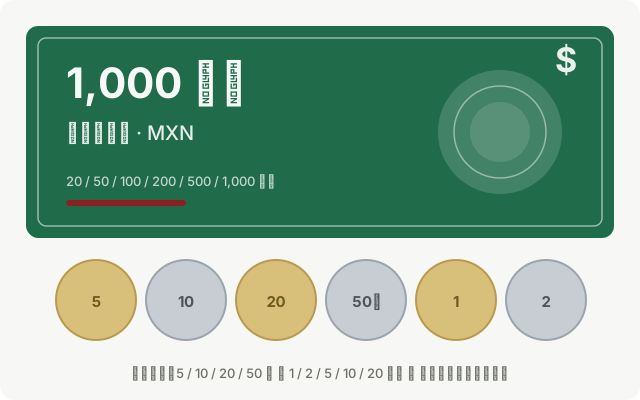
The official currency of Mexico is the Mexican Peso (currency code: MXN, symbol: $; to distinguish it from the U.S. dollar, it is often written as Mex$ or M$). One peso is equal to 100 centavos (cents) and is issued by Banco de México (Bank of Mexico). The peso is one of the most widely circulated and actively traded currencies in Latin America, with its exchange rate against the U.S. dollar typically fluctuating between approximately 17 and 20 pesos per dollar. Always check the daily real-time exchange rate when traveling.
Denominations
Paper currency comes in six denominations: 20, 50, 100, 200, 500, and 1,000 pesos. The 20 and 50 peso notes are printed on polymer. Recent new editions feature historical figures and natural and cultural heritage themes: the 100 peso note depicts poet and nun Sor Juana Inés de la Cruz, the 200 peso note features Nahua poet Nezahualcoyotl, the 500 peso note shows President Benito Juárez, and the 1,000 peso note honors Father Miguel Hidalgo, a leader of the independence movement. The new 50 peso note features the Sumidero Canyon on the front and the Palenque Mayan ruins on the back. Coins are issued in denominations of 50 centavos, and 1, 2, 5, 10, and 20 pesos. The 10 peso coin features the famous Aztec Sun Stone design and is highly collectible.
Cash and Payment Habits
Mexico remains a cash-heavy society: street taco vendors, local markets, shared vans (colectivos), and some taxis typically accept only cash. It is advisable to carry small bills worth around 300–500 pesos per person per day. Shopping malls, chain restaurants, hotels, and supermarkets in cities generally accept Visa and Mastercard credit cards. Cities like Mexico City, Guadalajara, and tourist areas also support contactless payments such as Apple Pay. ATMs at major banks are convenient for cash withdrawals, but a fee of around 30–50 pesos per transaction is usually charged. To reduce fees, withdraw larger amounts per transaction. In Cancún’s hotel zone, many businesses accept U.S. dollars, but the exchange rates are generally unfavorable—it’s better to convert to pesos first.
Traveler Tips
- Smaller denomination bills are more practical: street vendors and taxi drivers often cannot provide change for 500 peso notes.
- If prices are displayed in both pesos and dollars at tourist spots, calculate the equivalent using the real-time exchange rate before paying.
- A service tip of around 10%–15% is customary in restaurants and should preferably be given in cash directly to the server.
- Exchange rates at airports and banks are generally better than those at hotel front desks. Compare rates for large exchanges.
Mexico Overview
Country Details »Mexico Overview
Mexico (officially the United Mexican States) is located in southern North America, bordering the United States to the north, Guatemala and Belize to the southeast, the Gulf of Mexico and the Caribbean Sea to the east, and the Pacific Ocean to the west. With a land area of approximately 1.964 million square kilometers, it is the third-largest country in North America. The country is divided into 32 federal entities (31 states and Mexico City), with a population of about 129 million, making it the nation with the largest number of Spanish speakers in the world. The capital, Mexico City, is situated in a valley on the Central Plateau at an altitude of 2,240 meters, with a metropolitan population of over 20 million, making it one of the largest metropolitan areas in the Americas.
Mexico is an important economy in Latin America and a member of the G20. It has a strong manufacturing export sector, particularly in automotive, electronics, and aerospace components. Its geographic location makes it a key logistics hub connecting North and South America with both oceans.
Geography and Climate
Mexico’s terrain is dominated by plateaus and mountains, with the Mexican Plateau stretching across the central part of the country. The Sierra Madre Oriental and Sierra Madre Occidental mountain ranges lie to the east and west, respectively, and the country’s highest peak, Pico de Orizaba, rises to 5,636 meters. The flat Yucatán Peninsula in the south consists of limestone platforms dotted with natural sinkholes (cenotes). To the east and west are the narrow Baja California Peninsula and the Yucatán coastline, with a total coastline exceeding 9,000 kilometers.
The climate varies greatly due to elevation and latitude: the central plateau enjoys spring-like weather year-round, with Mexico City having an average annual temperature of around 16°C; the northern deserts are arid with significant temperature variations between day and night; the southern regions and Yucatán have a tropical climate, with the rainy season from May to October. The Caribbean coast (especially from June to November) is prone to hurricanes. Overall, the dry season from November to April is the best time to visit.
Historical Background
Mexico is the cradle of ancient civilizations in the Americas: the Olmec civilization is considered the mother culture of Mesoamerica, followed by the grand pyramid complexes of Teotihuacán built between the 1st and 8th centuries AD. The Toltecs, Maya, and Aztecs rose to prominence in succession. In 1325, the Aztecs founded Tenochtitlán on an island in Lake Texcoco. Legend says the city’s founding omen was an eagle perched on a cactus, devouring a snake—this image later became the national emblem of Mexico. In 1521, Spanish conquistador Hernán Cortés captured the city. For nearly three centuries afterward, Mexico served as the capital of the Viceroyalty of New Spain. Mexico declared independence in 1821 after Father Miguel Hidalgo’s call in 1810. The 19th century saw the Mexican-American War and French intervention, while the Mexican Revolution broke out in 1910. Since then, the country has entered a period of modern nation-building and, following the establishment of NAFTA in 1994, became deeply integrated into the global economy.
Economy and Currency
Mexico is one of the world’s 12th to 15th largest economies. It leads globally in automobile and auto parts manufacturing, consistently ranks first in silver production, and has strong petroleum, agricultural, and tourism sectors. The official currency is the Mexican Peso (MXN), issued by Banco de México, and it is one of the most actively traded currencies in Latin America. While some businesses in tourist areas like Cancún and Playa del Carmen accept U.S. dollars, change is usually given in pesos at unfavorable rates, and official transactions are conducted in pesos.
Culture and Society
Mexican culture is a rich blend of Spanish traditions and indigenous heritage. Catholicism is widely practiced, and indigenous languages and customs remain vibrant. Día de los Muertos is recognized by UNESCO as an Intangible Cultural Heritage, with families welcoming ancestors with marigolds and sugar skulls, making it one of Mexico’s most iconic cultural traditions. The mural and painting art of Diego Rivera and Frida Kahlo, tequila and mezcal spirits, and traditional foods like tamales and tortillas contribute to a diverse cultural tapestry. Mexicans are known for their warmth, and music and festivals are a year-round feature.
Tourism Overview
Mexico is one of the world’s top ten most visited countries, offering a wide range of experiences: Mexico City is home to the Zócalo, murals in the National Palace, and the National Museum of Anthropology, while the nearby Teotihuacán pyramids are awe-inspiring. The Yucatán’s Chichén Itzá, home to the Pyramid of Kukulkán—one of the New Seven Wonders of the World—attracts global visitors for the serpent shadow phenomenon during the equinoxes. Cancún and Tulum boast world-famous Caribbean beaches. Central Mexico’s Guanajuato and San Miguel de Allende are famed for their colorful hill towns, while Oaxaca is a slow-travel haven for food and mezcal culture. Mexico’s road trip culture, inspired by the historic U.S. Route 66, continues along the Pan-American Highway, which runs from Mexico City’s northern suburbs to the U.S. border. Visa-free entry for holders of a U.S. visa allows many international travellers to easily combine Mexico with North American itineraries. For safety, avoid certain border states and stick to mainstream tourist routes.
Mexico Travel Guide
All Guides »Mexico Travel Quick Guide: Visas, Seasons, Budgets & Etiquette Taboos
From U.S. visa waiver policies to high-altitude sun protection and street tippin...
Classic 7-day Mexico itinerary: Mexico City — Mérida — Chichén Itzá — Tulum — Cancún 7 days
Weave together civilization and beaches: start with highland ancient cities and ...
Mexico 4-Day Short Trip: In-Depth Tour of Mexico City 4 days
With limited time, focus on exploring the capital: divide the city into district...
Must-visit attractions in Mexico: From pyramids to the Caribbean coast
A regional guide to Mexico’s top attractions, with highlights and recommended du...
Mexico Food Guide: From Street Tacos to Oaxacan Mole
Mexico is a heavyweight contender on the global culinary map: even street snacks...
Complete Guide to Transportation in Mexico: Domestic Flights, ADO Buses, and Getting Around Cities
Mexico is a vast country — long-distance travel is best done by plane or overnig...