Bahrain Currency Bahraini DinarBHD
What money to use in Bahrain, how notes and coins break down, and the best ways to exchange - get the local cash sorted before you go.
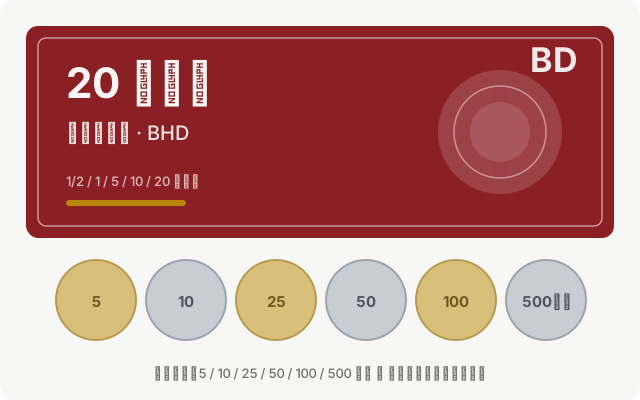
| Currency Name | Bahraini Dinar |
|---|---|
| Currency Code | BHD |
| Currency Symbol | BD |
| Issuing Country | Bahrain |
| Time Zone | UTC+3 |
| Dialling Code | +973 |
About Bahraini Dinar (BHD)
Currency Overview
The official currency of Bahrain is the Bahraini Dinar (currency code: BHD, symbol: BD). One dinar is divided into 1000 fils. The currency is issued by the Central Bank of Bahrain. The Bahraini Dinar has long been pegged to the U.S. dollar, with one U.S. dollar approximately equal to 0.376 dinars. The currency is among the highest-valued in the world, so travelers may find local price figures appear smaller than expected and should always double-check amounts.
Denominations
Banknotes currently in circulation come in denominations of ½, 1, 5, 10, and 20 dinars. They are color-coded and feature designs of Bahrain’s historical architecture, traditional crafts, and modern landmarks. Coins are issued in denominations of 5, 10, 25, 50, 100, and 500 fils. Coin designs often include the national emblem, date palms, and traditional pearling dhows, with lower-value fils coins commonly used in everyday transactions.
Cash and Payment Habits
Electronic payments are widely accepted in Bahrain, with hotels, malls, restaurants, supermarkets, and gas stations commonly taking international credit and debit cards such as Visa and Mastercard. Contactless payments are increasingly common. However, traditional markets, small eateries, taxis, and some street vendors still primarily deal in cash. It’s advisable to carry a small amount of dinars and fils for small purchases. ATMs are readily available, and currency exchange services are offered at the airport and in urban areas. Credit card transaction exchange rates are usually better than those for cash exchanges.
Traveler Tips
- The Bahraini Dinar has a high value—1 dinar is approximately 2.6 USD—so always check prices and change carefully when making purchases.
- Fils coins are small in value but commonly used, so it’s useful to keep some for taxi rides and market shopping.
- Hotels and malls generally accept cards, but bring cash for markets and older parts of town.
- Tipping is not mandatory, but leaving 5–10% in restaurants (outside the bill) and 1–2 dinars for porters is appreciated.
Bahrain Overview
Country Details »Bahrain Overview
Bahrain (officially the Kingdom of Bahrain) is located in the southwestern Persian Gulf and is an island nation composed of Bahrain’s main island and around thirty smaller islands. It lies in the Gulf waters between Saudi Arabia and Qatar and is connected to mainland Saudi Arabia via the King Fahd Causeway. The country covers an area of about 786 square kilometers, with the capital Manama situated on the northern part of the main island, serving as the national center for politics, economy, and culture. Bahrain has a population of approximately 1.5 million, with a significant proportion of expatriate residents, making it one of the more densely populated countries in the Gulf region.
Bahrain is a constitutional monarchy, with the king as the head of state and the government led by a prime minister. As a member of the Gulf Cooperation Council, Bahrain plays an important role in regional finance, logistics, and services. The country has relatively high social openness in the Gulf and has long been regarded as a key gateway to the Gulf market.
Geography and Climate
Bahrain has a low-lying terrain, mostly consisting of desert and salt flats. The highest point, Mount Dukhan, is only about 134 meters above sea level. The central part of the main island is a dry plateau, while the northern and western coasts feature oases and cultivated land. The shallow sea areas were historically known for their natural pearl beds. Due to its insular nature, Bahrain has a rugged coastline with interwoven beaches, mangroves, and reclaimed land.
The climate is tropical desert, with summers (May–September) being extremely hot and humid, often exceeding 40°C, and high humidity adding to the discomfort. Winters (November–March) are mild and pleasant, with temperatures generally ranging between 15–25°C, making it the most comfortable travel season. Rainfall is scarce throughout the year and is concentrated on just a few winter days.
Historical Background
Bahrain is one of the most historically significant regions in the Gulf, once the heart of the Dilmun civilization, flourishing as an important trade and pearl hub between Mesopotamia and the Indus Valley. From the 7th century onward, it became Islamicized with the expansion of the Arab Empire. In the 16th century, it was briefly occupied by the Portuguese, and later contested for centuries among powers such as Persia and Oman.
In 1783, the Al Khalifa family established rule over Bahrain, which continues to this day. Bahrain became a British protectorate in 1820, declared independence as the State of Bahrain in 1971, and adopted a constitutional monarchy in 2002, changing its name to the Kingdom of Bahrain. Bahrain was among the first Gulf countries to extract oil, discovering and exporting crude oil in 1932, laying the foundation for its subsequent modernization and economic diversification.
Economy and Currency
With relatively limited oil reserves, Bahrain pursued an economic diversification strategy early on, gradually establishing an industrial structure supported by finance, banking, aluminum smelting, petrochemicals, logistics, and tourism. The capital Manama is one of the Gulf’s important offshore financial centers. In recent years, Bahrain has actively developed conventions, motorsports, and cultural tourism to attract visitors and investment from both within and beyond the region.
The official currency is the Bahraini Dinar (BHD, symbol BD), issued by the Central Bank of Bahrain. The Bahraini Dinar has long been pegged to the U.S. dollar at a fixed rate, with one U.S. dollar approximately equal to 0.376 dinars. The currency is among the highest-valued in the world, and travelers should be aware that the overall cost of living is relatively high.
Culture and Society
Bahrain is an Islamic country, with Arabic as the official language. English is widely used in business, hotels, and tourism. While maintaining Islamic traditions, Bahraini society is relatively open by Gulf standards, with women allowed to drive and participating widely in work and education. Pearl diving was once the most important livelihood for Bahrainis, and the associated skills, music, and folklore are now systematically preserved and displayed.
The cuisine mainly features Arabic and Gulf flavors, with common dishes including grilled meats, spiced rice, seafood, and dates. Street tea houses and dessert shops are a regular part of daily life. Bahrain has a rich tradition of music, handicrafts, and festivals, with Manama and Muharraq hosting most of the country’s cultural events.
Tourism Overview
Bahrain is home to two UNESCO World Heritage Sites: Bahrain Fort, an important site of the ancient Dilmun civilization, and the Pearling Pathway, which documents the history of pearl diving and trade in Muharraq’s old town. The Bahrain International Circuit has hosted the F1 Bahrain Grand Prix since 2004, making it the first track in the Middle East to stage a Formula One event. Other highlights include the solitary Tree of Life growing in the desert, the Grand Mosque of Manama, the Bahrain National Museum, Muharraq’s old town, and traditional markets, all forming the core of Bahrain’s short-trip offerings.
Bahrain’s small size means attractions are relatively concentrated, and most can be explored comfortably in 2–4 days. With good security and convenient transport, it serves well as a stop on a Gulf itinerary or can be combined with trips to Saudi Arabia, Qatar, and other nearby destinations.
Bahrain Travel Guide
All Guides »Bahrain Travel Quick Guide: Visa, Best Time to Visit, Budget & Islamic Etiquette
Bahrain may be small, but it’s full of charm: this one-stop guide covers visas a...
6-Day In-Depth Tour of Bahrain: Manama – Muharraq – Bahrain Fort – Desert and Coast 6 days
Take your time exploring this small Gulf nation: ancient cities, UNESCO World He...
Bahrain 3-Day Itinerary: Classic Highlights of Manama and Muharraq 3 days
See the best of Bahrain even on a tight schedule: ancient alleys, UNESCO sites, ...
Must-visit attractions in Bahrain: UNESCO sites, racetracks, and desert wonders
From the Dilmun ruins to the F1 circuit, from the Pearl Route to the Desert Tree...
Bahrain Food Guide: Spiced Rice, Seafood & Arabic Sweets
A fusion of Gulf flavors and island ingredients: from spiced rice to grilled fis...
Bahrain Transportation Guide: Getting to and from the Airport, Car Rentals, and Taxis
Bahrain has no railways. The airport is close to the city center, making renting...