Vanuatu Currency Vanuatu VatuVUV
What money to use in Vanuatu, how notes and coins break down, and the best ways to exchange - get the local cash sorted before you go.
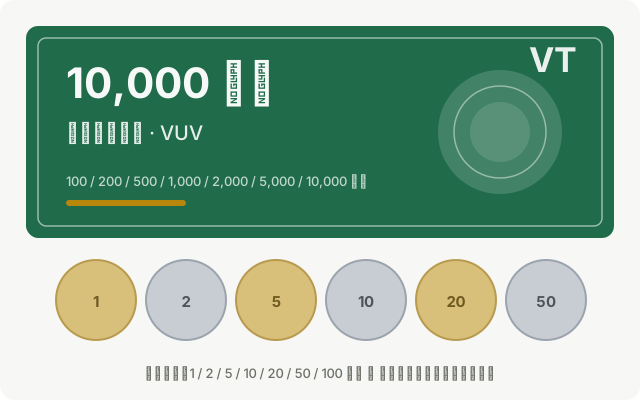
| Currency Name | Vanuatu Vatu |
|---|---|
| Currency Code | VUV |
| Currency Symbol | VT |
| Issuing Country | Vanuatu |
| Time Zone | UTC+11 |
| Dialling Code | +678 |
About Vanuatu Vatu (VUV)
Currency Overview
The official currency of Vanuatu is the Vatu (currency code: VUV, symbol: VT). The Vatu uses a non-decimal system, meaning it has no subunit — the smallest denomination is 1 Vatu. As a result, prices are generally displayed as whole numbers. The currency is issued by the Reserve Bank of Vanuatu. In 1981, following independence, Vanuatu replaced the previously circulating Australian Dollar and New Hebrides Franc with the Vatu, establishing its own national currency system.
Denominations
Current banknotes in circulation come in denominations of 100, 200, 500, 1,000, and 2,000 Vatu. The notes feature vibrant designs reflecting local themes such as island scenery, tribal dances, traditional canoes, fishing, and agriculture. Coins are issued in 1, 2, 5, 10, 20, 50, and 100 Vatu denominations, often displaying motifs related to the national emblem and marine life. With no fractional units, all transactions and change are in whole Vatu, eliminating the need to calculate smaller currency values.
Cash and Payment Practices
Vanuatu is predominantly a cash-based society, especially on outer islands and in rural areas. Markets, nakamals (kava bars), small boats, and local shops typically accept only cash. In Port Vila and Luganville (the main town on Santo Island), larger hotels, resorts, restaurants, and supermarkets may accept international credit cards such as Visa and Mastercard, though some may charge a fee. ATMs are available in the capital and main towns but are extremely rare on outer islands.
It’s recommended to withdraw sufficient cash in Port Vila before travelling to outer islands and to carry a supply of smaller denominations. The local currency cannot be exchanged directly within many countries. Travellers usually need to bring U.S. Dollars or Australian Dollars and exchange them at Port Vila Airport, banks, or authorized exchange counters. Exchange rates are subject to daily fluctuations. Additionally, Vanuatu imposes a value-added tax (VAT) on most goods, which is generally included in listed prices. Restaurant bills usually include a service charge, so tipping is not mandatory but can be offered at your discretion.
Travel Tips
- Vatu has no fractional denominations — all prices and change are whole numbers.
- ATMs are scarce on outer islands, so carry enough cash for your itinerary.
- The local currency is not directly exchangeable for many foreign currencies. Use U.S. Dollars or Australian Dollars for exchange.
- Some resorts may charge fees for credit card payments. Use cash for small purchases.
Vanuatu Overview
Country Details »About Vanuatu
Vanuatu is a Melanesian island nation located in the southwestern Pacific Ocean, about 1,750 kilometres east of Australia. It consists of around 83 islands stretching north to south, covering a land area of approximately 12,200 square kilometres. The capital, Port Vila, is situated on Efate Island and serves as the national centre for politics, economy, and tourism. The official languages are Bislama, English, and French. There are also over 100 indigenous languages spoken across the country, making it one of the most linguistically dense nations in the world.
Vanuatu gained independence from British-French condominium rule in 1980 and operates as a parliamentary democracy. It is a member of the Commonwealth. Its economy is based on agriculture, fishing, tourism, and offshore financial services. Key exports include coconuts, cocoa, kava, and beef. Comprising outer islands and rural communities, most residents engage in subsistence farming and fishing, and traditional social customs remain strong.
Geography and Climate
The Vanuatu archipelago includes volcanic and coral islands located along the Pacific Ring of Fire, with many active volcanoes. Mount Yasur on Tanna Island is one of the world’s most accessible active volcanoes, where visitors can approach the crater rim under guided supervision to view lava eruptions up close. Santo Island is the largest in the country, known for its beaches, blue holes, and wreck diving. Malakula and Pentecost Islands are famed for their traditional villages and cultural heritage.
The climate is tropical maritime, warm and humid year-round, with average temperatures around 24–27°C. The period from May to October is relatively dry and cool, with lower humidity and stable weather, making it the best time to visit. The rainy season and cyclone season from November to April bring concentrated rainfall and the risk of tropical cyclones, so it’s important to monitor weather and flight updates during this time.
Historical Background
The Vanuatu archipelago has been inhabited by Melanesians for around 3,000 years. In 1606, Spanish explorer Pedro Fernandes de Queirós was the first European to reach the islands, landing on Santo Island. In the 18th century, British explorer James Cook named the region the New Hebrides. During the 19th century, missionaries, merchants, and plantation owners from Britain and France arrived. In 1906, an agreement between Britain and France established the Condominium, a form of shared governance.
During World War II, Santo Island became a key U.S. military base in the Pacific, supporting Allied operations. After the war, a growing sense of national identity emerged. On 30 July 1980, Vanuatu gained independence, adopting a name meaning “Our Land” in a local language. Since then, the country has enjoyed general political stability, although it is prone to earthquakes and cyclones due to its location in a seismically active zone.
Economy and Currency
Vanuatu’s economy is driven primarily by agriculture, fishing, and tourism, with tourism being a significant source of foreign exchange. Key exports include coconuts, copra, cocoa, kava, beef, and seafood. The country also earns revenue through offshore financial services and ship registration. Due to the dispersion of islands and high transportation costs, imported goods tend to be expensive. The official currency is the Vanuatu Vatu (VUV), issued by the Reserve Bank of Vanuatu, with relatively stable exchange rates over time.
Culture and Society
Vanuatu maintains strong Melanesian traditions, with significant regional variations in Kastom (customary practices). The land diving ceremony, or Nanggol, practised on Pentecost Island, is one of the most iconic traditions. Men leap from tall wooden towers with vines tied to their ankles, making it the only known land-based bungee jump in the world. This practice has been recognized by UNESCO as an intangible cultural heritage. Pig tusks, kava, and woven crafts hold important roles in local exchanges and ceremonies.
Kava is a widely consumed social drink made from the root of the Piper methysticum plant, known for its relaxing effects. Nakamals, traditional kava drinking houses, are common in villages and towns. When visiting, it’s important to observe local customs. Additionally, Vanuatu has been ranked highly in assessments like the Happy Planet Index for its low ecological footprint and high resident well-being, earning it a reputation as one of the happiest countries in the world.
Tourism Overview
Vanuatu offers a unique appeal through its volcanoes, wreck diving, pristine islands, and traditional ceremonies. Mount Yasur on Tanna Island is the country’s most famous natural attraction, where visitors can safely watch lava eruptions. The SS President Coolidge wreck off Santo Island is one of the world’s largest and best-preserved diveable shipwrecks, attracting divers from around the globe.
Near Port Vila, attractions include Mele Cascades, an underwater post office, and various resort islands. Santo Island features Champagne Beach and blue holes, while Pentecost Island hosts seasonal land diving events. The country’s infrastructure is relatively basic, and travel typically involves domestic flights, 4WD vehicles, and boats. It is especially suited to nature-loving, adventure-seeking, and slow-paced travellers.
Vanuatu Travel Guide
All Guides »Vanuatu Travel Quick Guide: Visas, Seasons, Budget, and Volcano & Wreck Diving Essentials
Get all the key details in one go: visa on arrival, cyclone season, daily budget...
Vanuatu 7-Day Classic Itinerary: Port Vila – Tanna Island – Santo Island 7 days
Experience three star attractions in one trip: Mele Cascades and the Underwater ...
Vanuatu 4-Day Short Trip: In-Depth Exploration of Port Vila and Efate Island 4 days
Enjoy a fulfilling trip without flying to outer islands: Base yourself in Port V...
Must-visit attractions in Vanuatu: active volcanoes, shipwrecks, and blue holes
From Mount Yasur to the SS President Coolidge shipwreck — a breakdown of the top...
Vanuatu Food Guide: Coconut Crab, Santo Beef, and Kava
A blend of island ingredients and Melanesian home cooking, with recommendations ...
Vanuatu Transportation Guide: International Connections, Inter-Island Flights, and Island Travel
How to reach Port Vila, fly between islands, and get around town and the islands...