Rwanda Currency Rwandan FrancRWF
What money to use in Rwanda, how notes and coins break down, and the best ways to exchange - get the local cash sorted before you go.
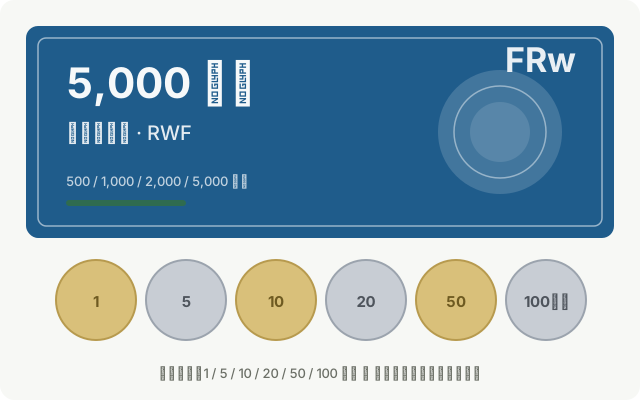
| Currency Name | Rwandan Franc |
|---|---|
| Currency Code | RWF |
| Currency Symbol | FRw |
| Issuing Country | Rwanda |
| Time Zone | UTC+2 |
| Dialling Code | +250 |
About Rwandan Franc (RWF)
Currency Overview
The official currency of Rwanda is the Rwandan Franc (currency code RWF, symbol FRw, also commonly written as RF), issued by the National Bank of Rwanda (the central bank). One franc theoretically equals 100 centimes, but these subdivisions are no longer in practical use due to their low value, and the smallest unit in daily transactions is 1 franc.
The Rwandan Franc is a floating currency, with exchange rates subject to market fluctuations. Travelers should check the current rates before departure. Given the widespread adoption of electronic payments and mobile money, cash is widely accepted, but cards and mobile payments are also commonly used at mid- to high-end establishments.
Denominations
Banknotes currently in circulation come in denominations of 500, 1,000, 2,000, and 5,000 Rwandan Francs. The National Bank has also issued commemorative 100-franc notes and has been updating designs to enhance security features. Different denominations are distinguished by color and design, often featuring the national emblem and iconic landscapes on the front, and agricultural scenes, wildlife, or traditional crafts on the back.
Coin denominations include 1, 2, 5, 10, 20, 50, and 100 francs, and are frequently used for small change. Due to the relatively small value of francs, everyday transactions often involve hundreds or thousands of francs—be mindful of the number of digits when assessing prices.
Cash and Payment Practices
In urban hotels, lodges, supermarkets, restaurants, and gas stations, international credit cards (Visa, Mastercard) are generally accepted, though fees may apply. In remote areas such as national parks, roadside stalls, markets, and rural shops, cash is usually the only option. Mobile money is extremely popular in Rwanda, with services like MTN Mobile Money and Airtel Money widely used by locals—but foreign visitors without a local phone number may find these services difficult to access.
It’s advisable to carry some cash for entrance fees, tips, handicraft purchases, and rural transactions, and to keep a supply of small-denomination notes. Foreign currency can be exchanged at airports, banks, and authorized exchange bureaus—rates in central Kigali are usually better than at the airport. ATMs are common in cities like Kigali, but confirm before use whether they accept international cards and what fees apply.
Traveler Tips
- Gorilla trekking permits are expensive (usually priced in USD) and must be booked well in advance through official Rwanda Development Board channels—avoid purchasing from unauthorized street sellers or online sources.
- Tipping guides, porters, and drivers is customary—carry small bills for this purpose.
- Payments inside national parks are often made by card or prepayment—ensure you carry enough cash before entering.
- Rwanda enforces a strict plastic bag ban—do not bring single-use plastic bags into the country and bring your own reusable bags for shopping.
- The last Saturday of each month is Umuganda, a national community service day, when some businesses and services may be suspended—plan accordingly.
- Maintain a respectful demeanor when visiting the Kigali Genocide Memorial, where photography is restricted in certain areas.
- Tap water is not safe to drink—opt for bottled or treated water instead.
- Cash is the main form of payment in national parks and rural areas—carry small-denomination Rwandan Francs for tips and small purchases.
- Rwanda is generally safe, but it’s wise to travel in pairs after dark and keep valuables secure.
- Always ask for permission before taking photos of people, and avoid photographing military sites, government buildings, and certain public structures.
Rwanda Overview
Country Details »About Rwanda
Rwanda (officially the Republic of Rwanda) is a landlocked country in east-central Africa, situated between the western branch of the East African Rift and the Great Lakes region. It borders Uganda to the north, Tanzania to the east, Burundi to the south, and the Democratic Republic of the Congo to the west across Lake Kivu. Covering an area of approximately 26,300 square kilometers, it is one of Africa’s smaller nations. Its capital, Kigali, is located on the central plateau and serves as the country’s political, economic, and transportation hub.
The country is divided into the City of Kigali and four provinces, with a population of around 14 million, making it one of the most densely populated countries in Africa. The official languages are Kinyarwanda, English, and French, while Swahili is also widely used in commerce. Rwanda is known for its mountainous terrain, consisting of rolling hills and highlands, which earned it the nickname "Land of a Thousand Hills."
Geography and Climate
Rwanda lies on the East African Plateau, with an average elevation of about 1,600 meters, sloping from west to east. The volcanic Virunga Mountains in the northwest form the highest region, with Mount Karisimbi (approximately 4,507 meters) being the country’s highest peak. This area is also home to the world’s last remaining habitat of mountain gorillas. The southwestern Nyungwe Forest preserves one of Africa’s oldest and largest montane rainforests, while the eastern Akagera National Park features savannahs and wetlands interspersed with lakes linked to those along the Tanzanian border.
The climate is classified as a highland tropical type, cooler than surrounding regions at similar latitudes due to the altitude, with temperatures typically ranging between 15–27°C. The year is divided into rainy and dry seasons: the long rainy season runs from March to May, the long dry season from June to September, the short rainy season from October to November, and the short dry season from December to February. The dry seasons feature clear skies and accessible roads, making them the best times for gorilla trekking and wildlife watching.
Historical Background
Early inhabitants of Rwanda included the Twa, Hutu, and Tutsi peoples. By the 16th century, a kingdom centered on the Tutsi monarchy had emerged. In the late 19th century, Rwanda became part of German East Africa, and after World War I, it was placed under Belgian mandate. Colonial policies, including the introduction of ethnic identity cards, exacerbated social divisions. Rwanda gained independence in 1962, but experienced prolonged political instability afterward.
In 1994, Rwanda suffered a devastating genocide targeting the Tutsi people, during which approximately 800,000 people were killed within about 100 days—one of the darkest chapters in modern history. After the genocide, the Rwandan Patriotic Front took power, and the country gradually embarked on a path of reconciliation and reconstruction. Efforts such as the establishment of community-based Gacaca courts helped foster social healing, alongside significant investments in economic development and public services, leading to visible improvements in urban and rural areas. The Kigali Genocide Memorial serves as a national site of remembrance and education, reflecting on this painful history.
Economy and Currency
Rwanda’s economy is driven primarily by agriculture, services, and tourism. Key exports include coffee, tea, horticultural products, and more recently, sectors such as information and communication technology, conferences and exhibitions, and financial services have seen rapid growth. The government aims to position Rwanda as a regional hub for information and finance. Known for efficient governance, a clean urban environment, and strong public safety, Rwanda is often referred to as "Africa’s Singapore." The official currency is the Rwandan Franc (RWF), issued by the National Bank of Rwanda.
Culture and Society
Rwandan society is united by the Kinyarwanda language and a strong emphasis on collectivism and reconciliation. Every last Saturday of the month, the country observes Umuganda, a national community workday held in the morning, where residents engage in activities such as cleaning, road repair, and tree planting. This practice is considered a symbol of governance and community cohesion. Since 2008, Rwanda has enforced a strict ban on plastic bags, restricting their import, sale, and use, contributing to the country’s notably clean appearance—tourists are advised not to bring single-use plastic bags into the country.
In traditional arts, Rwandan Intore dancers are known for their acrobatic jumps, warrior-style choreography, and distinctive grass headdresses, while drumming and choral singing play important roles in celebrations. The diet mainly consists of bananas, beans, cassava, maize, and potatoes, with staples like Ugali often served with stews.
Tourism Overview
Rwanda is a premier destination for high-end eco-tourism in East Africa, with its flagship attraction being gorilla trekking in Volcanoes National Park. The global population of mountain gorillas numbers only around 1,000, mostly found in the Virunga Mountains, and Rwanda issues a limited daily quota of permits, requiring bookings several months—or even longer—in advance. Other highlights include canopy walks and chimpanzee tracking in Nyungwe National Park, the “Big Five” wildlife experiences in Akagera National Park, and lakeside relaxation and coffee estate tours around Lake Kivu.
Rwanda enjoys overall good security and ranks high in Africa for hygiene standards. Kigali’s conference centers, art galleries, and craft markets reflect its modern side, while the Kigali Genocide Memorial offers an essential visit to understand the country’s past and renewal—visitors should maintain a respectful demeanor. Note that enforcement of anti-plastic and littering laws is strict, so compliance is expected.
Rwanda Travel Guide
All Guides »Rwanda Travel Quick Guide: Visas, Seasons, Budget & Etiquette
Gorilla permits, dry season timing, daily budget, and public etiquette—get these...
Rwanda Classic 7-Day Itinerary: Kigali — Volcanoes National Park — Nyungwe Forest — Lake Kivu — Akagera 7 days
From the capital to gorilla rainforests, alpine lakes, and eastern savannahs — e...
Rwanda 4-Day Short Trip: Kigali — Volcanoes National Park — Lake Kivu 4 days
Even with limited time, you can experience Rwanda’s highlights — gorillas, lakes...
Essential Attractions in Rwanda: From Kigali to the Rainforests of the Thousand Hills
A region-by-region guide to Rwanda’s top sights, including highlights and recomm...
Rwanda Food Guide: Ugali, Brochettes, and Lake Fish
From humble ugali and isombe to street-side brochettes and tiny fish from Lake K...
Rwanda Transportation Guide: Airport Transfers, Motorcycle Taxis, and Interregional Private Car Hire
How to get from the airport into town, how to get around the city, and how to co...