Saudi Arabia Currency Saudi RiyalSAR
What money to use in Saudi Arabia, how notes and coins break down, and the best ways to exchange - get the local cash sorted before you go.
| Currency Name | Saudi Riyal |
|---|---|
| Currency Code | SAR |
| Currency Symbol | ﷼ |
| Issuing Country | Saudi Arabia |
| Time Zone | UTC+3 |
| Dialling Code | +966 |
About Saudi Riyal (SAR)
Currency Overview
The official currency of Saudi Arabia is the Saudi Riyal (Saudi Riyal, currency code: SAR, symbol: ﷼ or ر.س, often written as SR in English). One Riyal is equal to 100 halalas (the fractional unit). The Riyal is issued by the Saudi Central Bank (formerly known as the Saudi Arabian Monetary Authority, SAMA). The Riyal has been pegged to the US dollar for decades at an official exchange rate of approximately 1 USD = 3.75 SAR, making it one of the most stable currencies in the Middle East and convenient for budgeting.
Denominations
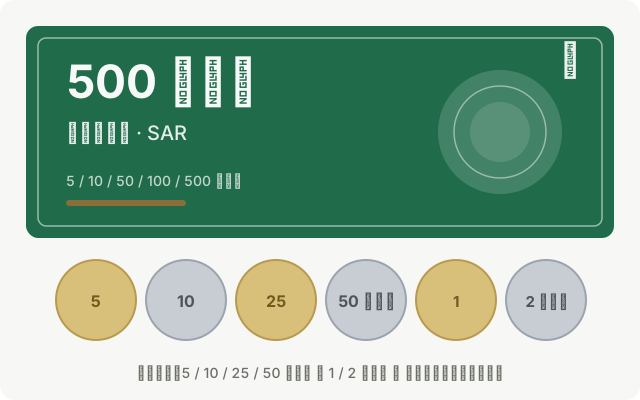
Current banknotes in circulation include denominations of 5, 10, 50, 100, and 500 Riyals; 1 Riyal notes exist but are rare. A 200 Riyal note was issued in 2020 to commemorate the G20 Summit. Banknotes feature portraits of former kings and images of holy sites and palaces on the front, while the back showcases oil facilities, mosques, and infrastructure achievements. Colors and sizes help differentiate the notes. Coins come in denominations of 1, 5, 10, 25, and 50 halalas, as well as 1 and 2 Riyals—the smaller halala coins are often overlooked in everyday transactions.
Thanks to the long-standing stable exchange rate, converting Riyals to US Dollars is straightforward, helping travelers easily estimate costs when shopping or dining. Just remember the approximate rate of 1 USD = 3.75 SAR to judge value quickly without frequent currency checks. Banknote sizes vary significantly, so sorting by color and size is practical—old notes remain valid.
Cash and Payment Habits
Electronic payments are widely accepted in Saudi Arabia. Major malls, chain restaurants, hotels, and gas stations support card payments and contactless transactions, and mobile payment systems like Apple Pay are common. The local debit card network, mada, has extensive coverage. Traditional markets, small shops, some taxis, and street vendors may prefer cash. ATMs are readily available in cities and airports, and Riyals can be exchanged at banks, authorized exchange offices, and some ATMs accept UnionPay cards.
During Hajj season, cash withdrawals can involve long queues around Mecca and Medina, so carry enough cash in advance. Saudi Arabia has no alcohol-related transactions—no alcohol is sold or listed on bills. Many shops and institutions are closed on Friday mornings, so plan accordingly. Everyday expenses like fuel and groceries are reasonable, but hotel and attraction costs often make up the bulk of travel spending.
Traveler Tips
- The Riyal is pegged to the US Dollar with a stable exchange rate, but watch out for fees and change when exchanging.
- Alcohol is completely banned in Saudi Arabia—do not bring it into the country or attempt to buy it.
- Most shops and institutions are closed on Friday mornings, so plan shopping and errands accordingly.
- Tipping is not mandatory, but 5–10% is appreciated for good service in restaurants and hotels.
Saudi Arabia Overview
Country Details »Overview of Saudi Arabia
Saudi Arabia (Arabic: المملكة العربية السعودية) is located on the Arabian Peninsula in the southwest of Asia, covering about 80% of the peninsula’s total area. It borders Jordan, Iraq, and Kuwait to the north, the Persian Gulf to the east (with Qatar, the UAE, and Oman as neighbors), Yemen to the south, and the Red Sea to the west. With a land area of approximately 2.15 million square kilometers, it is one of the largest countries in the Middle East. The country has a population of around 37 million, and its capital, Riyadh, located on the central plateau, serves as the political, economic, and administrative center.
Saudi Arabia is a monarchy, where the king is both the head of state and government, and also holds the title of Custodian of the Two Holy Mosques, responsible for protecting Mecca and Medina. The throne is passed down within the House of Saud. The country is divided into 13 provinces, with Islam as the state religion, and the Quran and Hadith serving as the fundamental basis for governance. Thanks to its abundant oil resources and religious significance, Saudi Arabia plays a pivotal role in the Arab world and the global energy landscape.
Geography and Climate
Saudi Arabia’s terrain is dominated by plateaus and deserts. The Red Sea coast features narrow coastal plains and coral reefs, while the Persian Gulf coast is an important oil-producing region and port area. The Rub' al Khali Desert (meaning "The Empty Quarter") in the southeast is one of the world’s largest continuous sand deserts. The central region is the Najd Plateau, and the southwestern Asir and Taif areas consist of mountainous regions, with peaks reaching around 3,000 meters—popular summer retreats. There are no permanent rivers or lakes in the country, and water supply mainly relies on groundwater, desalination, and recycled water.
The climate is tropical desert, with inland cities often experiencing temperatures above 40°C in summer (June to August), and some areas reaching up to 50°C. Winters (December to February) are milder, with Riyadh daytime temperatures around 15–20°C and cooler nights. The Red Sea coast remains warm and humid year-round, suitable for beach activities. Rainfall is scarce and mostly occurs in winter and spring, with slightly more precipitation in the southwestern mountains. Travelers should prioritize sun protection, hydration, and avoiding outdoor activities during midday heat.
Historical Background
The Arabian Peninsula has long been a key route for ancient spice trade and commerce. Even before the rise of Islam, Mecca was already a hub for trade and religion. In the 7th century, the Prophet Muhammad spread Islam in Mecca and Medina, establishing the region as the birthplace of Islamic civilization. The peninsula later came under the influence of the Arab and Ottoman Empires, becoming an important crossroads between East and West.
In the mid-18th century, the House of Saud allied with Wahhabi scholars in Diriyah to establish the First Saudi State, which was later destroyed by Ottoman and Egyptian forces. In the early 20th century, Abdulaziz Ibn Saud unified the Najd and Hejaz regions, and officially founded the Kingdom of Saudi Arabia on September 23, 1932—now celebrated as Saudi National Day. Oil was discovered in the east in 1938, dramatically transforming the nation’s fortunes. In 2016, Saudi Arabia unveiled Vision 2030 to diversify its economy and open up society. In 2019, it began issuing tourist visas to multiple countries for the first time, ushering in rapid growth in the tourism sector.
Economy and Currency
Saudi Arabia is one of the world’s most important oil producers and exporters. Its national oil company, Saudi Aramco, is among the highest-valued corporations globally. Oil and petrochemical products have long accounted for the majority of export and fiscal revenues. To reduce dependence on oil, Saudi Arabia launched Vision 2030, focusing on developing tourism, entertainment, logistics, renewable energy, and manufacturing. Flagship projects include the NEOM smart city, the Red Sea resort, and the development of AlUla.
The capital, Riyadh, is the financial and administrative hub, while Jeddah serves as the Red Sea gateway and a commercial center. The official currency is the Saudi Riyal (SAR, symbol ﷼), issued by the Saudi Central Bank. It has long been pegged to the US dollar at an exchange rate of approximately 1 USD = 3.75 SAR, a stability that has made the Riyal one of the most dependable currencies in the Middle East.
Culture and Society
As the birthplace of Islam, religion plays a central role in Saudi society. During the five daily prayer times, shops and businesses briefly close, and eating or drinking in public during Ramadan is prohibited. Millions of pilgrims visit Mecca and Medina annually. Over the past decade, Saudi society has undergone significant changes: restrictions on women driving and working have been lifted, cinemas, concerts, and large-scale entertainment events have emerged, and dress codes for foreign tourists have relaxed. However, it’s still important to respect local customs—women are advised to wear modest clothing covering the shoulders and knees, and men should avoid shorts in public.
Traditional Saudi culture includes camel culture, poetry, Arabic coffee, and the hospitality of dates. Alcohol is completely banned, and it is illegal to bring alcoholic beverages into the country or purchase them locally. Public displays of affection should be avoided, and permission should always be asked before photographing people, especially women.
Tourism Overview
Saudi Arabia’s tourism industry has grown rapidly in recent years. Riyadh boasts the UNESCO-listed Diriyah Old Town, the National Museum, and the Kingdom Centre. Jeddah is known for its Red Sea beaches and the historic Al-Balad district. The Asir Mountains near Taif offer cool retreats, including the Green Mountain Cable Car. Northwest Saudi Arabia’s AlUla preserves Nabatean rock tombs at Hegra (Madain Salih) and the Elephant Rock, a UNESCO World Heritage archaeological site. The Red Sea coast is ideal for diving and relaxation, while the Rub' al Khali Desert and Jebel Fihrayn (Edge of the World) are popular for adventure and stargazing.
Note that non-Muslims are not allowed to enter Mecca, and there are similar restrictions in Medina—plan accordingly. Additionally, distances between Saudi attractions are considerable, so driving, private car hire, or domestic flights are efficient options.
Saudi Arabia Travel Guide
All Guides »Saudi Arabia Solo Travel Quick Guide: Visas, Seasons, Budget, and Religious Etiquette
How to apply for an e-visa, which seasons are most comfortable to visit, daily s...
Classic 7-Day Itinerary in Saudi Arabia: Riyadh, AlUla, and Jeddah 7 days
From the history and skyline of the capital, to the Nabatean rock tombs and dese...
4-Day Short Trip to Saudi Arabia: Riyadh City and Desert Heritage Sites 4 Days
Even with just four days, you can have a fulfilling experience: base yourself in...
Essential Attractions in Saudi Arabia: Riyadh, AlUla, Jeddah, and the Red Sea
Organized by direction — capital city, northwest archaeological region, Red Sea ...
Saudi Arabia Food Guide: How to Eat Kabsa, Mandi, and Arabic Coffee
Saudi tables revolve around spiced rice, grilled meats, and dates. From national...
Saudi Arabia Transportation Guide: Ride-Hailing Apps, Car Rental, and Haramain High-Speed Rail
Cities in Saudi Arabia are far apart with frequent flights. Within cities, ride-...