New Zealand Currency New Zealand DollarNZD
What money to use in New Zealand, how notes and coins break down, and the best ways to exchange - get the local cash sorted before you go.
| Currency Name | New Zealand Dollar |
|---|---|
| Currency Code | NZD |
| Currency Symbol | NZ$ |
| Issuing Country | New Zealand |
| Time Zone | UTC+12 (UTC+13 during Daylight Saving Time) |
| Dialling Code | +64 |
About New Zealand Dollar (NZD)
Currency Overview
The official currency of New Zealand is the New Zealand Dollar (currency code: NZD, symbol: NZ$, locally often referred to as $), commonly known as the Kiwi Dollar. On July 10, 1967, New Zealand adopted the decimal currency system, replacing the former pound-based system with the NZD, where 1 NZD equals 100 cents. Issued by the Reserve Bank of New Zealand, the NZD is one of the actively traded commodity currencies in the international forex market, with its exchange rate closely linked to the prices of agricultural and livestock exports such as dairy and meat products.
Denominations
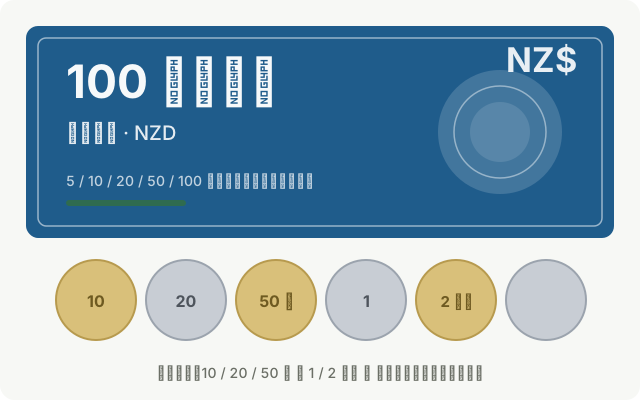
Current banknotes come in five denominations: NZD 5, 10, 20, 50, and 100. Since 1999, New Zealand has fully transitioned to polymer (plastic) banknotes, which are durable, waterproof, and highly secure. The notes feature important historical figures and native birds and plants, such as Sir Edmund Hillary and a yellow-eyed penguin on the NZD 5 note, and Māori politician Sir Āpirana Ngata and a falcon on the NZD 50 note. The designs strongly reflect natural themes.
Coins are issued in five denominations: 10, 20, and 50 cents, as well as 1 and 2 NZD. In 2006, New Zealand significantly reformed its coinage by discontinuing the 5-cent coin and reducing the size of the 10, 20, and 50-cent coins to lower production costs. As a result, older larger coins remain legal tender but are rarely seen in circulation. Coin obverses feature the British monarch, while reverses depict native birds and plants such as the kiwi, kiwifruit, and silver fern.
Cash and Payment Habits
New Zealand is one of the most cashless societies in the world. Locals commonly use debit cards, credit cards, and contactless payments. Almost all shops, restaurants, petrol stations, and public transport accept card and mobile payments. Supermarkets even offer self-checkout scanning. Overall, the payment experience is very convenient. Some small vendors may limit large cash transactions or charge a small fee for card payments.
Travellers are advised to rely mainly on bank cards and mobile payments, carrying only a small amount of cash for occasional needs such as rural markets, donation boxes, or individual shops that don’t accept cards. Foreign currency can be exchanged at airports and banks, though bank rates are usually better. UnionPay cards are accepted at some ATMs and merchants in major cities, but coverage is not as widespread as in the Australian zone. It’s recommended to also carry a Visa or Mastercard.
Traveller Tips
- Prices displayed already include the 15% Goods and Services Tax (GST)—no additional tax is required.
- Restaurants generally do not add service charges, and tipping is not mandatory. For excellent service, 5–10% is appreciated.
- Self-service petrol stations require pre-authorisation of funds; please note possible account holds and release times.
- Remote areas and hiking trails often rely on cash or card payments, so ensure sufficient balance before setting out.
New Zealand Overview
Country Details »New Zealand Overview
New Zealand (known as Aotearoa in Māori, meaning 'Land of the Long White Cloud') is located in the southwestern Pacific Ocean. It consists of two main islands—the North Island and the South Island—as well as around 600 smaller islands including Stewart Island, covering a total land area of approximately 270,500 square kilometres. It lies across the Tasman Sea from Australia, with the two countries about 1,600 kilometres apart. Its nearest neighbours are other South Pacific island nations. The capital is Wellington, situated at the southern tip of the North Island and one of the southernmost capital cities in the world; the largest city is Auckland on the North Island.
New Zealand is a constitutional monarchy with the British monarch as the head of state, represented by a governor-general. It operates under a parliamentary democracy. With a population of about 5.2 million, the majority are of European descent, while the Māori are the indigenous people. There are also immigrant communities from Pacific Island nations and Asia. English, Māori, and New Zealand Sign Language are all official languages.
Geography and Climate
New Zealand sits at the intersection of the Pacific Plate and the Indo-Australian Plate, resulting in high geological activity. Volcanoes and hot springs are widespread on the North Island, and earthquakes occur frequently. The South Island is traversed by the majestic Southern Alps, with Aoraki/Mount Cook being the highest peak at 3,724 metres. The mountain range features glaciers, lakes, and valleys. The southwestern fjord region was deeply carved by glaciers, creating world-class landscapes such as Milford Sound. The North Island is known for its volcanic plateaus, geothermal springs, and lakes, with Rotorua and Taupō as prime examples.
The climate is temperate oceanic, generally mild and moist year-round with small seasonal temperature variations. Seasons are opposite to those in the Northern Hemisphere: December to February is summer, and June to August is winter. The prevailing westerlies bring frequent rainfall, with the west coast being particularly wet and the east coast relatively dry. Due to its location in the mid-to-high southern latitudes, ultraviolet radiation is intense and the ozone layer is thinner, so sun protection is essential when outdoors. The high-altitude areas of the South Island receive heavy snowfall in winter, making them popular ski destinations.
Historical Background
The ancestors of the Māori arrived in New Zealand around the 13th century by canoe from Polynesia, developing a unique tribal society and oral traditions. In 1642, Dutch navigator Abel Tasman was the first European to record the existence of the land, followed by British Captain James Cook in 1769, who charted the coastline. Subsequently, European whalers, missionaries, and settlers gradually arrived. On February 6, 1840, representatives of the British Crown and many Māori chiefs signed the Treaty of Waitangi, which is now observed as New Zealand’s national day.
Later, due to disputes over land and sovereignty, the New Zealand Wars broke out in the mid-19th century. New Zealand became a British dominion in 1907 and achieved full legislative independence in 1947. Since the 20th century, New Zealand has been a global leader in social reform, being one of the first countries to grant women the right to vote (in 1893) and a pioneer in establishing a comprehensive welfare system.
Economy and Currency
New Zealand’s economy has traditionally been driven by agriculture and animal husbandry. Exports such as dairy products, lamb, beef, wool, and kiwifruit hold significant positions in global markets, with dairy being the top export for many years. Other strong sectors include forestry, wine production, tourism, and film production. The country’s stunning natural landscapes have made it a popular filming location for international movies. The efficiency of its livestock industry and the quality of its agricultural products form the economic foundation of New Zealand’s ‘clean and green’ national image.
The official currency is the New Zealand Dollar (NZD), also called the Kiwi Dollar, issued by the Reserve Bank of New Zealand. The NZD is one of the actively traded commodity currencies in the global foreign exchange market, with its exchange rate closely tied to the prices of exports such as agricultural and livestock products.
Culture and Society
Māori culture is at the heart of New Zealand’s multicultural identity. The haka war dance showcases strength through foot-stamping and chanting, the hongi is a traditional nose-pressing greeting, hangi earth-cooked meals and marae (Māori meeting grounds) gatherings carry communal heritage, and ‘Kia ora’ is a widely used greeting. Māori language is commonly used in the national anthem, schools, and public institutions, while Māori art and history are increasingly celebrated.
New Zealand society values equality, environmentalism, and outdoor living. Citizens are passionate about rugby (with the national All Blacks team being an iconic symbol), hiking, sailing, and camping. The pace of life is relaxed, safety is generally high, locals are often friendly and welcoming to strangers, and the gap between urban and rural areas is small.
Tourism Overview
A typical New Zealand travel combination is ‘mountains and lakes in the South Island, volcanoes and cities in the North Island.’ The South Island offers a world-class self-drive route linking Christchurch, Lake Tekapo, Aoraki/Mount Cook National Park, Wanaka, Queenstown, and Milford Sound. Queenstown is renowned as the adventure capital of the world, famous for bungee jumping, skydiving, and jet boating. The North Island highlights include Auckland’s harbour scenery, Rotorua’s geysers and Māori cultural villages, Lake Taupō, the Hobbiton movie set, and Wellington’s museums and coffee culture.
Other popular experiences include whale watching in Kaikōura, coastal hiking in Abel Tasman National Park, and alpine trekking in Tongariro National Park. New Zealand has a well-developed road network but with many mountainous roads; driving is on the left. Self-driving is the most popular way to explore, and accommodation and car rentals should be booked well in advance during peak seasons.
New Zealand Travel Guide
All Guides »New Zealand Travel Quick Guide: Visas, Seasons, Budget & Etiquette
Visa requirements, Southern Hemisphere seasons, self-drive budgets, and Māori et...
Classic 8-Day New Zealand Itinerary: Christchurch — Mount Cook — Queenstown — Milford Sound 8 days
Experience the best of the South Island: glacier lakes, snow-capped mountains, t...
New Zealand 4-day short trip: Auckland on the North Island — Hobbiton — Rotorua 4 days
Essential highlights of the North Island: experience the "City of Sails," the fi...
Essential Attractions in New Zealand: From Fjords and Snow-Capped Mountains to Geothermal Wonders
Explore mountain lakes and fjords in the South Island, and volcanoes and Māori c...
New Zealand Food Guide: Lamb Chops, Seafood, and National Desserts
From grass-fed lamb chops to green-lipped mussels, earth oven meals, and pavlova...
New Zealand Transport Guide: Driving, Ferries, and Buses
Driving is the absolute norm in New Zealand. Learn about left-hand driving rules...