Austria Currency EuroEUR
What money to use in Austria, how notes and coins break down, and the best ways to exchange - get the local cash sorted before you go.
| Currency Name | Euro |
|---|---|
| Currency Code | EUR |
| Currency Symbol | € |
| Issuing Country | Austria |
| Time Zone | UTC+1 to UTC+2 |
| Dialling Code | +43 |
About Euro (EUR)
Currency Overview
Austria’s official currency is the euro (currency code EUR, symbol €), issued by the Eurosystem and circulated within Austria by the Austrian National Bank. As one of the euro’s founding members, Austria began using euro banknotes and coins on January 1, 2002, replacing the former Austrian schilling. Euro banknotes are universally accepted across all eurozone countries, and travelers do not need to distinguish between different issuing sources.
Denomination System
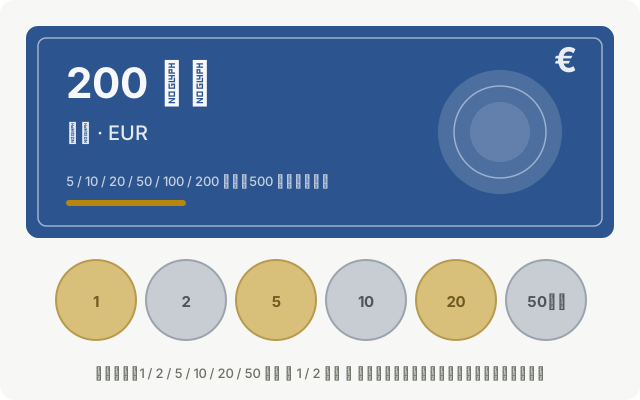
Euro banknotes come in denominations of 5, 10, 20, 50, 100, and 200 euros. There are eight coin denominations: 1, 2, 5, 10, 20, and 50 euro cents, as well as 1 and 2 euros. The reverse designs of Austrian coins prominently feature national symbols: the 1, 2, and 5-cent coins depict the edelweiss, gentian, and primrose — three iconic Alpine flowers; the 10, 20, and 50-cent coins show the Hundertwasser House, the Secession Building, and the Belvedere Palace — three famous Viennese structures; and the 1 and 2 euro coins feature the profile of Bertha von Suttner, commemorating this Austrian woman’s contribution to the international peace movement. Collecting a full set of Austrian coins is almost like owning a miniature cultural history of the nation.
Cash and Payment Habits
Austria is a eurozone country with a well-developed card payment environment but still retains some cash traditions: chain supermarkets, department stores, and gas stations generally accept Visa, Mastercard, and UnionPay cards, and mobile payments such as Google Pay and Apple Pay are widely accepted in cities like Vienna. However, in traditional old-style coffee shops, rural guesthouses, small bakeries, and Christmas markets, cash remains the primary method of payment. ATMs are widely available in cities and ski resorts, with fees for withdrawals with foreign cards depending on the card issuer.
Austrian prices are mid-to-high range within the eurozone. A typical meal in Vienna costs around 15–30 euros per person. When traveling across multiple countries such as Germany, Switzerland, and the Czech Republic, note that only eurozone countries accept euros directly — Switzerland requires Swiss francs and the Czech Republic uses the koruna. Plan your cash needs accordingly.
Traveler Tips
- Austrian coins often feature collectible reverse designs — keep an eye out for unique ones when receiving change.
- Service charges are usually included in café and restaurant bills, but it’s customary to leave an additional 5–10% tip or round up the bill.
- Christmas markets and rural shops often only accept cash, so carry 50–100 euros in small bills.
- Standing-room tickets at the Vienna State Opera are cash-only and cost just 10–15 euros if queued for in advance (about 80 minutes before the performance).
Austria Overview
Country Details »Overview of Austria
Austria (officially the Republic of Austria) is a landlocked country in Central Europe, bordered by Germany and the Czech Republic to the north, Hungary and Slovakia to the east, Slovenia and Italy to the south, and Switzerland and Liechtenstein to the west. Covering an area of approximately 83,900 square kilometers, over 60% of the country is covered by the Alps. Its capital, Vienna, lies along the Danube River, has a population of around 2 million, consistently ranks among the world’s most livable cities, and is globally recognized as the capital of music.
Austria is a federal parliamentary republic consisting of nine federal states. It has a highly developed economy with one of the highest per capita incomes in Europe, and is a member of the European Union, the Schengen Area, and the Eurozone. As the heartland of European classical music and the former center of the Habsburg Empire, Austria combines imperial grandeur with alpine charm.
Geography and Climate
Austria’s terrain extends west to east across the Alpine mountain range, with Grossglockner, the highest peak, reaching 3,798 meters. Valleys in Tyrol, Salzburg, and Styria are among Europe’s top destinations for skiing and hiking. The Salzkammergut lake district in the north, home to lakes such as Hallstatt and St. Wolfgang, is a UNESCO World Heritage Site known for its glacial lakes. The northeast features the Vienna Basin and the Danube Valley, where the terraced vineyards of the Wachau Valley offer picturesque views.
The climate is predominantly temperate: the western mountainous areas experience alpine conditions, cool and snowy, while the eastern region around Vienna shows more continental traits, with summer temperatures reaching up to 30°C and winter temperatures around -1 to -5°C. January is the peak season for skiing, July and August are ideal for mountain hiking, while May–June and September–October provide the most pleasant weather in valleys and cities.
Historical Background
The historical core of Austria is the Habsburg dynasty: beginning with Rudolf I’s election as Holy Roman Emperor in 1273, the Habsburgs ruled Austria for over 600 years, expanding their territory through dynastic marriages across Central and Southern Europe as well as the Low Countries, forming an empire that was once said to be bathed in perpetual sunlight. After repelling the Ottoman siege in 1683, Vienna became a hub of European power and culture, witnessing works by composers such as Haydn, Mozart, Beethoven, and Schubert.
Following the dissolution of the Holy Roman Empire in 1806, the Austrian Empire was established and reorganized into the Austro-Hungarian Empire in 1867, becoming the second-largest empire in Europe after Russia. The assassination of Archduke Franz Ferdinand in Sarajevo in 1914 triggered World War I, leading to the empire’s collapse in 1918. Austria was annexed by Nazi Germany in 1938, underwent Allied occupation after the war, and regained independence in 1955 with the signing of the Austrian State Treaty, declaring permanent neutrality. It joined the EU in 1995 and adopted the euro in 2002.
Economy and Currency
Austria is a highly developed industrialized nation with strong sectors in machinery manufacturing, steel, chemicals, forestry processing, and tourism. Brands such as Red Bull, Swarovski, and Steyr enjoy worldwide recognition, and winter tourism contributes significantly to the economy. Vienna has long been one of the four official headquarters cities of the United Nations, and also hosts the Organization for Security and Co-operation in Europe (OSCE) and the International Atomic Energy Agency (IAEA).
The official currency is the euro (EUR), jointly managed by the European Central Bank and the Austrian National Bank. Euro banknotes and coins replaced the Austrian schilling in 2002. The reverse sides of Austrian euro coins feature unique designs: lower denominations show three Alpine flowers — edelweiss, gentian, and primrose; middle denominations depict three iconic Viennese buildings — the Hundertwasser House, the Secession Building, and the Belvedere Palace; and 1 and 2 euro coins bear the portrait of Bertha von Suttner, an Austrian Nobel Peace Prize laureate.
Culture and Society
Music is Austria’s most celebrated hallmark: the Vienna Philharmonic, the Vienna State Opera, and the annual New Year’s Concert at the Golden Hall are broadcast worldwide. Salzburg, the birthplace of Mozart, hosts the prestigious Salzburg Festival each summer, a major event in the classical music calendar. Vienna’s café culture was inscribed on the UNESCO Intangible Cultural Heritage list in 2011 — sipping a Melange coffee alongside a slice of Sachertorte can easily fill an afternoon.
Austrian cuisine reflects the empire’s multi-ethnic heritage: Wiener Schnitzel originates from Milanese cutlet recipes, apple strudel and pastries share roots with German baking, and influences from Hungary, Czechia, and Italy appear in stews and desserts. The society places emphasis on etiquette and order — theaters and concert halls have dress codes, and queuing for standing-room tickets before opera performances is a local tradition.
Tourism Overview
Austria is one of Europe’s most classic travel destinations: the Schönbrunn Palace, Hofburg Imperial Palace, and St. Stephen’s Cathedral in Vienna carry the legacy of the empire, while the story of Empress Elisabeth (Sisi) and Emperor Franz Joseph keeps the Sisi Museum popular. Salzburg’s Old Town, fortress, and filming locations from The Sound of Music attract film fans from around the world. The lakeside villages of Hallstatt are iconic Alpine postcard scenes. Innsbruck, which hosted the Winter Olympics twice, offers the Golden Roof and the Nordkette Cable Car nearby. Scenic Danube cruises and apricot orchard walks in the Wachau Valley exemplify slow travel. With its mix of cities, lakes, mountains, and concert halls, Austria suits trips ranging from short 3–4 day visits to in-depth explorations of ten days or more.
Austria Travel Guide
All Guides »Austria Travel Quick Guide: Schengen Visa, Seasons, Budget, and Opera Etiquette
Apply for a visa based on your longest stay country. How to queue for standing-r...
Classic 8-Day Austria Itinerary: Vienna – Salzkammergut – Salzburg – Innsbruck 8 days
From the Imperial Capital to Alpine Passes: Palaces, lakes, Mozart’s hometown, a...
Austria 4-Day Short Trip: In-Depth Vienna Tour 4 days
No rush in four days: Explore Vienna through four themes—music, palaces, art, an...
Essential Attractions in Austria: Palaces, Lakes, and Mountains
Schönbrunn Palace, Hallstatt, Hohensalzburg Fortress, Golden Roof – The 18 most ...
A Guide to Austrian Cuisine: Wiener Schnitzel, Sachertorte, and Café Culture
The Imperial Table Legacy: From Vienna Schnitzel to Sachertorte, from Tafelspitz...
Complete Guide to Austrian Transportation: ÖBB, Lake District Buses, and City Transit Passes
Understand ÖBB discount tickets, Vienna’s 72-hour pass, and lake district bus tr...