Chad Currency Central African CFA francXAF
What money to use in Chad, how notes and coins break down, and the best ways to exchange - get the local cash sorted before you go.
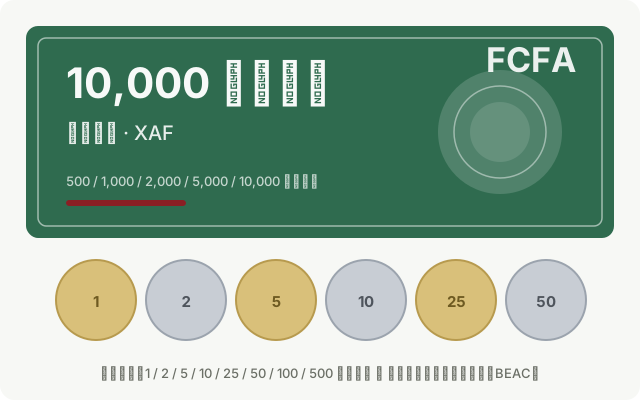
| Currency Name | Central African CFA franc |
|---|---|
| Currency Code | XAF |
| Currency Symbol | FCFA |
| Issuing Country | Chad |
| Time Zone | UTC+1 |
| Dialling Code | +235 |
About Central African CFA franc (XAF)
Currency Overview
The official currency of Chad is the Central African CFA franc (currency code XAF, symbol FCFA), issued by the Bank of Central African States (BEAC), headquartered in Yaoundé, Cameroon. Chad is one of the six member countries of the Central African Economic and Monetary Community (CEMAC). The CFA franc is pegged to the euro at a fixed exchange rate backed by a guarantee from the French Treasury, maintaining a long-term stable rate of approximately 655.957 CFA francs per euro. It is one of the most stable and widely circulated regional currencies in Africa. The CFA franc traces its origins to the 1945-established African franc system, which continued issuance by the BEAC after the countries' independence. Chad has used the BEAC-issued franc since 1972.
Denomination System
The current banknotes in circulation include denominations of 500, 1000, 2000, 5000, and 10000 francs. The national emblems and designs on the front of the banknotes are shared among CEMAC member states, with the issuing country code indicated (T for Chad). Coin denominations include 1, 2, 5, 10, 25, 50, 100, and 500 francs. Due to their small value and ease of loss, smaller coins are less commonly used in daily transactions. Chad does not issue its own separate currency—the circulating currency is the CFA franc.
Cash and Payment Habits
Chad is a highly cash-dependent economy, with the vast majority of transactions conducted in cash. Credit cards are only accepted at high-end hotels and a few foreign-affiliated establishments in N'Djamena. Banks and authorized exchange services are concentrated in the capital, with limited financial services in other cities. ATMs are scarce and unreliable for foreign cards. The safest approach is to carry euro cash into the country, exchange it for CFA francs at banks or authorized exchange points, and carry sufficient small-denomination bills.
Traveler Tips
- The CFA franc is fixed to the euro, so exchanging with euros is usually more favorable than using U.S. dollars.
- Before leaving, try to exchange any leftover CFA francs back into euros, as it is difficult to exchange outside Chad.
- Remote areas lack ATMs and card payment facilities. Carry enough cash for your itinerary and distribute it securely.
- Avoid informal street currency exchanges. Use only banks and authorized hotel exchange services and keep receipts.
- Cash is the primary form of transaction in Chad. It is advisable to distribute your cash holdings and keep an emergency reserve.
Chad Overview
Country Details »Overview of Chad
Chad (officially the Republic of Chad) is a landlocked country in north-central Africa, located on the southern edge of the Sahara Desert. It borders Libya to the north, Sudan to the east, the Central African Republic to the south, Cameroon and Nigeria to the southwest, and Niger to the west. With a land area of approximately 1.284 million square kilometers, it is the fifth-largest country in Africa. However, much of the country consists of desert and arid zones, and the population is mainly concentrated in the southern Sahel grasslands and around Lake Chad. The capital, N'Djamena, is located near the confluence of the Chari and Logone rivers in the southwestern part of the country and serves as the national center for politics, economy, and transportation. The official languages are French and Arabic.
Chad is a presidential republic divided into several regions. As a landlocked nation far from the sea, it faces high transportation and logistics costs, and its development has long been constrained by natural conditions, geographic location, and regional security issues. Travelers to Chad should focus their activities on the relatively stable southern and central areas.
Geography and Climate
Chad’s geography can be clearly divided into three zones from north to south: the northern Sahara Desert interior, which includes dramatic plateaus and sand dune landscapes such as the Tibesti, Ennedi, and Borkou highlands. The Ennedi region is known for its sandstone arches and prehistoric rock art, while the Tibesti features volcanoes and canyons—both have been designated UNESCO World Heritage Sites. The central zone is the Sahelian arid belt, a region of nomadic pastoralism. The southern zone is tropical savanna with higher rainfall and serves as the main agricultural area.
Lake Chad, located along the western border, is a vital inland freshwater lake in Africa. Historically much larger, it has shrunk dramatically over recent decades due to climate change and increased water usage, becoming a globally recognized environmental concern. The country has a hot and dry climate, with the Tibesti Plateau in the north once recording some of the highest temperatures in the country. The rainy season in the south is concentrated from June to September.
Historical Background
The Chad region has long been an important hub of trans-Saharan trade routes, with caravans traveling between the Mediterranean coast and the Sahel, exchanging salt, gold, ivory, and slaves. From the Middle Ages onward, kingdoms such as the Kanem-Bornu Empire, the Wadai Sultanate, and the Baguirmi Sultanate emerged around Lake Chad and its eastern regions, spreading Islamic culture. The rock art of the Ennedi and Tibesti regions records human activity from thousands of years ago when the Sahara was still a grassland.
From the late 19th century to the early 20th century, France gradually incorporated Chad into French Equatorial Africa. Chad declared independence on August 11, 1960. Since then, the country has experienced prolonged political instability and armed conflict, with recurrent security issues in the northern and eastern border areas. Since the 1990s, the political situation has gradually stabilized, but the northern and border regions remain high-risk areas.
Economy and Currency
Chad’s economy is primarily based on agriculture and livestock. The southern region produces cotton, peanuts, and grains, while the central and northern areas rely on cattle, sheep, and camel herding. Since 2003, oil exports via pipeline have become a significant source of national revenue. The industrial base is weak, with limited manufacturing, and the economy is sensitive to fluctuations in oil prices and climate conditions.
The official currency is the Central African CFA franc (XAF), issued by the Bank of Central African States (BEAC). Chad is a member of the Central African Economic and Monetary Community (CEMAC). The CFA franc is pegged to the euro at a fixed exchange rate, making it convenient for travelers to exchange euros for cash locally, though cash is the primary medium for daily transactions.
Culture and Society
Chad is a typical multi-ethnic and multilingual country, with communities such as the Sara, Arabs, Toubou, and Kanuri living together in linguistic and cultural diversity. The central and northern regions are dominated by nomadic and semi-nomadic cultures, while the south is primarily settled and agrarian. Both Islam and Christianity have large followings, and religious and ethnic relations are generally peaceful.
Local traditional music, poetry, and handicrafts are distinctive, and camels and horses hold significant social importance among certain ethnic groups. The diet is based on millet, sorghum, milk, and meat, with cassava and grains more common in the south. Tea is the main beverage. Travelers should respect local religious customs and traditions, especially during Ramadan and in rural areas.
Tourism Overview
Chad’s tourism resources are uniquely diverse in Africa but have long been limited by security concerns. Zakouma National Park is one of the most important elephant conservation areas in West and Central Africa, known as one of the last sanctuaries for elephants in Africa. In recent years, it has achieved notable success in elephant population recovery and anti-poaching efforts, making it one of the most promising wildlife destinations in sub-Saharan Africa. The areas around Lake Chad preserve traditional fishing, hunting, and nomadic lifestyles. The natural stone arches, cave paintings, and volcanic landscapes of the Ennedi Plateau and Tibesti Highlands showcase the grandeur of prehistoric Saharan civilization.
It is important to note that the security situation in northern Chad (Tibesti Plateau, Ennedi Plateau, Borkou) and many border areas is severe. Most governments advise against travel to these regions. If travel is essential, closely monitor the latest official travel advisories, strictly avoid border and military-controlled areas, purchase travel insurance covering medical treatment and emergency evacuation, and prepare for communication, water supply, and disease prevention.
Chad Travel Guide
All Guides »Chad Independent Travel Quick Guide: Visa, Safety Tips, Budget, and Local Etiquette & Taboos
Before traveling to Chad, you must first understand the security situation and v...
7-Day Chad Itinerary: N'Djamena – Moundou – Zakouma – Chad Lake Corridor 7 days
Focusing on the relatively stable southern and central regions, this route conne...
Chad 4-Day Short Trip Itinerary: Safe Travel Around N'Djamena and the Chari River 4 days
This short itinerary focuses on the capital, N'Djamena, and is ideal for busines...
Chad Must-Visit Destinations: Wildlife Reserves, Lake Chad, and the Sahara Highlands
Explore Chad’s most iconic natural and cultural destinations by region—from wild...
A Guide to Local Food and Culture in Chad: Millet Staples, Grilled Lamb, Lake Fish, and Mint Tea
Based on grains, dairy, and meat, Chadian cuisine is simple yet reflects nomadic...
Complete Guide to Transportation in Chad: Airport Transfers, Private Car Hire, and Access to Protected Areas
As a landlocked country, transportation in Chad mainly relies on road travel and...