Brunei Currency Brunei DollarBND
What money to use in Brunei, how notes and coins break down, and the best ways to exchange - get the local cash sorted before you go.
| Currency Name | Brunei Dollar |
|---|---|
| Currency Code | BND |
| Currency Symbol | B$ |
| Issuing Country | Brunei |
| Time Zone | UTC+8 |
| Dialling Code | +673 |
About Brunei Dollar (BND)
Currency Overview
The official currency is the Brunei Dollar (currency code BND, symbol B$, Malay: Ringgit Brunei). Issued by the Autoriti Monetari Brunei Darussalam, 1 BND = 100 sen. Though not a major global reserve currency, the Brunei Dollar holds unique value due to its 1:1 peg with the Singapore Dollar since 1967, allowing free circulation in both countries.
Denominations
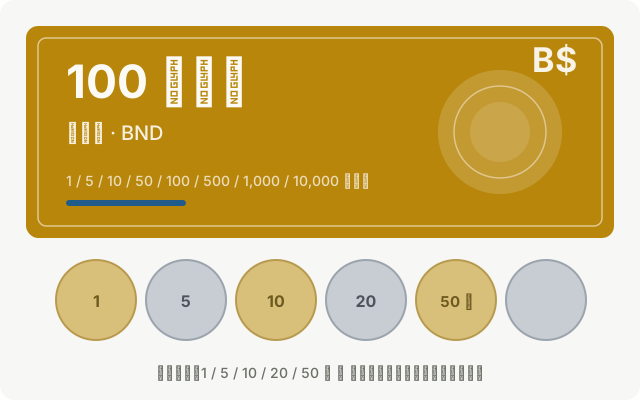
Banknotes come in 1, 5, 10, 20, 50, 100, 500, 1,000, and 10,000 denominations, with higher values mainly for interbank transactions. Daily use primarily involves 1, 5, 10, 50, and 100-dollar notes. Many Brunei Dollar bills are printed on polymer (plastic), offering durability and anti-counterfeiting features. Coins range from 1 to 50 sen, featuring the Sultan’s portrait or royal crest; 1-sen coins are rarely used.
Cash and Payment Practices
With a developed economy and small population, credit cards (Visa, Mastercard) are widely accepted in hotels, malls, chain restaurants, and car rental services. Debit cards and local mobile payments are also growing. However, small vendors, water village shops, some attraction tickets, and water taxis often require cash—carry some Brunei Dollars. Alcohol is banned, so no bars or alcohol sales exist, unlike in many other Southeast Asian nations.
Traveler Tips
- Brunei and Singapore Dollars are interchangeable; Singapore Dollars are widely accepted, usually with change given in Brunei Dollars.
- No alcohol is sold or consumed publicly; avoid bringing it into the country.
- Credit cards work in malls and hotels, but carry some cash for water taxis, markets, and entry fees.
- The fixed 1:1 exchange rate with Singapore Dollars ensures stable pricing and easy transactions.
Brunei Overview
Country Details »Brunei Overview
Brunei (officially Brunei Darussalam, meaning "Abode of Peace") is located on the northern coast of Borneo in Southeast Asia. The country is bordered by Malaysia’s Sarawak state on three sides and faces the South China Sea to the north. With a total area of just 5,765 square kilometers, Brunei is divided into two non-contiguous parts by the Malaysian district of Limbang. The capital, Bandar Seri Begawan, lies in the western part and serves as the political, economic, and cultural center.
Brunei is an absolute monarchy, with the Sultan serving as head of state, head of government, and religious leader. The current Sultan, Hassanal Bolkiah, has reigned since 1967. The population is around 450,000, predominantly Malay, with Islam as the state religion. Malay is the official language, while English is widely used in business and tourism. Brunei is a Commonwealth member and one of the highest-income countries in Southeast Asia per capita.
Geography and Climate
The terrain is mostly flat, with narrow coastal plains giving way to hills and tropical rainforests inland. Temburong District, separated from the mainland by the Brunei Bay, is the largest yet least populated district, home to vast pristine rainforests. Ulu Temburong National Park is a key nature reserve in northern Borneo. The Brunei River flows through the capital, where the iconic Kampong Ayer water village stretches along the riverbanks, often called the "Venice of the East."
The climate is tropical rainforest, with high temperatures and heavy rainfall year-round. Average temperatures hover around 28°C, with annual rainfall between 2,500 and 4,000 mm and consistently high humidity. February to April is relatively drier, making it the ideal time to visit. The rainy season from November to January brings frequent afternoon thunderstorms, so plan outdoor and rainforest activities accordingly.
Historical Background
Brunei was once a powerful Islamic kingdom. During the 15th and 16th centuries, the Bruneian Sultanate reached its peak, controlling much of Borneo and southern Philippines, thriving as a maritime trading power. European colonial powers—Portugal, Spain, the Netherlands, and Britain—later eroded its territory.
In 1888, Brunei became a British protectorate, with British residents assisting in governance from 1906. The discovery of oil in Seria in 1929 transformed the small nation’s fortunes, bringing immense wealth. Brunei gained internal self-government in 1959 and full independence on January 1, 1984, subsequently joining the Commonwealth and ASEAN. Oil and gas revenues have funded a high-welfare modern state, while the national philosophy of Melayu Islam Beraja (Malay Islamic Monarchy, or MIB) remains central.
Economy and Currency
Oil and natural gas dominate the economy, accounting for most export earnings and government revenue. Thanks to these resources, Brunei offers extensive welfare benefits, including free healthcare and education for citizens, subsidized housing and employment, and one of the highest GDP per capita in Southeast Asia. In recent years, the country has pursued economic diversification, developing Islamic finance, tourism, logistics, and downstream petrochemical industries to reduce reliance on hydrocarbons.
The official currency is the Brunei Dollar (BND), symbol B$. Issued by the Autoriti Monetari Brunei Darussalam, 1 BND = 100 sen. Notably, the Brunei Dollar has been pegged 1:1 to the Singapore Dollar since 1967 under a currency interchangeability agreement, allowing both currencies to circulate freely in each other’s countries. This means you can use Singapore Dollars in Brunei and Brunei Dollars in Singapore, greatly simplifying cross-border travel.
Culture and Society
As an Islamic state, Brunei’s social life is shaped by religious norms. The national philosophy of MIB emphasizes unity among Malay culture, Islamic faith, and monarchical authority. Alcohol is banned nationwide—no sales or public consumption—and public drinking is strongly discouraged. Social customs are conservative; dress modestly, and women should avoid overly revealing clothing. During Ramadan, non-Muslims should refrain from eating, drinking, or smoking in public during daytime.
Major celebrations include the Sultan’s birthday (July 15) and Hari Raya Aidilfitri (Eid al-Fitr), marked by festivities nationwide. Kampong Ayer, the historic water village, has existed for centuries with schools, mosques, clinics, and shops, and residents travel by water taxis—a living glimpse into traditional Bruneian life. Bruneians are courteous and value etiquette; using the right hand or both hands when passing items is basic protocol.
Tourism Highlights
Ideal for short 2–3 day cultural trips or combined with longer rainforest adventures. Bandar Seri Begawan’s Omar Ali Saifuddien Mosque, famed for its golden dome and marble boat, is an iconic landmark. The Sultan Hassanal Bolkiah Mosque, the nation’s largest, boasts striking minarets and a golden roof that shine at night. Key cultural sites include the Royal Regalia Museum, the Sultan’s palace exterior, and Kampong Ayer water village.
Nature lovers can explore Temburong’s rainforests via hikes and canopy walks in Ulu Temburong National Park. Seria in Belait District features the Billionth Barrel Monument and oilfield views, showcasing the source of the nation’s wealth. The Empire Hotel is renowned for its luxurious beachfront setting. Public transport is limited; travel typically involves private cars, self-driving, or water taxis, with Bandar Seri Begawan as the main hub.
Brunei Travel Guide
All Guides »Brunei Travel Quick Guide: Visa Requirements, Best Time to Visit, Budget Tips, and Etiquette
This small, wealthy, and clean Islamic nation has plenty of rules. Before you ca...
Classic 7-Day Brunei Itinerary: Capital, Temburong Rainforest, and Belait Oil Region 7 days
From the golden-domed mosque and water villages to the pristine rainforests of T...
Brunei 4-Day Short Trip: Exploring Bandar Seri Begawan and the Temburong Rainforest 4 days
Centered around the capital and divided by zones, this 4-day itinerary covers mo...
Must-visit attractions in Brunei: the Golden Dome Mosque, water villages, and the Temburong rainforest
Brunei may be small, but the Golden Dome Mosque, water villages, and Temburong r...
Brunei Food Guide: A Complete Guide to Dining at Ambuyat, Nasi Katok, and Gadong Night Market
In alcohol-free Brunei, the entire Malay culinary experience is built around coc...
Complete Guide to Transportation in Brunei: Ride-Hailing Apps, Water Taxis, and the Temburong Speedboat Experience
Public transportation in Brunei is underdeveloped. To travel smoothly, you’ll ne...