Canada Currency Canadian DollarCAD
What money to use in Canada, how notes and coins break down, and the best ways to exchange - get the local cash sorted before you go.
| Currency Name | Canadian Dollar |
|---|---|
| Currency Code | CAD |
| Currency Symbol | C$ |
| Issuing Country | Canada |
| Time Zone | UTC-3 to UTC-8 (Newfoundland Time) |
| Dialling Code | +1 |
About Canadian Dollar (CAD)
Currency Overview
The official currency of Canada is the Canadian Dollar (currency code CAD, symbol C$). Locally, it is nicknamed “loonie” (referring to the one-dollar coin with a loon design) and “toonie” (for the two-dollar coin). The Canadian Dollar is issued by the Bank of Canada (Canada’s central bank) and is one of the more widely traded reserve currencies globally. Its exchange rate is closely tied to commodity prices, especially crude oil. One Canadian Dollar equals 100 cents, and its subunit is the same as the U.S. dollar. The CAD/USD exchange rate typically fluctuates between 0.7 and 0.8, so do not confuse the two.
Denominations
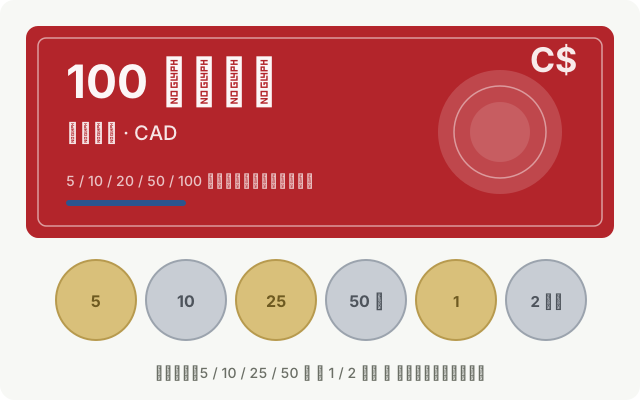
There are five banknote denominations in circulation: 5, 10, 20, 50, and 100 Canadian Dollars. All are printed on distinctive polymer plastic material and come in vivid colours: 5 CAD (blue), 10 CAD (purple), 20 CAD (green), 50 CAD (red), and 100 CAD (brown). Banknotes feature portraits of past monarchs and prime ministers on the front and symbols of Canadian heritage and history on the back. Coins come in six denominations: 5 cents, 10 cents, 25 cents (Quarter, the most commonly used), 1 dollar, 2 dollars, and a limited number of 50-cent commemorative coins. The 1-cent coin was discontinued in 2013 and is no longer in circulation. Cash transactions are usually rounded to the nearest 5 cents.
Cash and Payment Habits
Credit and debit cards (including the local Interac system) are extremely widely accepted in Canada. Virtually all merchants — including restaurants, supermarkets, and gas stations — accept card payments. Mobile payments such as Apple Pay are also broadly supported. Cash is mainly used for small purchases, tipping, and in some Chinese restaurants. ATMs in banks and large supermarkets support cash withdrawals with foreign cards, with a typical fee of around 2–3 Canadian Dollars per transaction. Currency exchange services at airports and city centres in Toronto and Vancouver offer average rates; it’s generally better to use foreign credit cards or withdraw cash as needed.
Similar to the U.S., tipping of 15–20% is customary in Canadian sit-down restaurants, excluding fast-food counters. Prices do not include sales tax. Ontario has a Harmonized Sales Tax (HST) of 13%, while British Columbia’s sales tax ranges from 12–15% (GST + PST).
Traveler Tips
- Both Canadian and U.S. Dollars use the $ symbol. Always check whether a bill or transaction is in CAD or USD to avoid pricing confusion.
- The 1-cent coin is no longer in use; cash payments are rounded to the nearest 5 cents.
- A tip of 15–20% is expected for dine-in meals, unless gratuity or service charge is already included on the bill.
- Polymer bills can warp when exposed to heat. Do not leave them in hot cars or near direct heat sources.
Canada Overview
Country Details »About Canada
Canada is located in northern North America, bordered by the Atlantic Ocean to the east, the Pacific Ocean to the west, the Arctic Ocean to the north, and the United States to the south. It is the second-largest country in the world by area, covering approximately 9.98 million square kilometres. The country consists of ten provinces and three territories. Its capital, Ottawa, is the federal political centre, while Toronto, Montreal, and Vancouver are the three largest metropolitan areas in terms of economy and immigrant population. With a population of about 40 million, Canada is one of the most urbanized and immigration-intensive countries in the world. Both English and French are official languages.
Canada has a federal parliamentary constitutional monarchy, known for its high welfare standards, multiculturalism, and livable cities. Toronto and Vancouver consistently rank among the world’s most livable cities. Tourism is a significant industry, and the national park system is managed by Parks Canada. Banff is the country’s oldest national park.
Geography and Climate
Canada’s terrain extends from east to west across the Appalachian Mountains, the St. Lawrence River Valley and Great Lakes Plain, the vast Canadian Shield, the central plains, and the Rocky Mountains in the west. The northern polar archipelago stretches into the Arctic Circle. The country has the most lakes in the world, and the Great Lakes along the U.S. border, along with Niagara Falls on the Niagara River, are among North America’s most famous natural landmarks.
Influenced by latitude, most of Canada experiences long, cold winters. Ottawa is one of the coldest capitals in the world. The densely populated southern corridor has distinct seasons with cool and pleasant summers. Vancouver on the west coast enjoys mild, rainy winters due to the warm ocean current. The northern and central inland regions have subarctic climates characterized by extreme cold and dryness. Maple foliage changes colour progressively from east to west between September and October, while the peak season for viewing the aurora in the horseshoe-shaped auroral oval runs from December to March each year.
Historical Background
Canada was originally inhabited by Indigenous peoples and Inuit. In the 16th century, French explorer Jacques Cartier arrived at the mouth of the St. Lawrence River, and France established New France in the Quebec region. After the Seven Years' War in 1763, Britain gained control. The British North America Act came into effect in 1867, forming the Dominion of Canada with the provinces of Ontario, Quebec, Nova Scotia, and New Brunswick. This day became Canada Day (July 1).
From the late 19th century to the early 20th century, the transcontinental Canadian Pacific Railway was completed, and western provinces joined the federation. In 1982, Canada regained full constitutional authority from Britain, becoming a fully independent sovereign nation. Today, Quebec retains a strong French-speaking cultural identity, and the historic stone districts of Montreal and Quebec City offer some of North America’s few European-style neighbourhoods.
Economy and Currency
Canada is a highly developed capitalist country and a member of the G7. Its economy is primarily service-based, with manufacturing concentrated in Ontario’s automotive industry. Resource and energy exports (oil, timber, potash, minerals) play an important role, and agriculture is known for wheat and canola production in the Prairie Provinces. The official currency is the Canadian Dollar (CAD), issued by the Bank of Canada. The currency’s exchange rate is closely linked to crude oil prices. Canada was among the first countries to introduce polymer plastic banknotes, which offer excellent anti-counterfeiting features.
Culture and Society
Canada is built on multiculturalism, officially promoting a cultural mosaic policy. English-speaking and French-speaking regions coexist, interwoven with Indigenous cultures, European traditions, and Asian immigrant influences. Ice hockey is the national sport. Ice wine, maple syrup, and butter tarts are iconic flavours, with Canada producing over 70% of the world’s maple syrup. Canadians are known for their politeness, inclusiveness, and frequent use of the word “sorry.” There is a strong emphasis on public order and nature conservation, and wildlife distance regulations must be followed in national parks.
Tourism Overview
Canada’s tourism highlights nature: the Rocky Mountain national parks of Banff and Jasper feature Lake Louise, Moraine Lake, and the Columbia Icefield, making them world-class destinations for alpine lakes and glaciers. A boat ride on the Maid of the Mist offers a close-up experience of Niagara Falls’ roaring mist. Yellowknife, located under the auroral oval, is one of the world’s top destinations for viewing the northern lights. Toronto’s CN Tower, the French old towns of Montreal and Quebec City, and Vancouver and Vancouver Island’s gardens and coastline create a complete route combining cityscapes and nature. Accommodation should be booked months in advance during aurora and foliage seasons.
Canada Travel Guide
All Guides »Canada Travel Quick Guide: Visitor Visas, Seasons, Budgets & Etiquette
How to apply for a visa and provide fingerprints, how long to see the aurora and...
Classic 8-day Canada itinerary: Vancouver — Banff — Niagara Falls — Toronto 8 days
West Coast cities + Rocky Mountain glaciers + Eastern waterfalls and metropolise...
Canada 4-Day Short Trip: Toronto–Niagara In-Depth Tour 4 days
Condense the best of Ontario into 4 days: urban skylines, waterfall wonders, and...
Essential Canadian Attractions: Waterfalls, Glaciers, and the Northern Lights
From Niagara Falls to the aurora borealis in Yellowknife, a roundup of Canada’s ...
Canada Food Guide: Maple Syrup, Ice Wine, and Diverse Cuisine
Don’t just think of Poutine: Maple syrup, ice wine, lobster rolls, and dishes fr...
Canada Travel Guide: Flights, Driving & VIA Rail
Break down Canadian transportation in three layers: domestic flights between cit...