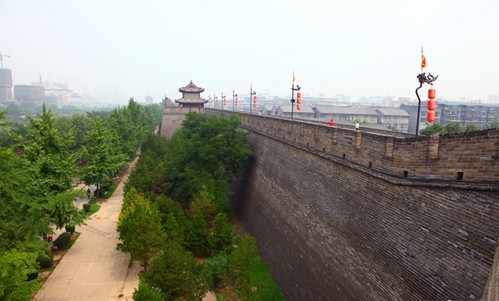
The Ming City Wall: The city wall of Xi’an during the Ming Dynasty was once a massive and intricate military defense system and is the most completely preserved ancient castle in China. The Xi’an ancient fortress showcases the wisdom of the ancient Chinese laboring people and provides rare tangible material for the study of the history, military, and architecture of the Ming Dynasty.
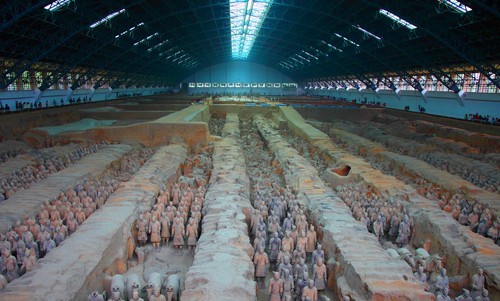
The Terracotta Army: One of the most significant archaeological finds in human history, the excavation of the Terracotta Army has always drawn global attention. In June 2009, the Emperor Qinshihuang’s Mausoleum Site Museum began its third large-scale archaeological excavation. After three years of painstaking work, a large number of terracotta figures, precious artifacts, and relics were unearthed.
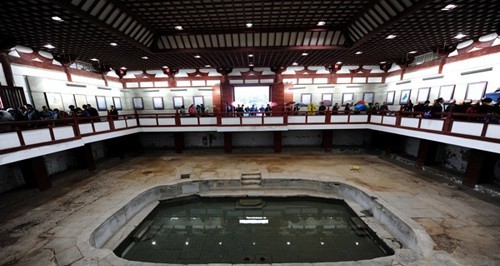
Huaqing Pool: Also known as Huaqing Palace, Huaqing Pool is located at the northern foot of Lishan Mountain in Lintong District, Xi’an, 30 kilometers west of the city. It lies south of Lishan Mountain and north of the Wei River. This ancient imperial retreat, famed for its hot springs, was cherished by rulers from the Zhou, Qin, Han, Sui, and Tang dynasties as a luxurious villa for leisure and pleasure. They either built stone palaces around the hot springs or constructed grand spa palaces within enclosed walls.
Huashan Mountain: One of China’s Five Great Mountains, Huashan stands at an elevation of 2,154.9 meters. It is located in Huayin City, Weinan, about 120 kilometers east of Xi’an in Shaanxi Province. Nestled north of the vast Wei River Plain and the roaring Yellow River, and south of the Qinling Mountains, it rises along the northern ridge of the Qinling range. Adorned by ever-changing natural elements, Huashan’s diverse forms are vividly sculpted, making it a national scenic area.

Tang Paradise: Built on the site of the original Tang Dynasty’s Lotus Park, today’s Tang Paradise is themed around “stepping into history, experiencing culture, and immersing in life,” showcasing the splendid civilization of the Tang Dynasty’s golden age. On May 1, 2012, alongside the grand opening of the “2nd Xi’an Qujiang International Light & Shadow Festival,” the second phase of the park—the Tang Market district—officially opened to visitors, recreating the bustling commercial life of the East and West Markets of ancient Chang’an.
Giant Wild Goose Pagoda: This pavilion-style brick pagoda stands 64.5 meters tall with seven stories. Its square, pyramid-like body features bays structured with imitation wooden beams, decreasing proportionally from the bottom up. Inside, a wooden staircase leads to the upper levels. Each floor has arched doorways on all four sides, offering views from the railings. The structure is grand in scale, simple yet dignified in design, with harmonious proportions and a solemn, classic style. It is one of the best-preserved pavilion-style pagodas, allowing visitors to overlook the ancient city of Xi’an from inside.
Shaanxi History Museum: The land of Shaanxi has been one of the cradles of the Chinese nation and the birthplace and development hub of Huaxia civilization. Thirteen of China’s most glorious dynasties—including the Zhou, Qin, Han, and Tang—established their capitals here. The region’s rich cultural relics and deep historical legacy have created a unique historical and cultural character. The Shaanxi History Museum, hailed as the “Pearl of Ancient Capitals and Treasure House of Huaxia,” serves as an artistic hall displaying the history and ancient civilization of Shaanxi and China.
Bell and Drum Towers: The Xi’an Drum Tower is the largest of its kind in China. It is situated at the southern end of Beiyuanmen on West Avenue in the city, facing the Bell Tower to the east. The Drum Tower was first built in the 13th year of the Hongwu reign during the Ming Dynasty under Emperor Zhu Yuanzhang, and was later renovated twice—in the 38th year of the Kangxi reign and the 5th year of the Qianlong reign of the Qing Dynasty.
Qinqiang Opera: Originating from folk songs and dances in ancient Shaanxi and Gansu, Qinqiang Opera grew and matured in Chang’an, the political, economic, and cultural center of ancient China. Shaped by generations of artistic evolution, it earned its name because the Guanzhong region has been called “Qin” since the Zhou Dynasty, making it one of the oldest forms of Chinese opera.

Shadow Puppetry: Also known as “shadow play” or “lantern shadow play,” this traditional performance art uses cut-out figures made from animal hide or cardboard, projected onto a backlit screen. It is one of the most popular forms of puppet theater in China. During performances, artists manipulate the puppets behind a white screen while narrating stories in local melodies, accompanied by percussion and string instruments, creating a rich folk atmosphere.
Share
This article is published by HowToTrip. Sharing and reposting are welcome — please credit the source.
Article URL: https://www.howtotrip.net/views-58317