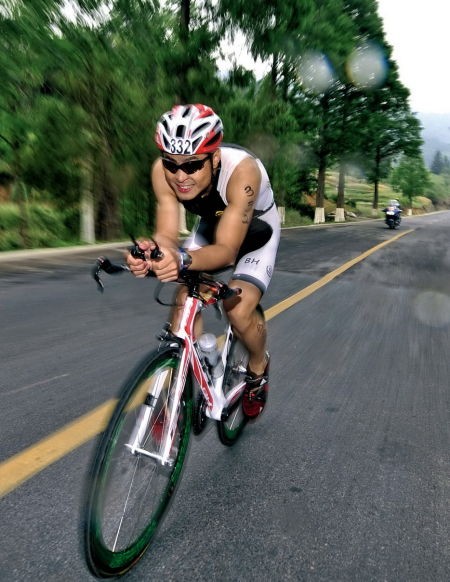
Triathlon originated on the Hawaiian island of Kona and quickly gained global popularity. Currently, China hosts around 10 triathlon events annually, with over 2,000 regular participants, most of whom are between 30 and 60 years old.
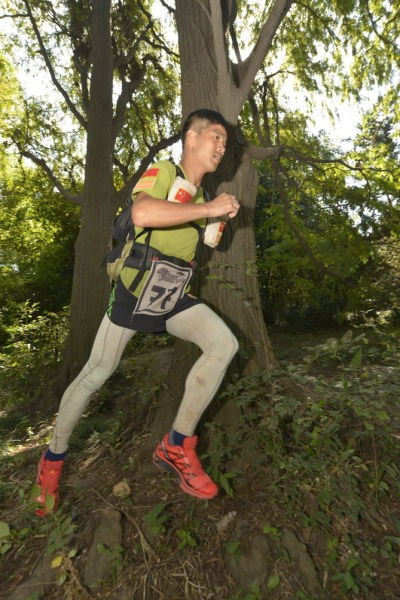
Chen Penbin is a natural endurance runner. He was the first Chinese person to grace the cover of Outside magazine in the United States, and is known as the "Chinese Ironman" and the "King of Endurance."
Among us, triathlon enthusiasts are a unique group. They undergo intense training in swimming, cycling, and long-distance running outside of work. A triathlete who can complete at least 1.5 km of swimming, 40 km of cycling, and 10 km of running in one go is undoubtedly someone who loves life, understanding the philosophy of life through sports better than most. In triathlon competitions, any impatience or overestimation of one's abilities can lead to accidents. Regarding the tragic death of a 21-year-old during the inaugural Guangzhou Marathon on November 18, "China's Ironman" Chen Penbin believes that marathon running requires consistent, targeted training in daily life, and during the race, conserving energy and finishing at a steady pace is the real victory.
Triathlon consists of three sequential events: open-water swimming, road cycling, and road running. Participants must complete all three. The four ironmen featured in this issue are not professional athletes; they all have their own jobs and careers. Through unwavering perseverance and hard work, they’ve transformed their athletic talents and passion into remarkable lives. Their stories offer valuable inspiration to people today. In an era of increasing pressure and faster-paced living, consistent exercise can help regulate daily routines, improve physical health, and foster friendships with like-minded individuals.
Chen Penbin: "China Also Has Outstanding Endurance Runners"
"King of Endurance," "China’s Ironman," "China’s First Super Marathoner," Honorary Director of the Beijing Triathlon Association, and the first Chinese to participate in and complete the Sahara Marathon.
On November 18, during the inaugural Guangzhou Marathon, a 21-year-old man competed in the 10 km race. After crossing the finish line, he collapsed unconscious. Despite emergency medical efforts, he tragically passed away the following day.
Regarding this incident, Chen Penbin, a renowned Chinese endurance athlete known as the "China Ironman" and "King of Endurance," told The Bund Magazine over the phone that during races, athletes are in a highly excited state and often unknowingly run faster than usual. This increases heart rate and places greater demands on cardiopulmonary function. If an athlete sprints toward the finish line when their cardiopulmonary capacity can't keep up, sudden cardiac death can easily occur. Many participants in 10 km or 5 km races may only run a few times a month, and signing up for a marathon without adequate training significantly increases risks.
Chen Penbin suggested that organizers of future domestic marathons should begin safety promotions half an hour or even one hour into the race. "As athletes, our influence is limited. If event organizers repeatedly remind participants an hour before the start, it can make a big difference." He also emphasized on Weibo: "Safety first. Finishing at a slow pace is a victory. Doing your best—even if you don’t complete the full race—is still being a winner."
Two weeks prior to this phone interview, the reporter met Chen Penbin. At the time, he had just returned to Shanghai after completing the 254 km Ultra Marathon in the Amazon Jungle of Brazil. He achieved second place, the best result ever by a Chinese in the race. Prior to that, he had participated in ultra marathons across six continents. Once he completes next year’s "Antarctica 100 km" race, he will be the first Chinese to complete ultra marathons on all seven continents.
Chen Penbin is not tall—only 1.72 meters—with dark skin and a likeness to Bruce Lee. This humble, sincere, detail-oriented, and unassuming young man from a coastal village in Zhejiang has an extraordinary story. Born into a fishing family in Yuhuan County, Zhejiang, his first competition was a push-up contest organized by the local youth league. He stunned everyone by performing 438 push-ups on his first try. From then on, he gradually realized his athletic talent and began training intentionally and participating in various domestic competitions. In 2003, Chen Penbin signed up for the Shanghai International Triathlon Points Race and National Championships—the first national-level sporting event he entered. "At the time I didn’t have a bike, so I borrowed one for 500 yuan. Everyone else had bikes worth tens of thousands. That’s when I realized how much equipment affects performance." But thanks to his rich experience and strong physique, he still finished eighth.
Triathlon is a relatively expensive sport, but Chen Penbin came from a poor background. Considering cost and his strengths, he chose ultra-long-distance trail marathons, which require almost no expensive gear: just a full marathon’s worth of training daily, a pair of ready-to-go feet, and a strong will. He then participated in various competitions at his own expense while seeking sponsors. He visited over ten companies in Taizhou and Wenzhou with numerous trophies and certificates but found no support. In 2004, he approached Supor Co., Ltd., where the boss readily agreed to help. Since then, Chen Penbin has worked at the company while competing in sports events—his travel and accommodation expenses are reimbursed, and he receives an annual sports nutrition allowance. If he places in a competition, the company gives additional bonuses based on the event level. This support was a lifesaver, freeing him from financial worries so he could focus on training and racing.
Compared to regular marathons, trail marathons are more rugged and injury-prone. On September 28 of this year, Chen Penbin competed in the 246 km Greek Trail Race, finishing 51st. The Greek Trail Race is a well-known classic event, and Chen Penbin was the first Chinese to take part. Of the 351 participants in the 30th Greek Trail Race, only one-fifth finished. Throughout the race, Chen Penbin raced against the clock, as each segment had strict time limits—if missed, runners were "closed out" or disqualified. His shoe failed during a downhill section, tearing off the entire nail of his pinky toe. At a rest station, a doctor bandaged and stabilized it, and he borrowed shoes from a fellow competitor to continue. At night, facing strong winds, he used his headlamp to climb a steep mountain. A Singaporean athlete gave him a sports drink that helped immensely, so he ran non-stop until dawn.
The next morning, Chen Penbin finally reached the finish line. There was no prize money, but the organizers gave each finisher a glass of water, an olive wreath, and a certificate. "I drank that water—it tasted completely different from tap water, incredibly sweet. Then the doctor made me soak my feet to prevent infection. When I put them in the water, the pain was intense—I saw they were covered in blisters. The doctor used a needle to drain them and applied some medicine. It hurt a lot."
To make it to Brazil for the Amazon Trail Race on time, Chen Penbin skipped the award ceremony for the Greek Ultra Marathon. On September 30, he flew from Athens to Paris, transferred to São Paulo, and then to the race location, Santarém.
On the morning of October 7, the race officially began. Spanning 254 km over six stages, the race hit all participants hard from the start. After the first day, Chen Penbin ranked 10th. "I was really disappointed—I didn’t expect the race to be this tough," he told The Bund Magazine. By the end of the second day, he moved up to ninth overall. On the third day, he stayed with the main pack at a slower pace. By the fourth day, during a stream ascent, his ranking improved steadily. By the sixth day, he was running alongside the leader, knowing he’d secure second place.
Without a team, not speaking English, and running ultra marathons around the world, Chen Penbin’s story has had a huge impact. He was the first Chinese to appear on the cover of Outside magazine. In 2011, he was nominated for the "2011 CCTV Sports Personality of the Year – Observers’ Award for Unsung Heroes." At press time, the reporter learned he had been shortlisted again for this year’s "CCTV Sports Personality of the Year" in the "Non-Olympic" category, with results to be announced soon.
In an interview with The Bund Magazine, Chen Penbin humbly described himself as an ordinary person who is just "a bit braver" and who persists in chasing dreams. "I want more people to know there are many such events globally. By participating, I want the world to see that China also has athletes excelling in endurance sports."
Anna Stroh: "A Fun but Expensive Sport"
Anna Stroh is a German female triathlete who won the women’s championship at the recently concluded Anting Shanghai Autumn Triathlon.
Q: When did you start doing triathlon?
A: I started competing in triathlon four years ago. By then, I was already an experienced long-distance runner, but extensive training and marathon races led to injuries. To recover and rehabilitate, I began swimming and cycling. Once, while visiting my parents in Germany, my father suggested we both sign up for a triathlon. So we did.
Q: Is triathlon popular in Germany?
A: In Germany, the sport has become very popular in recent years, with many events popping up everywhere. German winters are long, so the season is short. In summer, numerous races take place across the country. If you have the energy, you could even compete in several events per week. That’s quite different from China, where the sport has only emerged recently, events are gradually increasing, and awareness is slowly growing.
Q: When do you usually train in Shanghai?
A: I train at least six days a week. I usually start around 6 a.m., train again after work in the evening, and also train on weekends. I run and cycle in Xuhui Park and the Puxi Expo Park, do sprint training in Xuhui Park and the Luwan Gymnasium, swim and do strength training at my gym in People’s Square.
Q: What dietary requirements does frequent triathlon training entail?
A: Nutrition is very important. But due to work, I don’t always eat what I should or eat on time. Still, I try to eat plenty of vegetables and fruits, and I’m careful about sugar and fat intake. At home, I enjoy fresh vegetables with olive oil. I don’t eat much meat, mainly chicken and fish. I also like nuts. Carbohydrates are good for endurance athletes, but I try to limit them except right before a race.
Q: Is triathlon an expensive sport?
A: Compared to other sports, triathlon is an expensive one. Running only requires a pair of running shoes. What makes triathlon costly is the gear, especially the bicycle, which can be priced without an upper limit. In Asia, if we want to participate in international races, we often need to travel across continents, which is also quite expensive.
Dang Qi: “The philosophy of triathlon is everywhere.”
Dang Qi, originally a swimmer, with a legal background, worked as a flight attendant for six years, is a passionate triathlon enthusiast, and the first Chinese to compete in the Kona Ironman. Dang Qi is dedicated to promoting the highly captivating sport of triathlon in China.
Q: Can you introduce the Kona Ironman race?
A: Kona is a small place in the Pacific Ocean where a great sport was born: the Ironman race. The Kona Ironman is not something you can just sign up for—you need to achieve a certain ranking in your age group in Ironman races held earlier in the same year to qualify for this year-end championship. I’m very proud to compete alongside such a passionate group of athletes. I’ve long heard an unwritten saying in the triathlon world: only those who complete the Kona Ironman are true ironmen. It’s for that very reason that so many triathletes travel the world every year to earn their Kona qualification, and I gave my all to realize this dream.
Q: Your best international result is 9th place—can you talk about that race?
A: That was the Ironman race on Jeju Island, South Korea. Before the swimming start, I spent about 10 minutes “pushing hands” with a few foreigners to secure a spot in the front row. Throughout that time, they kept looking at me with disdain. When the gun went off, I didn’t hold back and dashed straight to the front. After just a few strokes in the water, they were all behind me.
I believe that although swimming makes up a smaller portion of triathlon, training it well is still very important. Being good at swimming won’t guarantee you the win, but it can save energy and build advantages for the cycling and running segments that follow. Because I was much more relaxed than in previous races, during the bike leg I focused more on my cycling technique, striving to make it smooth and fluid. In fact, if I had concentrated too much on speed, I might not have gone faster. But when I focused on technique, the speed naturally improved—sports philosophy is truly everywhere. Along the way, I also saw various finish-line moments, most of them with families crossing together. One day, I also want to cross the line with my child and tell him that triathlon is life—there are no free lunches, and what you put in will always be proportional to what you get. This is also one of the reasons I love this sport.
As the sky gradually darkened, I could still clearly see a foreign girl trembling with excitement, tears streaming down her face as she crossed the finish line 100 meters from the end. I think she must have been moved to tears by her own incredible feat. Let those tears flow a little more—such happiness can only be truly understood by those who finish.
Q: What is the current state of triathlon events in China?
A: The number of triathlon events in China has increased from five in 2007 to ten currently, and the number of regular participants has grown from a few hundred to over two thousand. Most participants are aged between 30 and 60. The events have become more lively, adding formats like duathlon (bike-run), aquathlon (swim-run), relays, and experience races, allowing enthusiasts who aren’t yet able to complete a full triathlon to enjoy the fun of racing. More and more related brands are also paying attention to and sponsoring these events. Overall, we’re slowly aligning with international standards.
Q: You aim to promote triathlon, a highly captivating sport, in China. What do you think makes it so appealing?
A: Chinese people nowadays aren’t short of money—they lack health and a positive, uplifting mindset. Drinking and playing mahjong can cost tens of thousands a year and still not be enough. Compared to any single sport, triathlon is a comprehensive activity that gives your body a great workout from top to bottom, inside out, left to right, front to back. Runners alone tend to have weak upper bodies, swimmers often have thick body fat and weak joint strength. Moreover, triathlon reflects a positive lifestyle—a person who doesn’t love life won’t invest a lot of time to improve their own physical condition. Those who train in triathlon usually have strong family and social responsibility.
Q: You call yourself a “cheese maniac”—are you very particular about your diet?
A: I prefer French cheeses, among which the Brie de Meaux from Borgonzola is one of my favorites.
I eat six meals a day instead of three. The first meal is within half an hour after waking up—usually cereal, bread, vegetables, and fruit. The second meal around 10 a.m. includes yogurt, apple, and nuts. The third meal at noon is beef, chicken, or fish with vegetables and starches. The fourth meal around 2:30 p.m. is bread and fruit. The fifth meal at 5 p.m. is pasta and vegetables. The sixth meal at 7 p.m. is milk and fruit. I don’t eat stir-fried dishes. Vitamin E mainly comes from nuts, I eat less meat but more fish, rarely eat rice or white flour, and consume more starches.
Q: How has triathlon shaped the person you are today?
A: I don’t race for rankings. Through practicing triathlon, my daily routine is very regular, my time management is excellent, my physical condition has improved like never before (anyone who trains knows this), and I’ve also made many good friends. Since I have no bad habits, my family is also particularly pleased with me. To me, all of this is far more valuable and meaningful than winning a championship.
Zhang Ling: The Triathlon Gear Enthusiast and Tech Geek
Founder of the Shanghai Triathlon Sports Club, three-time participant in the Haikou “Ironman” event, and an ultra-marathon runner.
In 2004, Zhang Ling and several friends founded the “Shanghai Triathlon” sports club, hoping to bring together triathlon enthusiasts in Shanghai to train and compete. Zhang Ling told the Bund Pictorial that the club’s members come from all over the world, and the “Shanghai Triathlon Club” is far more active on the international scene than in domestic races.
Zhang Ling is also a finisher of the “Ironman” events (3.8 km swim, 180 km bike, 42.2 km run) held in Haikou in 2008, 2009, and 2010. Of the three races, the third China Ironman left the deepest impression. “Race day was as hot as in previous years. I didn’t perform well in the swim and finished nearly half an hour behind Dang Qi, the first Chinese athlete out of the water. The bike stage had strong winds, but because I trained in strong winds throughout the winter in Shanghai, I performed fairly normally. By the run stage, I gave it my all to chase Dang Qi, fully immersed in the competition—I couldn’t even hear friends greeting me as they passed by. I was constantly calculating whether I could catch him. Around the 35 km mark, we passed each other. His electrolyte pills had accidentally fallen on the road, and he asked if I had any left. I checked my race belt and found two remaining, so we each took one and continued the race. Although I still finished about two minutes behind, it was an exhilarating race I’ll never forget.”
Besides triathlon, Zhang Ling is also an ultra-marathon runner. One week after the Haikou Ironman in 2009, he went directly to Beijing to compete in The NorthFace 100 km trail marathon. Talking about the differences between triathlon and ultra-trail marathons, Zhang Ling used his consecutive participation in the Haikou Ironman and The NorthFace 100 km in 2009 as an example. “The Ironman consists of swimming, biking, and running. Due to the varied terrain, the entire race keeps you in an excited state. In each stage, you give your all to achieve the best possible result. During transitions—from swim to bike, and bike to run—there’s a feeling of being physically drained. Especially in the final running stage, it’s a pure test of stamina. I really love that feeling of sweating profusely and then being drenched in ice water. Though the whole process is tough, there’s no bodily pain. The muscles used in the three disciplines are quite different, so it’s less likely to cause injuries. Simply put, the difficulty of the Ironman comes from stamina, while The NorthFace 100 km’s challenge lies in the joints and bones.”
Zhang Ling graduated from Beihang University and was originally a “standard” office worker. After falling in love with endurance running and triathlon, he invested more and more time and energy into it until it became his entire life. Last year, he participated in the “12-Hour Super Marathon” organized by Shanghai’s running community to raise winter clothes for children in impoverished areas. By running continuously for 12 hours, he helped raise nearly a hundred fleece jackets for those children.
Now, besides frequently competing in endurance running and triathlon events both domestically and abroad, Zhang Ling also runs a triathlon gear retail store near Century Park in Pudong. The shop sells a variety of endurance running and triathlon gear—all items he has personally researched, used, and approved. He calls himself a gear enthusiast and tech geek, closely following international races and brands. Whenever he discovers new products or methods, he finds ways to buy or learn about them, then puts them into practice.