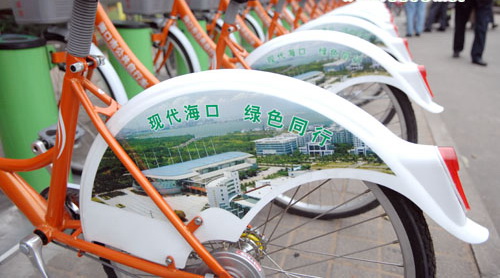
The bright orange eco-friendly bikes are highly visible
Since the public bicycle project in Haikou was launched in January 2011, it has garnered widespread attention from all sectors of society. During this period, many residents have reported issues such as too few service points, limited bike lanes, and poor connectivity. On December 20, reporters from Nanhai Net learned from the project operator that Haikou plans to build 300 bike rental service points to cover the entire city. It was also reported that the government will construct a network of slow traffic greenways to provide “dedicated lanes” for citizens and tourists who choose cycling as a green and low-carbon mode of transport.
Few people “use” public bikes during working hours
According to reports, since the launch of the public bicycle project in Haikou, service points have only been set up at Yihao Mansion Station on Mudan Road, Zijin Garden Station, Aihua Auto Plaza Station, and Electric Village Station. Each service point is equipped with 15 bike racks and 15 bicycles, totaling 60 racks and 60 bicycles across the four sites. Citizens can rent and return bikes at any service point with a card.
On the afternoon of December 20, reporters from Nanhai Net visited the service points at Mudan Road and Zijin Garden Station on Haikou’s Binhai Avenue. Most of the bikes were neatly parked at the stations, with staff performing maintenance. The reporters waited at the site for 15 minutes and saw virtually no citizens “using” these bikes.
According to service point staff, since the project began, more people tend to rent bikes after work or on weekends, while usage during working hours is relatively low. As a bike rental card is required, all four service points currently offer card issuance, though staff noted that the number of applicants is modest.
Few service points and weak connectivity of slow traffic routes
So, what has been the response from Haikou residents since the project launched? Reporters conducted interviews, and most respondents felt that the limited number of public bike service points restricts the range of cycling. The lack of dedicated bike lanes in the urban area and poor connectivity of slow traffic routes make cycling quite challenging.
“There are only four points in total. Although you can return a bike at any of them, the coverage is still too limited,” said Mr. Liang, a Haikou resident. “Right now, you can only ride around the existing four points. You can’t even make it to Fucheng—it’s too far from the service points, and riding there and back is really tiring.”
Ms. Deng, who enjoys cycling, told reporters that some road surfaces in Haikou are in poor condition, with many sections poorly designed. The connectivity of slow traffic routes is weak, vehicles often park illegally on bike lanes, and the entire non-motorized lane feels like an obstacle course. Add to that the ubiquitous electric scooters, and there’s virtually no space left for bicycles. “I think the urban cycling environment here is poor, and cyclists lack safety.”
$60 million investment to build service points covering the whole city
To meet the travel needs of residents, Hainan Yangjia Culture Media Co., Ltd., the operator of the project, plans to invest 60 million yuan to develop a citywide network of public bicycle service points.
According to the plan, 300 public bicycle and international tourism smart service points will be built across the city, implemented in three phases. The first phase, which started this year, aims to establish 100 service points by January 30 next year; the second phase targets another 100 points by May 30; and the third phase will complete the final 100 points by November 30.
The service points will cover the main urban areas of Longhua, Meilan, Qiongshan, and Xiuying districts. They will be strategically located near major transportation hubs, shopping and leisure areas, office buildings, schools, and residential communities, forming a slow-traffic network for public bike use. This allows residents to pick up and return bikes at any service point, enjoying truly convenient and healthy travel. Key locations include RT-Mart, Carrefour, Hainan University, Holiday Beach, Guanhai Platform, Mingzhu Plaza, and People’s Park.
Dang Weina, deputy general manager of Hainan Yangjia Culture Media Co., Ltd., explained that unlike the initial four trial service points, the new public bike stations will integrate bikes, shelters, and cards. Advanced management technologies and intelligent, networked services will be employed. Through electronic touchscreens at the service points, information resources will be integrated and updated 24/7. With just a public bike rental card, citizens and visiting tourists can access convenient services such as tourism information, hotel and restaurant bookings, utility payments, e-commerce transactions, and government updates at any bike station.
Cycling for fitness—Haikou is suited for green riding
What is the current state of bike rentals in Haikou? Dang Weina noted that there are currently only four bike rental service points in the city, with about 1,000 active cards due to the mobility of users. Most rentals occur in the evening and on weekends. While many residents have expressed concerns, a significant number also support the bike rental system. She added that many office workers spend most of their time sitting and lack exercise. Renting a bike offers a way to stay active—commuting by bike not only helps avoid traffic congestion but also promotes better health.
Sanya launched public bike rentals earlier but has nearly collapsed—what advantages does Haikou have? Dang Weina believes that cycling is low-carbon and environmentally friendly, aligning well with the goals of Hainan’s International Tourism Island. As a tourist destination, Hainan attracts many visitors, and biking serves as an excellent way to explore the city. Sanya’s bike rental system failed largely because it relied on a traditional network requiring manual check-in, timekeeping, and other cumbersome procedures. In contrast, Haikou uses an advanced smart system that makes the rental process simple and fast. Users only need a smart card—swipe it at the lock post to unlock the bike, which automatically disengages, then remove it. To return, insert the bike’s lock into the post, swipe the card, and the lock automatically secures the bike. The entire process takes less than a minute, completely avoiding queues. “Besides, Haikou is the provincial capital, so its infrastructure should be more comprehensive.”
“Our company is undertaking this project with a public welfare mindset and has received strong government support,” Dang Weina said. When public bike rentals were introduced in 2011, the government considered it a novel technology. Out of responsibility to residents, it initially set up four trial service points along Binhai Avenue to gauge public feedback before deciding on further expansion. After nearly two years of trials, the response was very positive, leading to the decision this year—with government backing—to build 100 additional service points, covering the entire urban area of Haikou for greater convenience.
Building a green slow traffic network to enhance leisure environments
Regarding this, reporters learned from Haikou’s planning and municipal departments that green slow traffic channels have already been developed along Binhai Avenue, Binhai West Road, and Binjiang Road, providing “dedicated lanes” for pedestrians and cyclists. According to the compiled “Haikou Green Slow Traffic Leisure System Plan,” the city will integrate tourism needs, fitness, and leisure activities to create an integrated “public transit + slow traffic” travel model. A citywide network of slow traffic leisure greenways will be established to form a complete urban green leisure system encompassing recreation, daily life, and entertainment.
Related links:
1. How to apply for public bike rental and return procedures?
Citizens and tourists can apply for a smart card at any bike service point with their ID. For the first card, a 200-yuan deposit and 100-yuan credit are required. Once the credit is used up, it can be recharged in multiples of 50 yuan.
2. How are public bike rentals charged?
The first hour is free every day; each user gets one free hour per day. Hours 1–2 cost 1 yuan/hour; hours 2–3 cost 2 yuan/hour; and any time beyond 3 hours is charged at 3 yuan/hour. Fees are deducted from the smart card. If a bike is rented multiple times in a day, the time between rentals is not cumulative—each rental period is calculated separately.