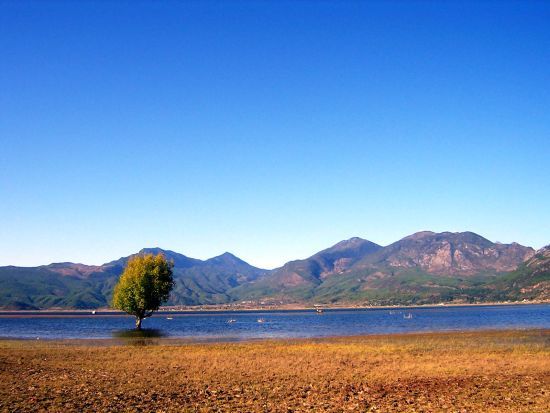
Napahai
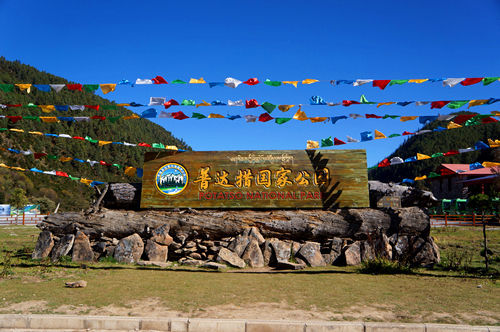
Pudacuo National Park
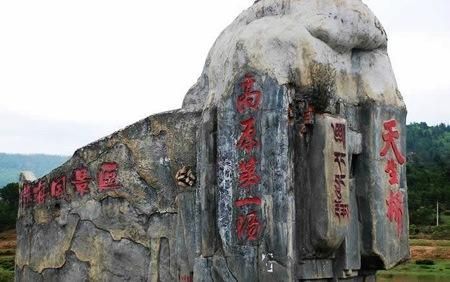
Tianshengqiao
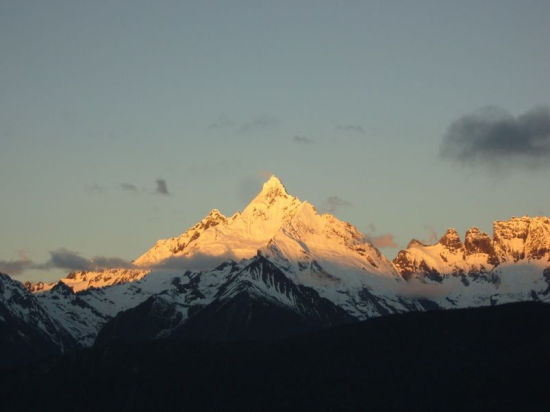
Sunlight on Golden Summit
"You are the sun and moon in my heart, fallen here;
all before and after the journey is superfluous, just to meet you;
how I wish to turn into the mud beneath your feet;
in this deserted valley now, it seems I can hear you say 'I love you'!"
Listening to this familiar melody, softly singing these well-known lyrics. Leehom Wang used his song "Sun and Moon in My Heart" to depict the beauty of Shangri-La, and it's also this song that has inspired countless people to deeply yearn for this place.
On Highway 214, you often see cyclists heading to Tibet. Shangri-La is a must-pass on the Yunnan-Tibet route, naturally becoming a resting spot for riders. More and more cyclists are coming to Shangri-La, bringing this cycling lifestyle with them. A few years ago, there were hardly any places to rent bikes in Shangri-La, but as cycling has gained wider acceptance and the concepts of green, low-carbon travel have taken root, biking has also begun to thrive in this sacred land. Nowadays, it’s very convenient to rent a bicycle near Dukezong Ancient Town.
Bring your good mood, hop on a bike, enjoy the bright sunshine of the plateau, and explore the beauty of Shangri-La. Although Shangri-La sits at an altitude of 3,280 meters, and many worry about altitude sickness, there’s really no need to fret — if you do experience it, just drink some Rhodiola or get some oxygen, and you’ll be fine.
Attractions near Shangri-La such as Napahai, Napa Grassland, Pudacuo National Park, Tianshengqiao Hot Springs, and Ganden Sumtseling Monastery are all close to the county town, making cycling around Shangri-La a great choice.
Shangri-La’s Napahai is located northwest of Zhongdian County, about 8 kilometers from the county seat. The reserve covers an area of 3,125 square kilometers, sits at an elevation of 3,266 meters, and has a lake surface area of 660 square kilometers. The terrain is flat, surrounded by mountains on three sides, with snow-covered peaks in winter and spring. Over ten rivers, including the Nuqu River and the Naizi River, meander through the grasslands and flow into Napahai. On the northwestern side of the lake, at the foot of the Xinkuoyala Snow Mountain, there are nine natural sinkholes. Floodwaters pass through these caves and exit via the Nixi Tangman River, eventually flowing into the Jinsha River. During the rainy season, the water level rises, and in the dry season, the floodwaters recede, shrinking the lake and leaving most areas as marshes and meadows.
Shangri-La’s Napahai is one of the county’s most distinctive highland scenic spots and its largest grassland. Due to the moist climate of the Napahai Nature Reserve, grass grows faster than in similar regions. In May, when other grasslands are just sprouting, Napahai is already lush and green. Starting in June, various wildflowers bloom competitively, creating a vast sea of vibrant blooms. Herds of cattle and sheep move with the grassy waves, as if floating on the sea. The endless grassland offers the classic view of “seeing cattle and sheep when the wind blows the grass low.” To the west stand the majestic Shika, Yeka, and Xinkuoyala snow mountains. Snow mountains, grasslands, and grazing animals create a unique northern-style landscape in the southwest.
When autumn and winter arrive, the grassland turns golden, distant mountains appear dark blue, and the snowy peaks reflect in the lake. During this season, black-necked cranes, yellow ducks, and bar-headed geese gather here, playing and wandering among the grass and water, adding poetic charm to the vast and ethereal grassland.
On the northwest mountain of Napahai lies the ruins of Gongqin Temple, surrounded by towering ancient trees and lush greenery, with broken walls and scattered debris all around. The temple was built in the late Ming Dynasty and destroyed in the early Qing Dynasty. Historical records mention a 3.6-zhang (approximately 12 meters) tall statue of Maitreya Buddha. The famous Ming Dynasty traveler Xu Xiake once visited but was blocked by the local Mu clan rulers of Lijiang and couldn’t fulfill his wish, leaving him full of regret. This spot is also one of the best places to view and photograph Napahai. There are many villages around Napahai, featuring tall barley drying racks and traditional Tibetan houses. If you’re into photography, the scenery with blue skies, white clouds, barley racks, and Napahai will have you furiously clicking your camera shutter.
Pudacuo National Park is located 22 kilometers east of Shangri-La County in Diqing Tibetan Autonomous Prefecture, Yunnan Province, and consists of the Bita Lake and Shudu Lake eco-tourism areas.
It features mirror-like alpine lakes, lush grassy pastures, blooming wetlands, and pristine forests teeming with wildlife. The park’s two beautiful freshwater lakes, Bita Lake and Shudu Lake, are known as the "Pearls of the Plateau." Strolling through the forested pastures, the rhythmic jingling of horse bells and the distant smoke rising from herders’ huts blend harmoniously with nature. The diverse trees in the primeval forest take on countless forms and moods. Sometimes the sky is veiled in mist, appearing and disappearing like a fairyland; other times, the sea of clouds envelops everything, giving you the sensation of riding the clouds — an extraordinary experience.
On the way to Pudacuo National Park, there’s another spot worth visiting — Tianshengqiao Hot Springs.
For the people of Shangri-La, this place has long been regarded as a mysterious and meaningful site associated with Tianshengqiao. In Tibetan, Tianshengqiao is called “Baiqiong Naobo,” which can be translated as “the heavenly bridge walked by Padmasambhava.” Legend has it that after Padmasambhava was invited to Tibet, he translated Buddhist scriptures and spread the Dharma. He often traveled to inspect various places. When he reached the Shuoduo River during midsummer, the surging waters blocked his path, so he stayed on a nearby sacred mountain. The mountain deity, learning of his plight, used magic to move a huge rock from the mountain and built a bridge over the river, allowing Padmasambhava to cross. After crossing, Padmasambhava bathed in a hot spring pool created by the mountain deities. This legend gives Tianshengqiao a distinct Tibetan Buddhist aura, inspiring reverence. As a result, it has become a sacred site for the Tibetan people of Shangri-La.
Tips:
1. You can travel from Kunming to Shangri-La by plane, long-distance bus, or train to Dali or Lijiang and then transfer to Shangri-La. Transportation is very convenient.
2. Hostel prices in Shangri-La vary between peak and off-peak seasons. Peak season rates are around 400 RMB per standard room, while off-peak rates are about 70–80 RMB. It’s best to book your accommodation in advance. The peak tourist season runs from April to the end of October each year.
3. Shangri-La is on the plateau, and people from lower altitudes may experience altitude sickness. It’s advisable to bring Rhodiola or portable oxygen.
4. Shangri-La has strong ultraviolet rays, so take proper sun protection measures.
5. Shangri-La is a Tibetan-inhabited area, so please respect local customs and traditions during your visit.