
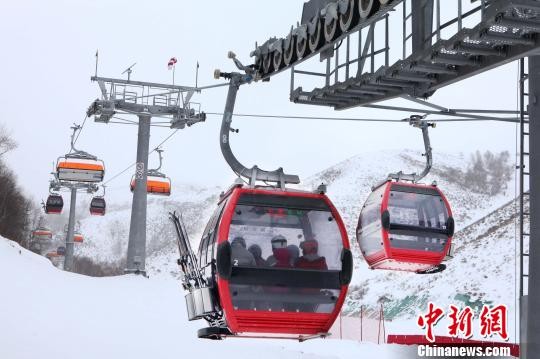
The Genting Ski Resort, jointly invested in by Malaysia’s Genting Group and Excellence Group, has introduced high-speed chairlifts from Austria’s Doppelmayr. The cable cars can reach speeds of 5 meters per second, and the entire 1,800-meter-long lift can take you to the top in just 8 minutes. The seats in the cabins are instantly heated. In cases of strong high-altitude winds, the cable cars can automatically hover. —— Shi Jiasheng
Xinhua News Agency, Zhangjiakou, Dec. 5 (Reporter Chen Jian) For Zhangjiakou City in Hebei Province, which neighbors Beijing, December 2014 is all about skiing and the Winter Olympics bid. On the 6th, the FIS Alpine Skiing World Cup and Far East Cup, along with the 10th China Chongli International Ski Festival, are set to kick off. On the first weekend of December, Chongli County, with a population of 126,000, will welcome over 6,000 skiers and snow enthusiasts from around the world every day.
Recent interviews by Xinhua reporters revealed that the “Zhangjiakou competition zone” plays a crucial role in the joint Beijing-Zhangjiakou bid, potentially hosting 50 gold medal events in snow sports.
Natural Advantage Brought by Snow
In the first week of December, a strong cold front swept across North China. Chongli, located at the western end of the Yanshan Mountain Range and the transitional zone between the North China Plain and the Inner Mongolia Plateau, also saw daytime temperatures below zero degrees Celsius. Since early November, several winter snowfalls have occurred in Chongli.
With clear skies overhead, the snow on the slopes reflects the sunlight. At Wanlong Ski Resort, not far from Chongli County, snowmaking machines have been spraying fresh powder onto the slopes since dawn. Bathed in the morning sun, the fine snow fills the air like a white mist, swirling among the undulating hills like waves.
Oba Junji, 56, leads a team of 280 Japanese skiers who arrived early at Wanlong Ski Resort to begin training.
Born in Miyagi Prefecture, Japan, Oba Junji told reporters that he learned to ski at age 5 and began competing at age 10. After 2006, for eight consecutive years, he led Japanese athletes to Chongli for pre-season training ahead of the FIS Alpine Skiing World Cup.
“Especially during November and December each year, the temperatures at ski resorts in Japan aren’t low enough, and the snow is relatively soft, failing to meet the requirements for competitive training,” explained Oba Junji, who serves as the strengthening committee chairman of the All Japan Ski Association.
He said that for international top-tier skiing events like the Winter Olympics, World Cup, and World Championships, the slopes need to be hardened. While Japan receives more snowfall than North China, in early winter, higher temperatures and humidity in Japan make it difficult to produce snow surfaces hard enough for competitive events.
The Indispensable “Zhangjiakou Competition Zone”
In July 2014, Beijing officially became a candidate city for the 2022 Winter Olympics; in January 2015, it will submit its “bid report” to the International Olympic Committee. The final decision will be announced by the end of July 2015. Although the bid report has yet to be released, the overall planning layout of the Beijing-Zhangjiakou bid is becoming increasingly clear.
According to the plan, the ice events of the 2022 Winter Olympics are scheduled to be held in venues within Beijing’s urban area. The snow events will be divided between the Yanqing and Zhangjiakou zones. Except for bobsleigh, luge, and alpine skiing, which will be held in the “Yanqing competition zone” located between Beijing and Zhangjiakou in the suburbs of Beijing, all other snow events will take place in the core competition area centered around the Taizicheng Ice and Snow Town in Chongli County, Zhangjiakou. These include 2 major sports, 6 disciplines, and 50 events. In other words, the “Zhangjiakou competition zone” will host over half of the total Winter Olympic events and award 50 gold medals. Moreover, the ski resorts in Chongli are highly concentrated, each within a 10-minute drive of one another.
Li Li, the young and graceful Party Secretary of Chongli County, is always eager to talk about why Chongli is an ideal location for the Winter Olympics. Her confidence is evident in every conversation.
— Chongli usually sees its first snowfall in mid-to-late October, with ski resorts opening in early November and remaining operational until early April of the following year. The snow season typically features snow depths of over half a meter and a snow retention period of more than 150 days. The average winter temperature is around -12°C, with an average wind force of level 2, making it suitable for winter sports.
— The mountain slopes in Chongli are moderate, mostly ranging between 5 and 35 degrees, ideal for competitive skiing. It is home to Asia’s earliest-opening ski resort and boasts four fully equipped and uniquely featured ski resorts: Genting, Wanlong, Dolomiti, and Great Wall Ridge. There are 82 ski runs of varying difficulty levels, 24 chairlifts and magic carpets with a total hourly capacity of 40,000 people, earning it the title of “one of the most ideal natural regions in China for developing the ski tourism industry.”
— The journey from Chongli to Beijing is a direct 220-kilometer drive via highway. The Beijing-Zhangjiakou high-speed railway is set to begin construction soon, and once operational, the trip from Beijing Qinghe Station to Zhangjiakou Taizicheng Station will take just 50 minutes.
A Mountain Life Centered Around Snow
Yue Zhiyun, 54, has dark skin and is not one for small talk. In 2004, this middle-aged man responded to the call and built his own family-run guesthouse right in his courtyard, just two kilometers from Wanlong Ski Resort, offering accommodations and meals in a rustic farmhouse style.
Yue Zhiyun named his guesthouse “Huangtuzui No. 1 Courtyard.” Stepping into the “reception hall,” you’ll find a roughly 100-square-meter space equipped with treadmills, pull-up bars, pool tables, and ping-pong tables. Further inside, along the quiet hallway, are the standard guest rooms of a Northern Chinese farmhouse: double kang beds (traditional heated brick beds) take up most of the room, warmed by natural gas heating, keeping the space cozy and the sheets snow-white. In front of the window is a simple, single-person wooden table and chair set. The private bathroom is equipped with a flush toilet and an electric water heater for showers. Such a “kang bed standard room” costs 150 RMB per night.
Is business good? Yue Zhiyun answers somewhat boastfully: “Weekends during summer and autumn are always fully booked—you have to make a reservation by phone.”
Does running a farmhouse make money? “I employ eight or nine people year-round, and my annual income is always two or three hundred thousand.”
As if afraid of appearing too wealthy, he adds: “The profits have all gone into renovations and expansions. We started with just six rooms, and now we have 37. I’ve invested over 3.8 million RMB so far, and finally paid off all my debts!”
Yue Zhiyun smiles contentedly and says he plans to build a karaoke room in the courtyard next spring. “Most of the tourists and skiers are from Beijing—young and fun-loving.”
“My yard is only this big. If we get even more guests in the future, I’ll have to tear down the bungalows and build a three-story building. With the Olympics right at our doorstep, even more people will come.” He looks around his little world with confidence.
Social Capital, Each with Their Own Strategy
In fact, Wanlong Ski Resort, which Yue Zhiyun is optimistic about, is just one of the “pioneers” that have gradually gained international recognition for Chongli’s ski industry over the past decade.
Before that, there were already those who pursued their “snow and ice dreams” with naivety and determination. His name is Shan Zhaojian, China’s first national champion in a 3,000-meter alpine skiing competition.
In 1996, Shan Zhaojian and his friends came to Chongli, hiring local farmers at three or five jiao per sack to manually carry snow up the mountain and build a 300-meter ski slope. Every time these “ski enthusiasts” skied down the makeshift slope, they would take a 212 Jeep back up the mountain, repeating the process over and over.
That was Chongli’s first ski resort, named “Saibei,” which means “beyond the frontier, north of the Great Wall.”
The year 2008 was a turning point when the Olympic movement became deeply intertwined with the Chinese people. That year, Beijing successfully hosted the Summer Olympics. It was also in 2008 that Malaysia’s Genting Group and Excellence Group decided to invest in building the largest single ski resort in China—the Secret Garden Resort in Chongli. This laid a “milestone” foundation for the major development of Chongli’s skiing industry.
Recently, a reporter rode the fully enclosed gondola at Genting Ski Resort. A sign inside the cabin indicated that the equipment was provided by the world-leading Austrian company Doppelmayr. The gondola travels at a speed of 5 meters per second, and the entire 1,800-meter cableway can be covered in as little as 8 minutes. The seats in the cabin can be instantly heated. In cases of strong high-altitude winds, the gondola can automatically hover.
The Secret Garden Resort in Genting not only offers competitive skiing but also includes services such as sports leisure, health and wellness, summer retreats, and conference exhibitions. According to the Beijing-Zhangjiakou bid plan for the Winter Olympics, nearly half of the 50 snow events planned for the “Zhangjiakou competition zone” are located within the planned area of Genting Ski Resort.
Zhao Qiong, who moved to Australia with his family at the age of 12, also joined the Excellence Group’s Australian office in 2008. Last October, he was transferred to work in “a place I had never heard of before”—Chongli—where he took on the role of marketing director for Genting.
This young man, who wears Hermes perfume, speaks with a Beijing accent, and is sharp yet approachable, said that in 2013, the Malaysian Genting Group and Excellence Group brought in at least 15 senior executives from around the world, covering departments such as construction, finance, human resources, and marketing, all coming to work in Chongli together.
Currently, the first phase of the Secret Garden Resort in Genting covers a construction area of 155,000 square meters, including a 130,000-square-meter five-star hotel, 35 ski slopes, and 3 cableways. But Zhao Qiong said, “This is just the first phase of our five-phase investment.” For the winter skiing project alone, the group plans to develop 80 ski slopes with a total length of about 70 kilometers, along with 22 high-speed cableways totaling about 30 kilometers.
At Genting Ski Resort, employees in departments such as coaching and ski equipment rental are “seasonal workers,” hired for about five months each year. However, every new employee undergoes a full month of training before starting work. Isn’t the cost high? Zhao Qiong insists that it’s “absolutely necessary”: Genting and Excellence Group are built on service, and they must strengthen management and cultivate talent. Pre-job training is just the first step.
The “Great Wall Museum” by the ski slope
Andrea Coatti, 30, was born in a small town in the Italian Alps, two hours’ drive from Milan. When he recalls starting to ski at the age of 5, a smile spreads across his face. By chance, a reporter recently met the slender, bearded Andrea in Chongli.
He is now a ski resort designer, providing consulting advice to resort owners on planning and constructing ski areas. For example, how to design the layout of ski slopes based on the unique terrain of the area; what technical specifications must be met for slopes used in different competitive events, such as giant slalom or moguls (freestyle skiing); where to build the jump towers and how to integrate them perfectly with other facilities...
For the past nine years, Andrea has come to Chongli to work every ski season. At the same time, he has also taken on ski resort planning and design projects in northeastern China, Xinjiang, and other regions.
Andrea said, “I love snowboarding. To have this passion become my career—there’s nothing better!” He has noticed that Chinese attitudes toward skiing have changed significantly in recent years. In the past, many people would ski only once a winter, for about two hours, treating it as a one-time experience. Now, more and more Chinese people are embracing skiing as a lifestyle.
This ski season, Andrea invited his personal friend, Italian freestyle skiing athlete Manuel Dioli, to visit Chongli for sightseeing.
Andrea said that foreign athletes coming to China to compete always hope to experience the region’s unique cultural traditions and local customs. Pointing to Manuel beside him, he said, “He loves being able to see the Great Wall while skiing here.”
Zhangjiakou City in Hebei Province, where Chongli is located, has since ancient times been a melting pot of Han, Mongolian, Hui, and Manchu cultures. The area is home to sections of the Great Wall built during eight dynasties—Yan, Qin, Han, Northern Wei, Northern Qi, Tang, Jin, and Ming—spanning a total of 1,476 kilometers, with over 1,000 beacon towers. As a result, Zhangjiakou is also known as the “Great Wall Museum.”
The “Zhang-Ku Highway,” as renowned as the Silk Road and the Ancient Tea Horse Road, began in the Ming Dynasty and flourished in the Qing Dynasty. Starting from Zhangjiakou, it led to Kulun (now Ulaanbaatar, the capital of Mongolia) and extended to Kyakhta in Russia, forming an ancient trade route over 1,400 kilometers long. It is referred to as the “Grassland Silk Road” and the “Grassland Tea Road.”
Zhang Chunsheng graduated from Tsinghua University’s Department of Civil Engineering with a Ph.D. Although he is part of the post-70s generation, he has already served as the Executive Deputy Director of the Zhangjiakou Operation Center of the Winter Olympics Bid Committee.
This gentle-spoken young man from Heilongjiang told the reporter softly: For Chongli and Zhangjiakou, bidding for the Winter Olympics is a once-in-a-lifetime opportunity. If seized well, it can help the region achieve industrial transformation and upgrading, form the Beijing-Zhangjiakou sports tourism and leisure industry belt, and benefit the local people. At the same time, it can also introduce more people to the area’s rich cultural heritage and popularize winter sports among hundreds of millions of people. “But the challenges are also huge. If not handled well, the opportunity may be fleeting.”
Wu Weidong, Executive Deputy Mayor of Zhangjiakou City, told the reporter: “Currently, Zhangjiakou should start with hardware and accelerate supporting infrastructure construction. But bidding for and hosting the Winter Olympics is not the end goal. Our aim is to promote coordinated development in the Beijing-Tianjin-Hebei region and build Zhangjiakou into an ecological hinterland for North China and a leisure home for the Chinese people.”
According to the air quality report of 74 cities released by China’s Ministry of Environmental Protection, Zhangjiakou ranks first in air quality north of the Yangtze River. Chongli County has the best air quality in the entire province of Hebei. At the ski resorts, the concentration of fine particulate matter PM2.5 remains around 10 year-round; the concentration of negative oxygen ions in the air reaches 10,000 per cubic centimeter, several times or even more than ten times higher than in urban areas, making it a “natural oxygen bar.” (End)